- ES Español (Latinoamérica)

- EN English

7.27. Statistics and Probability (Mandatory)
- Semester: 4th Sem. Credits: 3
- Hour of this course: Theory: 1 hours; Practice: 4 hours;
- Syllabus:
- htmlonly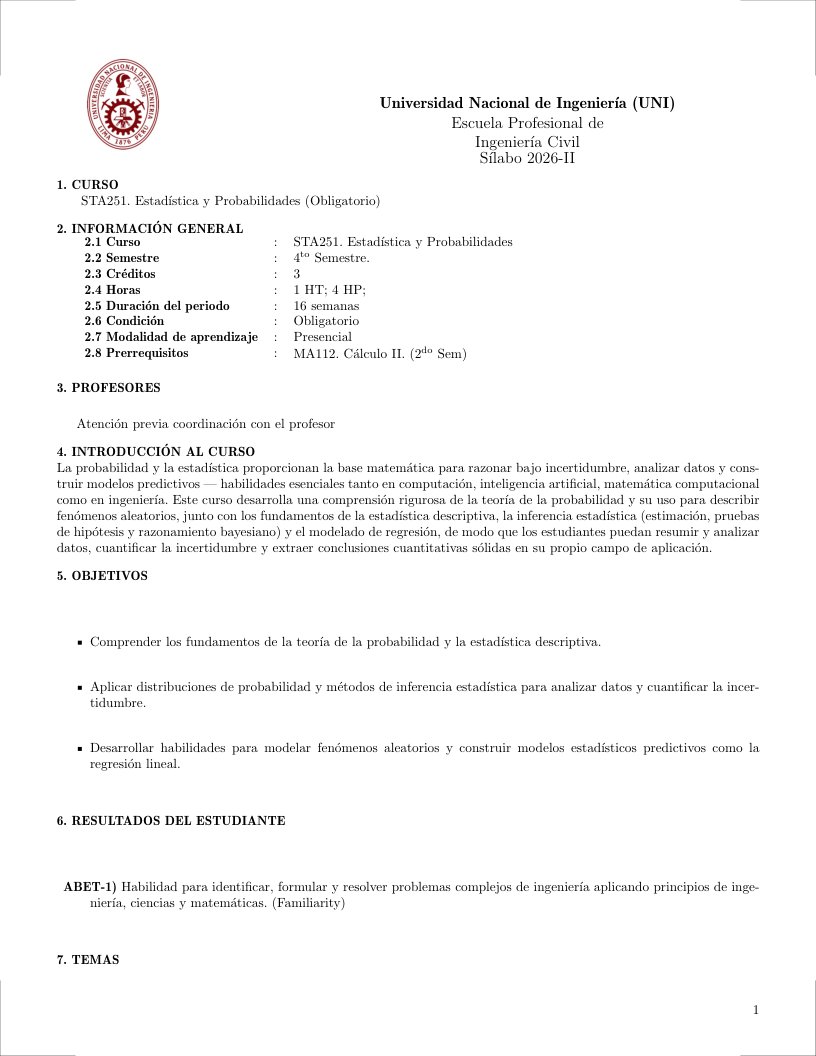
 Español (Latinoamérica)
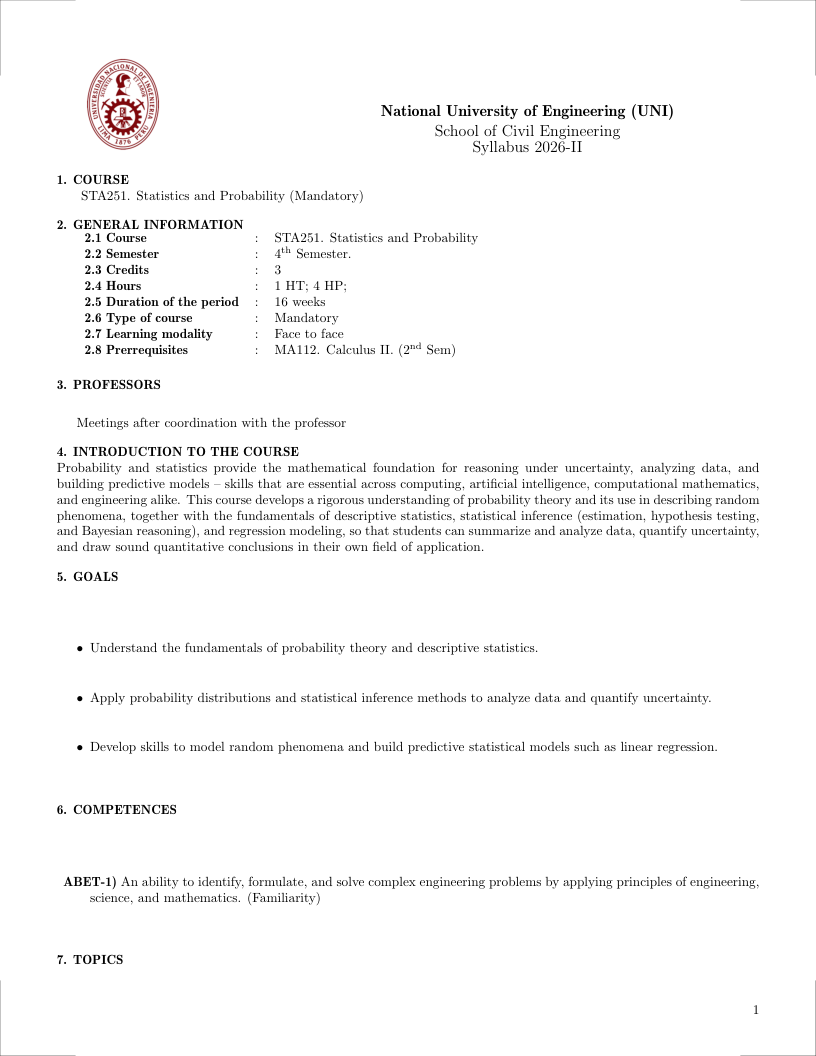 English
 - Prerrequisites:
- MA112 Calculus II (2nd Sem)
7.27.1. Justification ↑ Back to top
Probability and statistics provide the mathematical foundation for reasoning under uncertainty, analyzing data, and building predictive models – skills that are essential across computing, artificial intelligence, computational mathematics, and engineering alike. This course develops a rigorous understanding of probability theory and its use in describing random phenomena, together with the fundamentals of descriptive statistics, statistical inference (estimation, hypothesis testing, and Bayesian reasoning), and regression modeling, so that students can summarize and analyze data, quantify uncertainty, and draw sound quantitative conclusions in their own field of application.
7.27.2. Generales Goals ↑ Back to top
- Understand the fundamentals of probability theory and descriptive statistics.
- Apply probability distributions and statistical inference methods to analyze data and quantify uncertainty.
- Develop skills to model random phenomena and build predictive statistical models such as linear regression.
7.27.3. Contribution to Outcomes ↑ Back to top
- ABET-1) An ability to identify, formulate, and solve complex engineering problems by applying principles of engineering, science, and mathematics. (Familiarity)
7.27.4. Content ↑ Back to top
7.27.4.1. Numerical Summaries: Location, Spread, and Shape (4 hours) [Skills ABET-1] ↑ Back to top
Bibliography: (Devore, 2016)
Topics
- Measures of location: mean, median, mode, trimmed mean, and weighted mean
- Measures of spread: variance, standard deviation, IQR, MAD, and range
- Measures of shape: skewness and kurtosis; quantiles and percentiles
- Robust summary statistics: resistance to outliers and heavy-tailed distributions
Learning Outcomes
- Calculate and interpret measures of location, spread, and shape for a univariate dataset [Usage]
- Select appropriate summary statistics based on the distributional properties of the data [Usage]
- Compare classical and robust summary statistics and justify the choice for a given dataset [Assessment]
7.27.4.2. Sample Spaces and Events (4 hours) [Skills ABET-1] ↑ Back to top
Bibliography: (Ross, 2014; Devore, 2016)
Topics
- Random experiments, outcomes, and sample spaces: finite, countable, and uncountable
- Set-theoretic operations on events: union, intersection, complement, and De Morgan's laws
- Sigma-algebras and measurable spaces as the foundation for rigorous probability
- Borel sets and the Borel sigma-algebra on the real line
Learning Outcomes
- Define sample spaces, events, and sigma-algebras for a given random experiment [Familiarity]
- Apply set-theoretic operations to compute probabilities of compound events [Usage]
- Construct appropriate sigma-algebras for measurable spaces arising in statistical problems [Assessment]
7.27.4.3. Probability Axioms and Properties (4 hours) [Skills ABET-1] ↑ Back to top
Bibliography: (Ross, 2014; Devore, 2016)
Topics
- Kolmogorov's three axioms of probability and their consequences
- Derived properties: complement rule, addition rule, monotonicity, and continuity of probability
- Classical, frequentist, and subjective (Bayesian) interpretations of probability
- Counting methods: permutations, combinations, and the multiplication principle
Learning Outcomes
- State Kolmogorov's axioms and derive fundamental probability properties [Familiarity]
- Calculate probabilities of events using the addition rule and complement rule [Usage]
- Apply counting methods to compute probabilities in finite sample spaces [Usage]
7.27.4.4. Conditional Probability and Independence (4 hours) [Skills ABET-1] ↑ Back to top
Bibliography: (Ross, 2014; Devore, 2016)
Topics
- Definition and interpretation of conditional probability P(A|B) and its properties
- Bayes' theorem and the law of total probability: derivation and applications
- Independence of events: pairwise and mutual independence
- Conditional independence and its role in probabilistic graphical models
Learning Outcomes
- Explain conditional probability and independence and their relationship [Familiarity]
- Apply Bayes' theorem and the law of total probability to solve probability problems [Usage]
- Analyze whether events are independent or conditionally independent in a given probability model [Assessment]
7.27.4.5. Discrete Random Variables and Distributions (4 hours) [Skills ABET-1] ↑ Back to top
Bibliography: (Ross, 2014; Devore, 2016)
Topics
- Probability mass functions (PMF) and cumulative distribution functions (CDF) for discrete random variables
- Key discrete distributions: Bernoulli, Binomial, Geometric, Negative Binomial, Poisson, Hypergeometric
- Properties of discrete distributions: mean, variance, skewness, and kurtosis
- Poisson approximation to the Binomial and limiting distribution arguments
Learning Outcomes
- Identify and describe the key discrete probability distributions and their parameters [Familiarity]
- Calculate probabilities, means, and variances using PMFs of standard discrete distributions [Usage]
- Select an appropriate discrete distribution to model a given random phenomenon and justify the choice [Assessment]
7.27.4.6. Continuous Random Variables and Distributions (4 hours) [Skills ABET-1] ↑ Back to top
Bibliography: (Ross, 2014; Devore, 2016)
Topics
- Probability density functions (PDF) and CDFs for continuous random variables
- Key continuous distributions: Uniform, Normal, Exponential, Gamma, Beta, Chi-squared, t, F
- The Normal distribution: properties, standard normal, and its central role in statistical inference
- The exponential family of distributions: canonical form and sufficient statistics
Learning Outcomes
- Describe the properties and parameters of key continuous probability distributions [Familiarity]
- Calculate probabilities and quantiles for standard continuous distributions [Usage]
- Identify distributions belonging to the exponential family and derive their sufficient statistics [Assessment]
7.27.4.7. Joint, Marginal, and Conditional Distributions (4 hours) [Skills ABET-1] ↑ Back to top
Bibliography: (Ross, 2014; Devore, 2016)
Topics
- Joint PMFs and PDFs for two or more random variables
- Marginal and conditional distributions derived from joint distributions
- Covariance, correlation, and their properties; independence implies zero covariance (converse not always true)
- The bivariate normal distribution and its conditional distributions
Learning Outcomes
- Derive marginal and conditional distributions from a given joint distribution [Usage]
- Calculate covariance and correlation between two random variables [Usage]
- Analyze the conditional structure of the bivariate normal distribution [Assessment]
7.27.4.8. Limit Theorems: LLN and CLT (4 hours) [Skills ABET-1] ↑ Back to top
Bibliography: (Ross, 2014; Devore, 2016)
Topics
- Weak law of large numbers: convergence in probability and its implications for estimation
- Central limit theorem: statement, conditions, and role in justifying normal approximations
- Applications of the CLT: normal approximation to the binomial and sampling distributions
- Strong law of large numbers: almost sure convergence
- The delta method: asymptotic distribution of smooth functions of estimators
Learning Outcomes
- State the LLN and CLT and explain the conditions under which they hold [Familiarity]
- Apply the CLT to derive normal approximations and sampling distributions [Usage]
- Apply the delta method to derive asymptotic distributions of nonlinear estimators [Assessment]
7.27.4.9. Point Estimation (4 hours) [Skills ABET-1] ↑ Back to top
Bibliography: (Devore, 2016)
Topics
- Desirable properties: unbiasedness, consistency, efficiency, and sufficiency
- Method of moments estimation: derivation and asymptotic properties
- Maximum likelihood estimation: derivation, properties, and invariance principle
- Cramer-Rao lower bound and the concept of Fisher information
Learning Outcomes
- Describe the key properties of estimators and explain the trade-offs between them [Familiarity]
- Derive method of moments and MLE estimators for standard distributions [Usage]
- Evaluate the efficiency of an estimator using the Cramer-Rao lower bound [Assessment]
7.27.4.10. Interval Estimation and Confidence Intervals (4 hours) [Skills ABET-1] ↑ Back to top
Bibliography: (Devore, 2016)
Topics
- Constructing confidence intervals using pivotal quantities and exact distributions
- Correct interpretation of confidence intervals: coverage probability and common misconceptions
- Large-sample confidence intervals based on asymptotic normality
- Duality between confidence intervals and hypothesis tests
Learning Outcomes
- Construct confidence intervals for means, proportions, and variances using exact and large-sample methods [Usage]
- Interpret confidence intervals correctly and identify common misinterpretations [Usage]
- Explain the duality between confidence intervals and hypothesis tests and use it to draw inferences [Assessment]
7.27.4.11. Hypothesis Testing Foundations (4 hours) [Skills ABET-1] ↑ Back to top
Bibliography: (Devore, 2016)
Topics
- Neyman-Pearson framework: null/alternative hypotheses, rejection regions, Type I and II errors
- p-values: definition, correct interpretation, and common misuse; power and sample size
- Common parametric tests: z-test, t-test, F-test, chi-squared test
- Neyman-Pearson lemma and uniformly most powerful tests
Learning Outcomes
- Explain the logic of hypothesis testing, Type I and II errors, and the meaning of a p-value [Familiarity]
- Apply standard parametric tests and interpret the results in context [Usage]
- Derive the most powerful test for a simple hypothesis using the Neyman-Pearson lemma [Assessment]
7.27.4.12. Bayesian Inference (4 hours) [Skills ABET-1] ↑ Back to top
Bibliography: (Ross, 2014; Devore, 2016)
Topics
- Bayesian framework: prior, likelihood, posterior, and the role of Bayes' theorem
- Prior distributions: informative, non-informative, and conjugate priors
- Posterior inference: point estimates, credible intervals, and posterior predictive distributions
- Bayesian model comparison: Bayes factors and posterior model probabilities
Learning Outcomes
- Explain the Bayesian approach to inference and contrast it with the frequentist approach [Familiarity]
- Derive the posterior distribution for standard conjugate models [Usage]
- Apply Bayes factors to compare statistical models and interpret the evidence [Assessment]
7.27.4.13. Simple Linear Regression (4 hours) [Skills ABET-1] ↑ Back to top
Bibliography: (Devore, 2016)
Topics
- Ordinary least squares estimation: derivation of coefficients and their properties
- Inference for regression coefficients: t-tests, confidence intervals, and p-values
- Coefficient of determination R-squared and analysis of variance decomposition
- Gauss-Markov theorem: BLUE property of OLS under classical assumptions
Learning Outcomes
- Fit a simple linear regression model and interpret the estimated coefficients [Usage]
- Conduct hypothesis tests and construct confidence intervals for regression parameters [Usage]
- Verify the Gauss-Markov assumptions and assess their consequences when violated [Assessment]
7.27.5. Bibliography ↑ Back to top
Devore, J. L. (2016). Probability and Statistics for Engineering and the Sciences. Cengage Learning.
Ross, S. M. (2014). A First Course in Probability. Pearson.