- ES Español (Latinoamérica)

- EN English

7.44. Business Organization and Management (Mandatory)
- Semester: 8th Sem. Credits: 3
- Hour of this course: Theory: 2 hours; Laboratory: 2 hours;
- Syllabus:
- htmlonly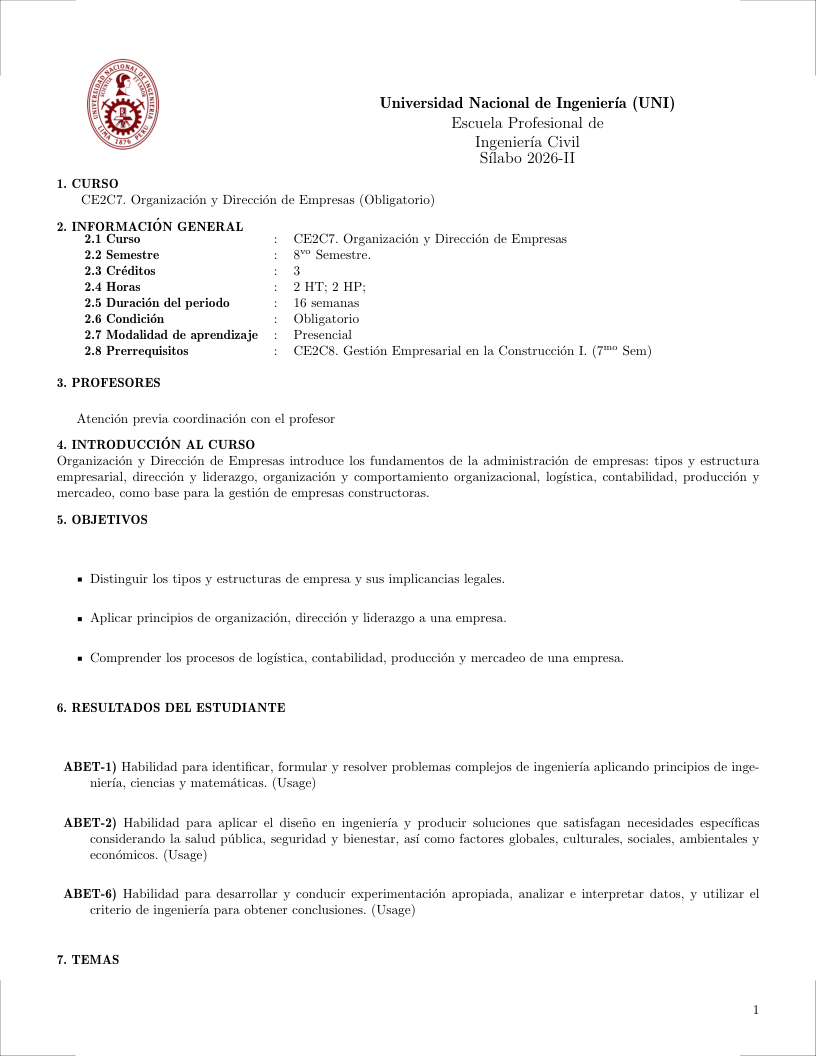
 Español (Latinoamérica)
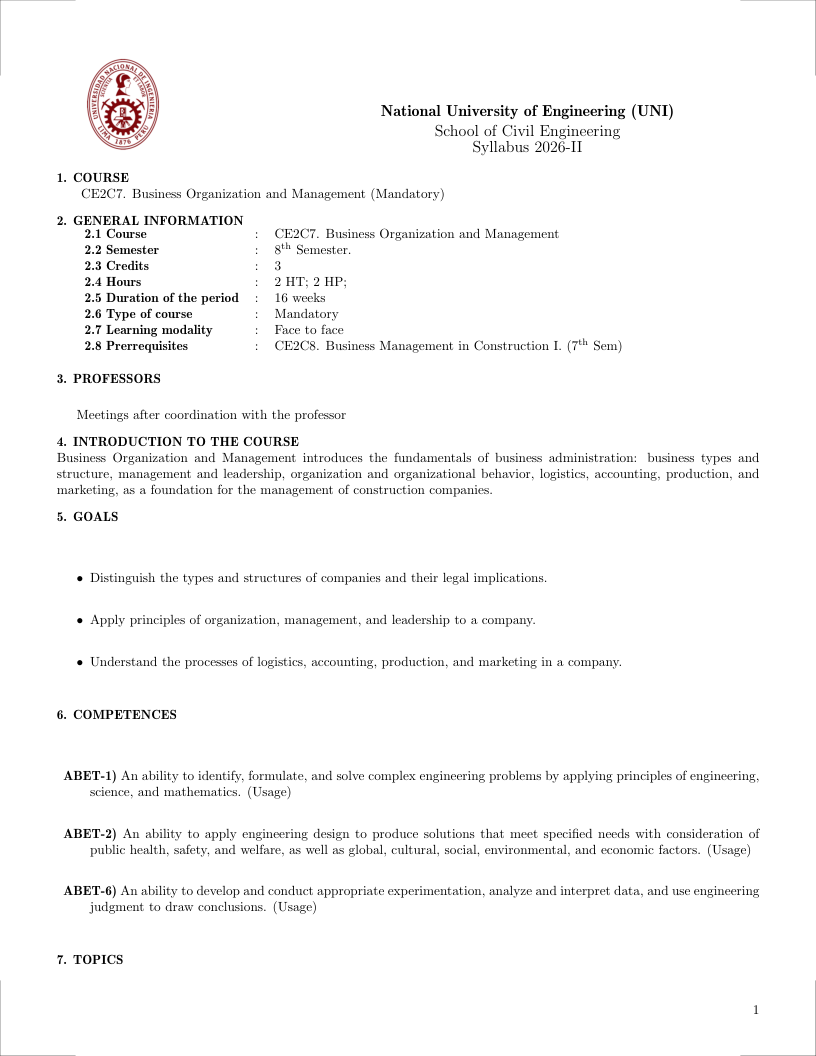 English
 - Prerrequisites:
- CE2C8 Business Management in Construction I (7th Sem)
7.44.1. Justification ↑ Back to top
Business Organization and Management introduces the fundamentals of business administration: business types and structure, management and leadership, organization and organizational behavior, logistics, accounting, production, and marketing, as a foundation for the management of construction companies.
7.44.2. Generales Goals ↑ Back to top
- Distinguish the types and structures of companies and their legal implications.
- Apply principles of organization, management, and leadership to a company.
- Understand the processes of logistics, accounting, production, and marketing in a company.
7.44.3. Contribution to Outcomes ↑ Back to top
- ABET-1) An ability to identify, formulate, and solve complex engineering problems by applying principles of engineering, science, and mathematics. (Usage)
- ABET-2) An ability to apply engineering design to produce solutions that meet specified needs with consideration of public health, safety, and welfare, as well as global, cultural, social, environmental, and economic factors. (Usage)
- ABET-6) An ability to develop and conduct appropriate experimentation, analyze and interpret data, and use engineering judgment to draw conclusions. (Usage)
7.44.4. Content ↑ Back to top
7.44.4.1. Organizational Behavior (8 hours) [Skills ABET-1] ↑ Back to top
Bibliography: (Robbins and Coulter, 2017)
Topics
- Motivation theories: Maslow's hierarchy, Herzberg's two-factor theory, expectancy theory, and self-determination theory
- Team formation, group roles, cohesion, diversity, and performance in organizational settings
- Organizational culture: dimensions, formation, cultural change, and its impact on performance
- Sources of organizational conflict, conflict resolution strategies, and negotiation fundamentals
Learning Outcomes
- Explain major motivation theories and their implications for managerial practice [Familiarity]
- Analyze team dynamics and cultural factors affecting organizational performance [Usage]
- Design an intervention to address a specific organizational behavior challenge [Assessment]
7.44.4.2. Business Entity Law (4 hours) [Skills ABET-1] ↑ Back to top
Bibliography: (Robbins and Coulter, 2017)
Topics
- Legal forms: sole proprietorship, general/limited partnership, LLC, and corporation; comparative liability and taxation
- Corporate formation, articles of incorporation, shareholder rights, board duties (fiduciary duty of care and loyalty)
- Agency relationships in business: actual and apparent authority, principal-agent duties, and vicarious liability
- Mergers, acquisitions, and dissolution: legal process, shareholder approval, due diligence, and winding-up procedures
Learning Outcomes
- Compare the liability, tax, and governance characteristics of different business entity forms [Familiarity]
- Analyze the legal implications of a business transaction from the perspective of agency law [Usage]
- Select the appropriate legal entity form for a new business venture, justifying the choice on legal and strategic grounds [Assessment]
7.44.4.3. Strategic Management (4 hours) [Skills ABET-2] ↑ Back to top
Bibliography: (Robbins and Coulter, 2017)
Topics
- External and internal analysis using PESTEL, Porter's Five Forces, and SWOT frameworks
- Generic strategies (cost leadership, differentiation, focus) and their application to competitive positioning
- Strategy implementation: organizational alignment, balanced scorecard, and performance management systems
- Corporate-level strategy: diversification, vertical integration, mergers and acquisitions, and portfolio management
Learning Outcomes
- Describe the strategic management process and the role of environmental analysis in strategy formulation [Familiarity]
- Apply competitive strategy frameworks to analyze the strategic position of a real organization [Usage]
- Evaluate the coherence and feasibility of a corporate strategy using analytical frameworks [Assessment]
7.44.4.4. Leadership Theory and Practice (4 hours) [Skills ABET-2] ↑ Back to top
Bibliography: (Robbins and Coulter, 2017)
Topics
- Leadership theories: trait, behavioral (Ohio State, Michigan), situational (Hersey-Blanchard), and contingency (Fiedler) models
- Transformational and transactional leadership: vision, inspiration, intellectual stimulation, and individualized consideration
- Emotional intelligence dimensions (self-awareness, empathy, social skills) and their relevance to leadership effectiveness
- Ethical and servant leadership: leader as steward, moral courage, values-based decision-making, and community service orientation
Learning Outcomes
- Compare major leadership theories and identify the contextual conditions favoring each approach [Familiarity]
- Apply situational leadership principles to diagnose leader behavior appropriate for a given team context [Usage]
- Evaluate a leader's effectiveness using multiple theoretical lenses including transformational and ethical leadership criteria [Assessment]
7.44.4.5. Inventory Management and Logistics (4 hours) [Skills ABET-2] ↑ Back to top
Bibliography: (Heizer et al., 2020)
Topics
- Economic order quantity (EOQ): derivation, assumptions, extensions, and total inventory cost minimization
- Reorder point models, safety stock calculation, and service level determination under demand uncertainty
- Logistics management: transportation modes, warehousing, distribution network design, and 3PL providers
- ABC inventory classification: Pareto principle applied to inventory value, cycle counting policy, and selective control strategies
Learning Outcomes
- Explain the trade-offs between ordering costs and holding costs in inventory management [Familiarity]
- Calculate EOQ, reorder points, and safety stock for a product with specified demand parameters [Usage]
- Evaluate the inventory and logistics performance of a supply chain and recommend improvements [Assessment]
7.44.4.6. Financial Accounting and Reporting (4 hours) [Skills ABET-6] ↑ Back to top
Bibliography: (Weygandt et al., 2018)
Topics
- Accounting equation (Assets = Liabilities + Equity), double-entry bookkeeping, and the chart of accounts
- The accounting cycle: journalizing, posting, trial balance, adjusting entries, closing entries, and financial statement preparation
- Income statement, balance sheet, statement of cash flows, and statement of changes in equity: structure and content
- Ratio analysis and financial statement interpretation: liquidity, solvency, profitability, and efficiency ratios for decision-making
Learning Outcomes
- Explain the accounting equation and the logic of double-entry bookkeeping [Familiarity]
- Prepare journal entries and basic financial statements for a simple business entity [Usage]
- Analyze the financial position and performance of a firm using its financial statements [Assessment]
7.44.4.7. Operations Strategy and Process Design (4 hours) [Skills ABET-2] ↑ Back to top
Bibliography: (Heizer et al., 2020)
Topics
- Competitive priorities in operations: cost, quality, speed, flexibility, and dependability
- Process types: job shop, batch, assembly line, and continuous flow; process selection and product-process matrix
- Capacity measurement, capacity planning strategies (lead, lag, match), and bottleneck analysis
- Facility layout types (product, process, fixed-position, cellular) and layout efficiency measures
Learning Outcomes
- Describe the main competitive priorities in operations and explain how process type selection reflects strategic objectives [Familiarity]
- Apply capacity planning methods and bottleneck analysis to improve throughput in a production system [Usage]
- Design a facility layout for a specified production environment and evaluate its efficiency [Assessment]
7.44.4.8. Marketing Mix Strategy (4 hours) [Skills ABET-1] ↑ Back to top
Bibliography: (Kotler and Armstrong, 2016)
Topics
- Product decisions: product mix, product life cycle, new product development, and packaging
- Pricing methods: cost-based, competition-based, value-based, and dynamic pricing; price elasticity
- Distribution channel design: direct and indirect channels, channel conflict, logistics, and omnichannel retailing
- Integrated marketing communications: advertising, sales promotion, public relations, personal selling, and direct marketing
Learning Outcomes
- Identify the components of the marketing mix and explain how they are integrated to create customer value [Familiarity]
- Apply pricing and channel strategies to a specific product/market combination [Usage]
- Design an integrated marketing communication plan aligned with a given marketing strategy [Assessment]
7.44.4.9. Human Resource Management (6 hours) [Skills ABET-1] ↑ Back to top
Bibliography: (DeCenzo et al., 2019)
Topics
- Workforce planning, job analysis, recruitment channels, and selection methods (interviews, testing, assessment centers)
- Compensation structures (base pay, incentives, benefits) and performance appraisal methods
- Training needs assessment, onboarding, career development, and succession planning
- Document control and records management: filing systems, correspondence control, document version/traceability, and retention policies supporting HR and administrative functions
Learning Outcomes
- Describe the core HR functions of recruitment, compensation, and training within an organization [Familiarity]
- Design a recruitment and selection process for a specified position and organizational context [Usage]
- Evaluate an organization's document control and records management practices against administrative best practices [Assessment]
7.44.4.10. Corporate Governance (4 hours) [Skills ABET-2] ↑ Back to top
Bibliography: (Robbins and Coulter, 2017)
Topics
- Agency theory: principal-agent problem, information asymmetry, moral hazard, and alignment mechanisms
- Board of directors: composition, independence, committees, fiduciary duties, and board effectiveness
- Corporate governance codes and regulation: Sarbanes-Oxley, OECD Principles, and ESG reporting requirements
- ESG and stakeholder governance models: environmental, social, and governance criteria, materiality assessment, and multi-stakeholder accountability
Learning Outcomes
- Explain the agency problem and the governance mechanisms designed to align managerial and shareholder interests [Familiarity]
- Analyze the governance structure of a corporation and identify potential weaknesses [Usage]
- Evaluate the effectiveness of corporate governance practices against best-practice standards [Assessment]
7.44.5. Bibliography ↑ Back to top
Robbins, S. P. and Coulter, M. (2017). Management. Pearson, 14th edition.
Heizer, J., Render, B., and Munson, C. (2020). Operations Management: Sustainability and Supply Chain Management. Pearson, 13th edition.
Weygandt, J. J., Kimmel, P. D., and Kieso, D. E. (2018). Financial Accounting. Wiley, 10th edition.
Kotler, P. and Armstrong, G. (2016). Principles of Marketing. Pearson, 16th edition.
DeCenzo, D. A., Robbins, S. P., and Verhulst, S. L. (2019). Fundamentals of Human Resource Management. Wiley, 13th edition.