- ES Español (Latinoamérica)

- EN English

7.59. General Hydrology (Mandatory)
- Semester: 9th Sem. Credits: 3
- Hour of this course: Theory: 2 hours; Practice: 2 hours;
- Syllabus:
- htmlonly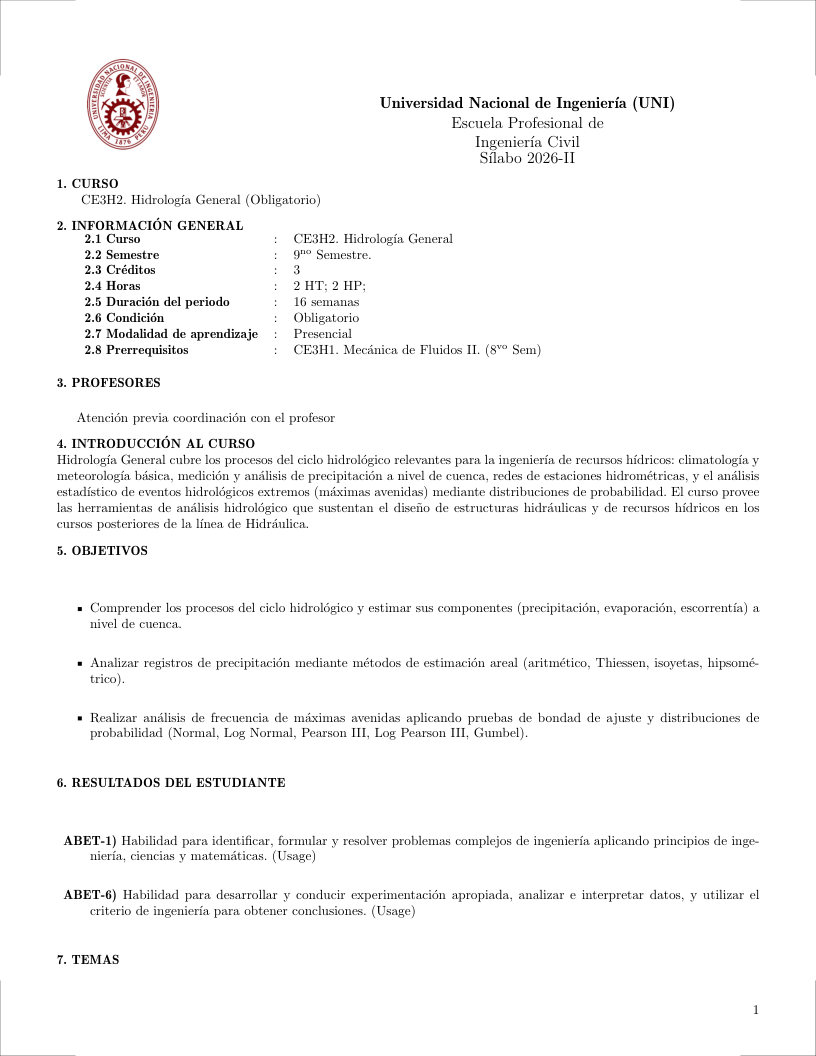
 Español (Latinoamérica)
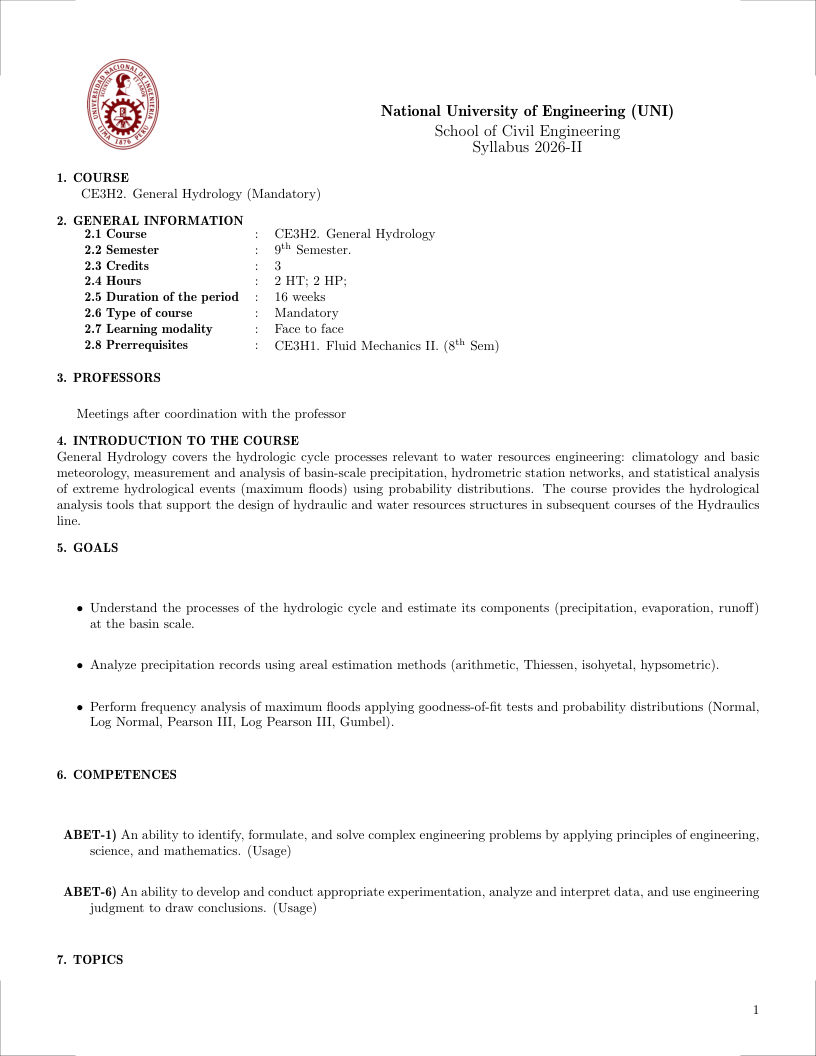 English
 - Prerrequisites:
- CE3H1 Fluid Mechanics II (8th Sem)
7.59.1. Justification ↑ Back to top
General Hydrology covers the hydrologic cycle processes relevant to water resources engineering: climatology and basic meteorology, measurement and analysis of basin-scale precipitation, hydrometric station networks, and statistical analysis of extreme hydrological events (maximum floods) using probability distributions. The course provides the hydrological analysis tools that support the design of hydraulic and water resources structures in subsequent courses of the Hydraulics line.
7.59.2. Generales Goals ↑ Back to top
- Understand the processes of the hydrologic cycle and estimate its components (precipitation, evaporation, runoff) at the basin scale.
- Analyze precipitation records using areal estimation methods (arithmetic, Thiessen, isohyetal, hypsometric).
- Perform frequency analysis of maximum floods applying goodness-of-fit tests and probability distributions (Normal, Log Normal, Pearson III, Log Pearson III, Gumbel).
7.59.3. Contribution to Outcomes ↑ Back to top
- ABET-1) An ability to identify, formulate, and solve complex engineering problems by applying principles of engineering, science, and mathematics. (Usage)
- ABET-6) An ability to develop and conduct appropriate experimentation, analyze and interpret data, and use engineering judgment to draw conclusions. (Usage)
7.59.4. Content ↑ Back to top
7.59.4.1. Hydrologic Cycle and Water Balance (22 hours) [Skills ABET-1,ABET-6] ↑ Back to top
Bibliography: (Chow et al., 1988)
Topics
- Hydrologic cycle and water balance concepts
- Precipitation measurement and analysis
- Evaporation and evapotranspiration estimation
- Infiltration theory and rainfall-runoff processes
Learning Outcomes
- Explain the hydrologic cycle and quantify water balance components [Familiarity]
- Analyze precipitation data and develop depth-area-duration relationships [Assessment]
- Estimate evaporation and evapotranspiration using empirical methods [Usage]
- Apply infiltration models to estimate runoff from rainfall events [Assessment]
7.59.4.2. Surface Hydrology and Watershed Modeling (17 hours) [Skills ABET-1,ABET-6] ↑ Back to top
Bibliography: (Chow et al., 1988)
Topics
- Hydrograph analysis and unit hydrograph method
- Watershed modeling and hydrologic simulation
- Streamflow measurement and gauging techniques
Learning Outcomes
- Derive unit hydrographs and synthesize runoff hydrographs [Usage]
- Develop watershed models using software tools for hydrologic simulation [Usage]
- Conduct streamflow measurements and interpret flow duration curves [Assessment]
7.59.4.3. Flood Frequency Analysis and Climate Change (17 hours) [Skills ABET-1,ABET-6] ↑ Back to top
Bibliography: (Chow et al., 1988)
Topics
- Flood frequency analysis and design storms
- Hydrologic routing methods for channels and reservoirs
- Climate change impacts on hydrologic systems
Learning Outcomes
- Perform flood frequency analysis using statistical methods [Assessment]
- Route flood hydrographs through channels and reservoirs [Usage]
- Evaluate climate change impacts on watershed hydrology and design implications [Assessment]
7.59.5. Bibliography ↑ Back to top
Chow, V. T., Maidment, D. R., and Mays, L. W. (1988). Applied Hydrology. McGraw-Hill.