- ES Español (Latinoamérica)

- EN English

7.19. Calculus III (Mandatory)
- Semester: 3rd Sem. Credits: 4
- Hour of this course: Theory: 3 hours; Practice: 2 hours;
- Syllabus:
- htmlonly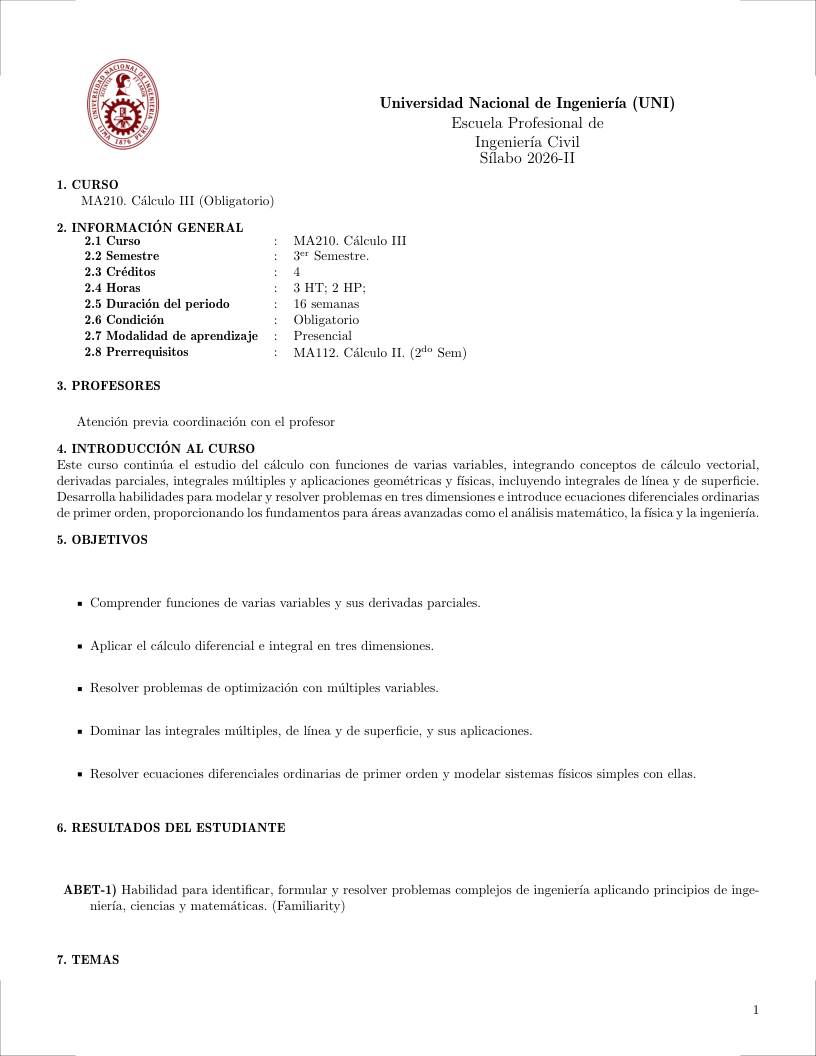
 Español (Latinoamérica)
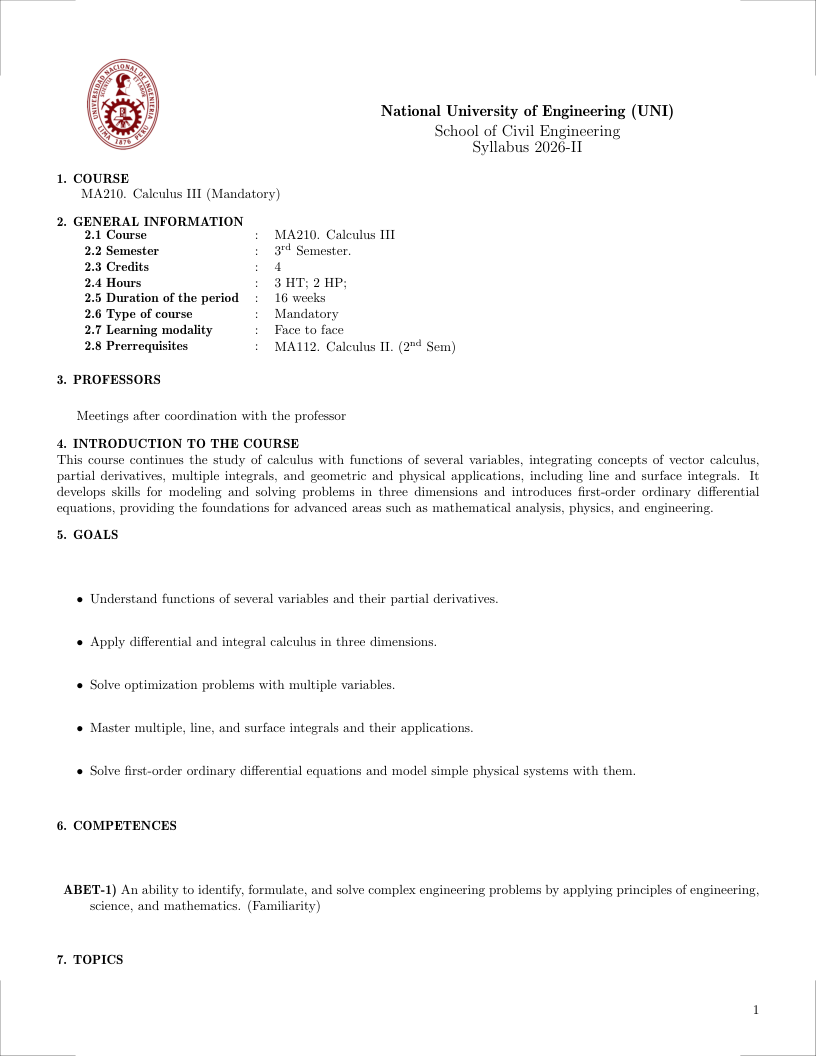 English
 - Prerrequisites:
- MA112 Calculus II (2nd Sem)
7.19.1. Justification ↑ Back to top
This course continues the study of calculus with functions of several variables, integrating concepts of vector calculus, partial derivatives, multiple integrals, and geometric and physical applications, including line and surface integrals. It develops skills for modeling and solving problems in three dimensions and introduces first-order ordinary differential equations, providing the foundations for advanced areas such as mathematical analysis, physics, and engineering.
7.19.2. Generales Goals ↑ Back to top
- Understand functions of several variables and their partial derivatives.
- Apply differential and integral calculus in three dimensions.
- Solve optimization problems with multiple variables.
- Master multiple, line, and surface integrals and their applications.
- Solve first-order ordinary differential equations and model simple physical systems with them.
7.19.3. Contribution to Outcomes ↑ Back to top
- ABET-1) An ability to identify, formulate, and solve complex engineering problems by applying principles of engineering, science, and mathematics. (Familiarity)
7.19.4. Content ↑ Back to top
7.19.4.1. Multivariable and Vector Calculus (22 hours) [Skills ABET-1] ↑ Back to top
Bibliography: (Stewart, 2016; Thomas et al., 2014)
Topics
- Partial derivatives and the gradient vector
- Multiple integrals in Cartesian, cylindrical, and spherical coordinate systems
- Vector fields and line and surface integrals
- Integral theorems: Green, Stokes, and the Divergence Theorem
- Applications to flux, circulation, and conservative fields in engineering contexts
Learning Outcomes
- Compute gradients and directional derivatives for scalar fields describing physical quantities [Usage]
- Evaluate double and triple integrals for volumes, masses, and centroids of engineering objects [Usage]
- Apply Stokes' and Gauss's Divergence Theorems to relate field integrals in electromagnetism and fluid mechanics [Assessment]
- Determine whether a vector force field is conservative and compute the potential function [Assessment]
7.19.4.2. Multiple Integrals (12 hours) [Skills ABET-1] ↑ Back to top
Bibliography: (Stewart, 2016; Larson and Edwards, 2018)
Topics
- Double integrals over rectangles and general regions; iterated integrals (Fubini's theorem)
- Double integrals in polar coordinates and change-of-variables formula
- Triple integrals in Cartesian coordinates and applications to volume and mass
- Triple integrals in cylindrical and spherical coordinates
- Applications: area, volume, centers of mass, and moments of inertia
Learning Outcomes
- Evaluate double and triple integrals over general regions using iterated integrals [Usage]
- Apply coordinate changes in polar, cylindrical, and spherical systems to simplify multiple integrals [Usage]
- Compute areas, volumes, and centers of mass using multiple integrals [Assessment]
7.19.4.3. Line Integrals and Vector Fields (18 hours) [Skills ABET-1] ↑ Back to top
Bibliography: (Marsden and Tromba, 2003; Stewart, 2016)
Topics
- Vector fields: definition, visualization, divergence, and curl
- Line integrals of scalar functions: arc length and mass
- Line integrals of vector fields: work and circulation
- Conservative fields, potential functions, and path independence
- Green's Theorem and its applications in the plane
Learning Outcomes
- Compute scalar and vector line integrals over oriented curves [Usage]
- Determine whether a vector field is conservative and construct its potential function [Usage]
- Apply Green's Theorem to evaluate line integrals via double integrals [Assessment]
7.19.4.4. Surface Integrals and Fundamental Theorems (16 hours) [Skills ABET-1] ↑ Back to top
Bibliography: (Marsden and Tromba, 2003; Apostol, 1969)
Topics
- Parametric surfaces, tangent plane, and surface area
- Surface integrals of scalar functions
- Flux integrals: surface integrals of vector fields
- Stokes' Theorem: relation between line integrals and surface integrals
- Divergence Theorem (Gauss): relation between flux and volume integral
Learning Outcomes
- Parametrize surfaces and evaluate scalar and flux surface integrals [Usage]
- Apply Stokes' and Divergence Theorems to reduce complex integrals [Assessment]
- Relate local differential properties (curl, divergence) to global behavior via integral theorems [Assessment]
7.19.4.5. First-Order Ordinary Differential Equations (ODEs) (16 hours) [Skills ABET-1] ↑ Back to top
Bibliography: (Boyce et al., 2017; Stewart, 2016)
Topics
- First-order equations: separable, linear, and exact forms
Learning Outcomes
- Solve linear first-order ODEs using integrating factors [Usage]
7.19.5. Bibliography ↑ Back to top
Stewart, J. (2016). Cálculo de una variable: Trascendentes tempranas. Cengage Learning, 8th edition.
Thomas, G. B., Weir, M. D., and Hass, J. (2014). Cálculo de una variable. Pearson, 13th edition.
Larson, R. and Edwards, B. H. (2018). Cálculo. Cengage Learning, 10th edition.
Marsden, J. E. and Tromba, A. J. (2003). Cálculo Vectorial. Pearson, 5th edition.
Apostol, T. M. (1969). Calculus, Volume II: Multi-Variable Calculus and Linear Algebra. Wiley, 2nd edition.
Boyce, W. E., DiPrima, R. C., and Meade, D. B. (2017). Ecuaciones Diferenciales y Problemas con Valores en la Frontera. Limusa Wiley, 11th edition.