- ES Español (Latinoamérica)

- EN English

7.29. Mechanics of Materials II (Mandatory)
- Semester: 5th Sem. Credits: 4
- Hour of this course: Theory: 4 hours; Practice: 4 hours;
- Syllabus:
- htmlonly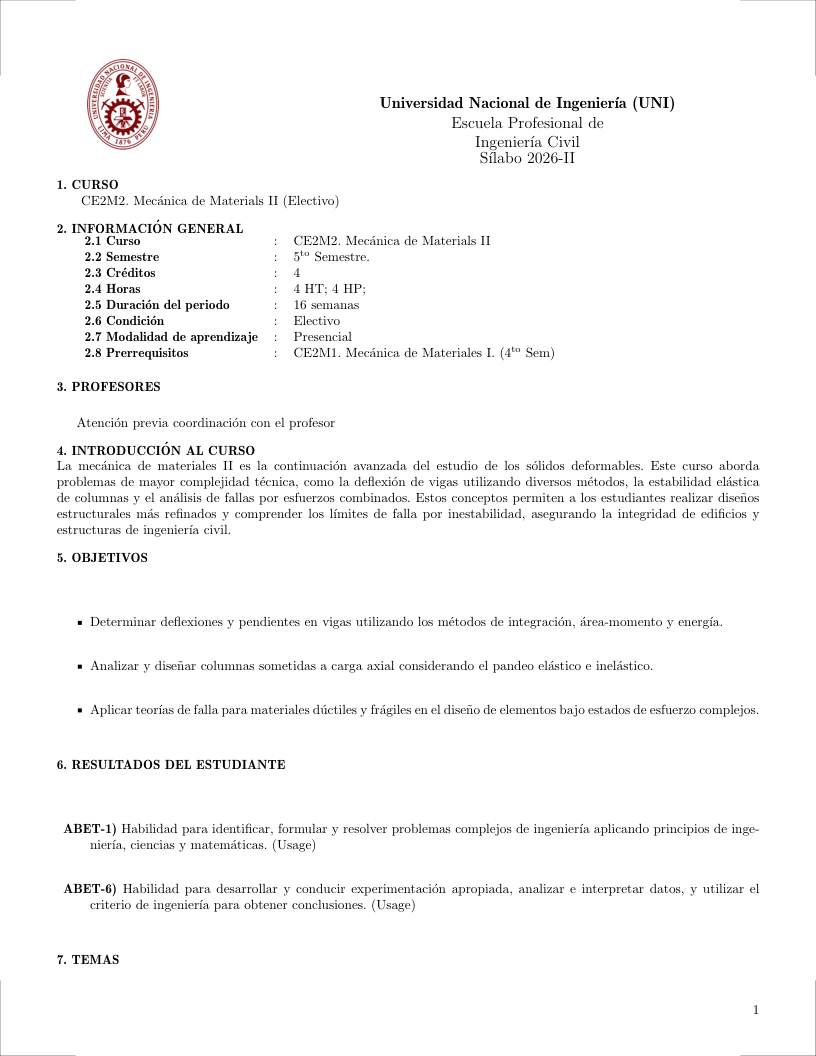
 Español (Latinoamérica)
 English
 - Prerrequisites:
- CE2M1 Mechanics of Materials I (4th Sem)
7.29.1. Justification ↑ Back to top
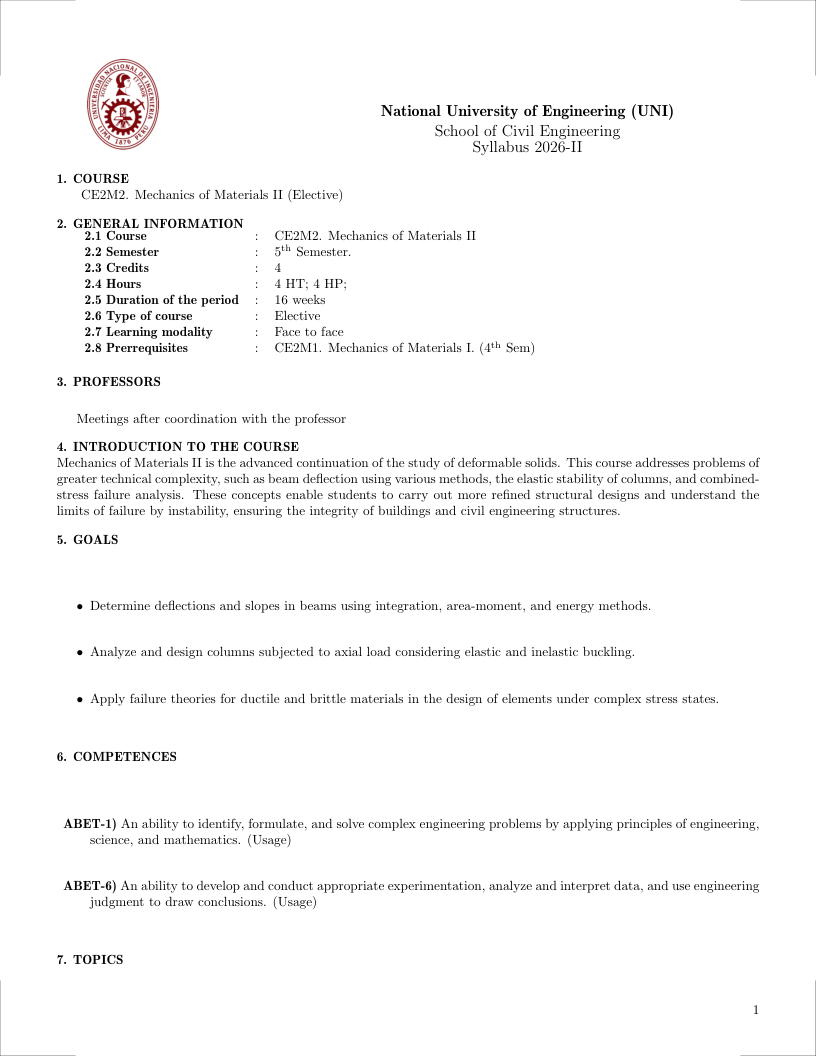
Mechanics of Materials II is the advanced continuation of the study of deformable solids. This course addresses problems of greater technical complexity, such as beam deflection using various methods, the elastic stability of columns, and combined-stress failure analysis. These concepts enable students to carry out more refined structural designs and understand the limits of failure by instability, ensuring the integrity of buildings and civil engineering structures.
7.29.2. Generales Goals ↑ Back to top
- Determine deflections and slopes in beams using integration, area-moment, and energy methods.
- Analyze and design columns subjected to axial load considering elastic and inelastic buckling.
- Apply failure theories for ductile and brittle materials in the design of elements under complex stress states.
7.29.3. Contribution to Outcomes ↑ Back to top
- ABET-1) An ability to identify, formulate, and solve complex engineering problems by applying principles of engineering, science, and mathematics. (Usage)
- ABET-6) An ability to develop and conduct appropriate experimentation, analyze and interpret data, and use engineering judgment to draw conclusions. (Usage)
7.29.4. Content ↑ Back to top
7.29.4.1. Beam Deflections (24 hours) [Skills ABET-1,ABET-6] ↑ Back to top
Bibliography: (Hibbeler, 2017a; Gere and Goodno, 2017)
Topics
- The equation of the elastic curve.
- Double integration method and discontinuity functions.
- Moment-area method and the conjugate-beam method.
- Analysis of statically indeterminate beams by superposition.
Learning Outcomes
- Calculate displacements and rotations in beams under various loading and support conditions [Assessment].
- Solve statically indeterminate structures through compatibility-of-deformation analysis [Usage].
7.29.4.2. Column Stability (16 hours) [Skills ABET-1,ABET-6] ↑ Back to top
Bibliography: (Hibbeler, 2017a)
Topics
- Concept of stability and Euler's critical load.
- Columns with different support conditions: effective length.
- Inelastic buckling and the secant formula.
- Design of columns under concentric and eccentric loading.
Learning Outcomes
- Determine the maximum load a slender column can support before failing by instability [Assessment].
- Design column cross-sections that comply with structural safety codes [Usage].
7.29.4.3. Energy Methods and Failure Theories (24 hours) [Skills ABET-1,ABET-6] ↑ Back to top
Bibliography: (Gere and Goodno, 2017)
Topics
- Strain energy due to axial load, bending, and torsion.
- Castigliano's theorem and its application to deflections.
- Failure theories for ductile materials: Tresca and von Mises.
- Failure theories for brittle materials: Mohr-Coulomb.
Learning Outcomes
- Apply energy principles to solve displacement problems in structures of complex geometry [Usage].
- Predict the onset of yielding or fracture of a material under combined stress states [Assessment].
7.29.5. Bibliography ↑ Back to top
Hibbeler, R. (2017a). Mechanics of Materials. Pearson, 10th edition.
Gere, J. and Goodno, B. (2017). Mechanics of Materials. Cengage Learning, 9th edition.