- ES Español (Latinoamérica)

- EN English

7.22. Dynamics (Mandatory)
- Semester: 4th Sem. Credits: 4
- Hour of this course: Theory: 4 hours; Practice: 4 hours;
- Syllabus:
- htmlonly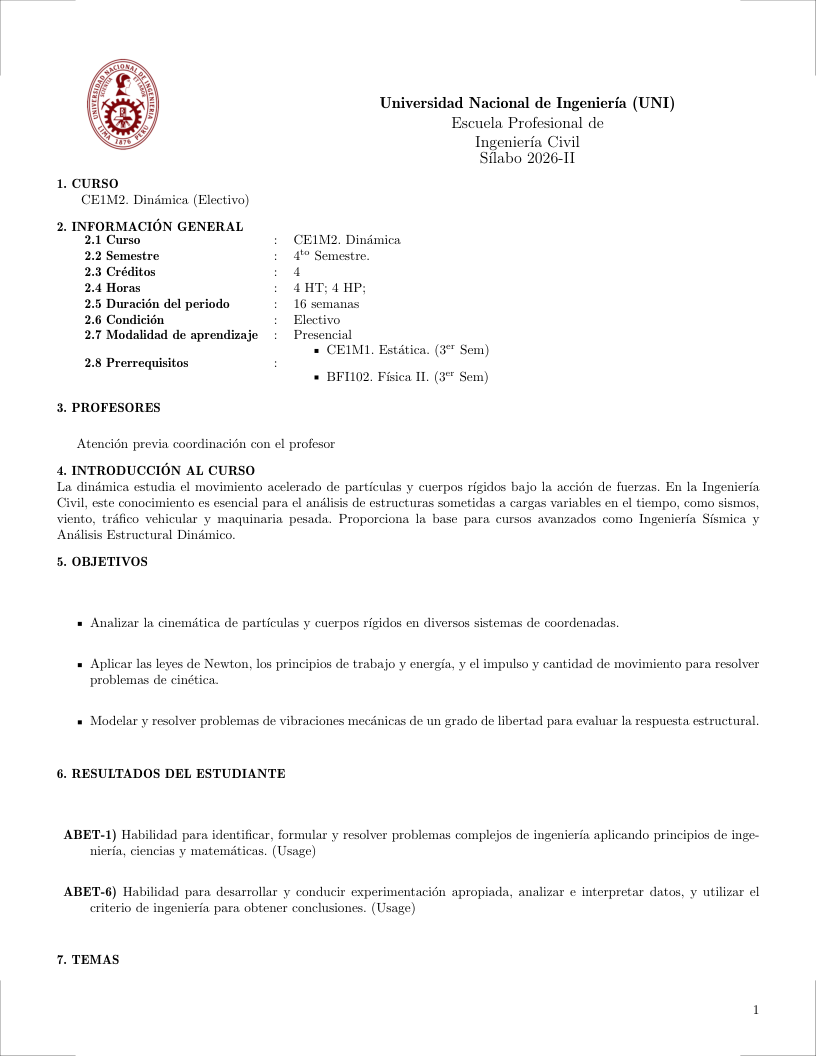
 Español (Latinoamérica)
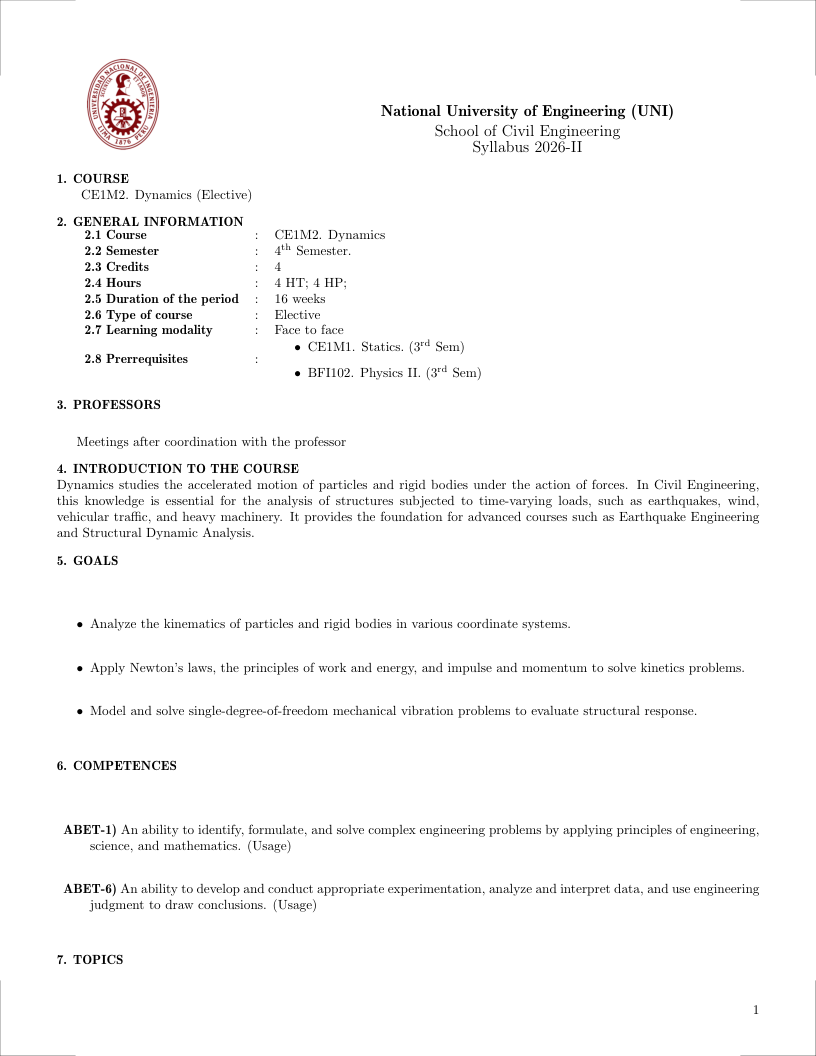 English
 - Prerrequisites:
- CE1M1 Statics (3rd Sem)
- BFI102 Physics II (3rd Sem)
7.22.1. Justification ↑ Back to top
Dynamics studies the accelerated motion of particles and rigid bodies under the action of forces. In Civil Engineering, this knowledge is essential for the analysis of structures subjected to time-varying loads, such as earthquakes, wind, vehicular traffic, and heavy machinery. It provides the foundation for advanced courses such as Earthquake Engineering and Structural Dynamic Analysis.
7.22.2. Generales Goals ↑ Back to top
- Analyze the kinematics of particles and rigid bodies in various coordinate systems.
- Apply Newton's laws, the principles of work and energy, and impulse and momentum to solve kinetics problems.
- Model and solve single-degree-of-freedom mechanical vibration problems to evaluate structural response.
7.22.3. Contribution to Outcomes ↑ Back to top
- ABET-1) An ability to identify, formulate, and solve complex engineering problems by applying principles of engineering, science, and mathematics. (Usage)
- ABET-6) An ability to develop and conduct appropriate experimentation, analyze and interpret data, and use engineering judgment to draw conclusions. (Usage)
7.22.4. Content ↑ Back to top
7.22.4.1. Kinematics of Rigid Bodies in Plane Motion (10 hours) [Skills ABET-1,ABET-6] ↑ Back to top
Bibliography: (Hibbeler, 2016a)
Topics
- Translation and rotation about a fixed axis
- General plane motion: relative velocity and acceleration, and the instantaneous center of rotation
Learning Outcomes
- Determine the velocity and acceleration of any point in a planar mechanism using the instantaneous center of rotation [Usage]
- Explain the distinction between translation, fixed-axis rotation, and general plane motion [Familiarity]
7.22.4.2. Kinetics of Rigid Bodies in Plane Motion (10 hours) [Skills ABET-1,ABET-6] ↑ Back to top
Bibliography: (Hibbeler, 2016a)
Topics
- Equations of motion for a rigid body in plane motion
- Kinetic energy of a rigid body and the principle of work and energy
Learning Outcomes
- Apply the equations of motion to relate external forces to the angular acceleration of rigid bodies [Assessment]
- Analyze rigid-body motion problems using the principle of work and energy [Usage]
7.22.4.3. Introduction to Structural Vibrations (12 hours) [Skills ABET-1,ABET-6] ↑ Back to top
Bibliography: (Bedford and Fowler, 2008)
Topics
- Undamped free vibration of a single-degree-of-freedom system
- Simple pendulum and mass-spring models
- Natural frequency, period, and amplitude concepts
- Introduction to damped free vibration
Learning Outcomes
- Model simple structural systems as single-degree-of-freedom systems [Usage]
- Calculate the natural frequency of a structure to avoid basic resonance phenomena [Assessment]
- Describe the effect of damping on the free-vibration response of a structural system [Familiarity]
- Interpret period and amplitude parameters from a structure's free-vibration response [Usage]
7.22.5. Bibliography ↑ Back to top
Hibbeler, R. (2016a). Engineering Mechanics: Dynamics. Pearson, 14th edition.
Bedford, A. and Fowler, W. (2008). Engineering Mechanics: Dynamics. Prentice Hall, 5th edition.