- ES Español (Latinoamérica)

- EN English

7.36. Business Management in Construction I (Mandatory)
- Semester: 7th Sem. Credits: 3
- Hour of this course: Theory: 4 hours; Laboratory: 2 hours;
- Syllabus:
- htmlonly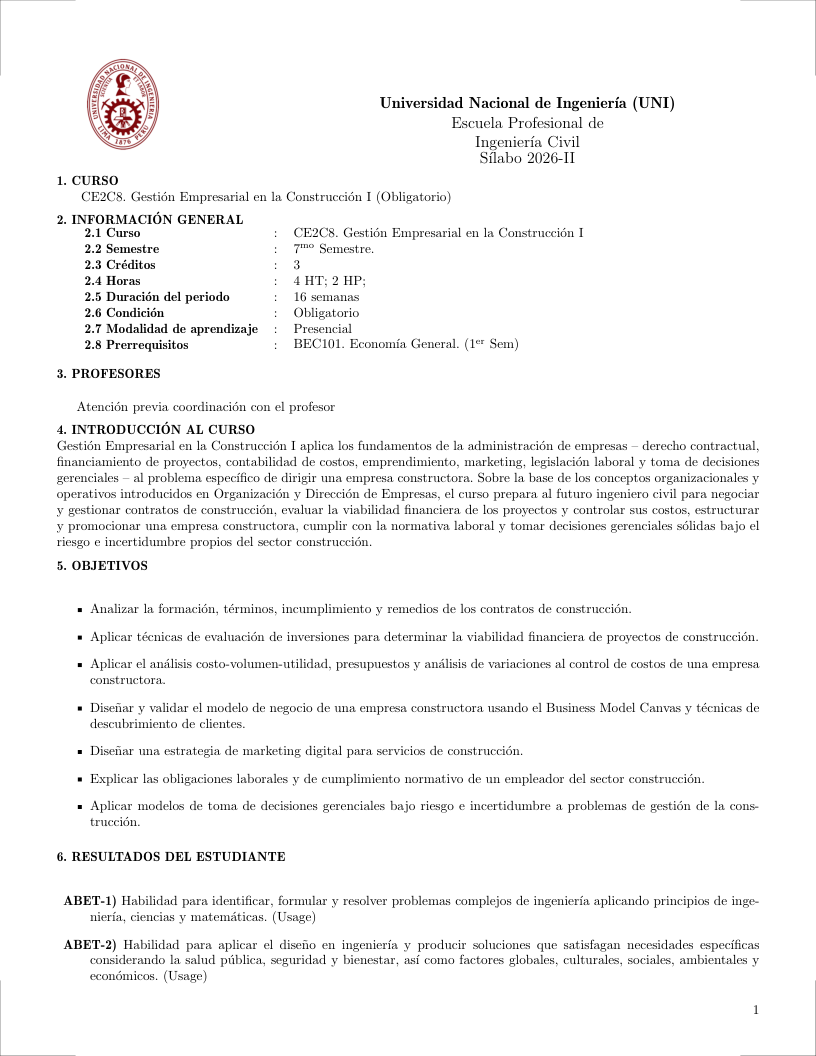
 Español (Latinoamérica)
 English
 - Prerrequisites:
- BEC101 General Economics (1st Sem)
7.36.1. Justification ↑ Back to top
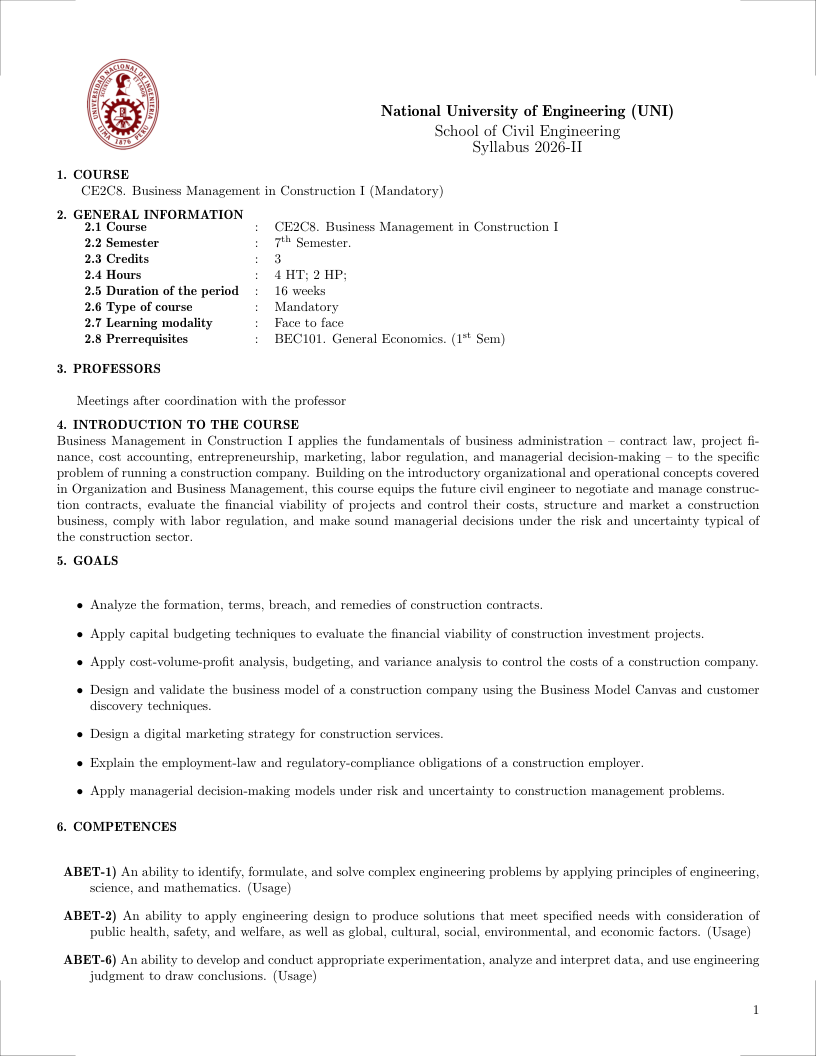
Business Management in Construction I applies the fundamentals of business administration – contract law, project finance, cost accounting, entrepreneurship, marketing, labor regulation, and managerial decision-making – to the specific problem of running a construction company. Building on the introductory organizational and operational concepts covered in Organization and Business Management, this course equips the future civil engineer to negotiate and manage construction contracts, evaluate the financial viability of projects and control their costs, structure and market a construction business, comply with labor regulation, and make sound managerial decisions under the risk and uncertainty typical of the construction sector.
7.36.2. Generales Goals ↑ Back to top
- Analyze the formation, terms, breach, and remedies of construction contracts.
- Apply capital budgeting techniques to evaluate the financial viability of construction investment projects.
- Apply cost-volume-profit analysis, budgeting, and variance analysis to control the costs of a construction company.
- Design and validate the business model of a construction company using the Business Model Canvas and customer discovery techniques.
- Design a digital marketing strategy for construction services.
- Explain the employment-law and regulatory-compliance obligations of a construction employer.
- Apply managerial decision-making models under risk and uncertainty to construction management problems.
7.36.3. Contribution to Outcomes ↑ Back to top
- ABET-1) An ability to identify, formulate, and solve complex engineering problems by applying principles of engineering, science, and mathematics. (Usage)
- ABET-2) An ability to apply engineering design to produce solutions that meet specified needs with consideration of public health, safety, and welfare, as well as global, cultural, social, environmental, and economic factors. (Usage)
- ABET-6) An ability to develop and conduct appropriate experimentation, analyze and interpret data, and use engineering judgment to draw conclusions. (Usage)
7.36.4. Content ↑ Back to top
7.36.4.1. Contract Law and Business Transactions (14 hours) [Skills ABET-1] ↑ Back to top
Bibliography: (Clarkson et al., 2021)
Topics
- Elements of a valid contract: offer, acceptance, consideration, capacity, and legality
- Express and implied terms, exclusion clauses, misrepresentation, and frustration of contracts
- Breach of contract: types, consequences, and remedies (damages, specific performance, rescission)
- E-contracts and digital signatures: legal validity, electronic signature laws (eIDAS, ESIGN), and click-wrap and browse-wrap agreements
Learning Outcomes
- Identify the essential elements of a legally binding contract and the circumstances that render contracts void or voidable [Familiarity]
- Apply contract law principles to analyze the legal enforceability of a business agreement [Usage]
- Evaluate contractual remedies available in a given breach scenario and recommend appropriate legal action [Assessment]
7.36.4.2. Capital Budgeting and Investment Decisions (12 hours) [Skills ABET-2] ↑ Back to top
Bibliography: (Brealey et al., 2020)
Topics
- Net present value (NPV), internal rate of return (IRR), modified IRR, and their decision rules
- Payback period, discounted payback, and profitability index as capital budgeting criteria
- Sensitivity analysis, scenario analysis, Monte Carlo simulation, and break-even analysis in capital projects
- Real options in capital investment: option to expand, abandon, or defer; recognizing strategic flexibility in project valuation
Learning Outcomes
- Explain the NPV rule and its superiority over alternative capital budgeting criteria [Familiarity]
- Calculate NPV and IRR for a capital project and apply decision rules [Usage]
- Evaluate a capital investment proposal under uncertainty using sensitivity and scenario analysis [Assessment]
7.36.4.3. Managerial Accounting and Cost Analysis (12 hours) [Skills ABET-6] ↑ Back to top
Bibliography: (Garrison et al., 2021)
Topics
- Cost classification: fixed vs. variable, direct vs. indirect, product vs. period, and relevant costs for decisions
- CVP analysis: break-even point, contribution margin, margin of safety, and operating leverage
- Master budgets, flexible budgets, standard costing, and variance analysis (price and efficiency variances)
- Activity-based costing (ABC): cost drivers, activity pools, overhead allocation accuracy, and ABC versus traditional costing
Learning Outcomes
- Identify different types of costs and explain their relevance for managerial decision-making [Familiarity]
- Calculate break-even point, contribution margin, and budget variances for a business unit [Usage]
- Evaluate a business unit's performance using variance analysis and flexible budgets [Assessment]
7.36.4.4. Business Model Design and Validation (12 hours) [Skills ABET-2] ↑ Back to top
Bibliography: (Osterwalder and Pigneur, 2010)
Topics
- Business Model Canvas: nine building blocks (customer segments, value propositions, channels, revenue streams, key resources, key activities, key partnerships, cost structure)
- Customer discovery and validation: problem interviews, solution interviews, and pivot vs. persevere decisions
- Minimum viable product (MVP): design principles, lean experimentation, and build-measure-learn feedback loop
- Platform business models and network effects: multi-sided platforms, winner-take-all dynamics, and monetization strategies for digital platforms
Learning Outcomes
- Describe the components of the Business Model Canvas and explain how they interact to create and deliver value [Familiarity]
- Design a business model canvas for a new venture idea and identify key assumptions to test [Usage]
- Evaluate a startup's business model for internal consistency and market viability [Assessment]
7.36.4.5. Digital Marketing (10 hours) [Skills ABET-1] ↑ Back to top
Bibliography: (Chaffey and Ellis-Chadwick, 2019)
Topics
- SEO, SEM, and social media marketing: platforms, algorithms, organic vs. paid reach, and community management
- Content marketing strategy: content types, editorial calendars, storytelling, and inbound marketing
- Digital analytics: web metrics, conversion funnels, A/B testing, and data-driven campaign optimization
- Email marketing and marketing automation: segmentation, drip campaigns, lead nurturing, CRM integration, and deliverability metrics
Learning Outcomes
- Describe the key digital marketing channels and the metrics used to measure their effectiveness [Familiarity]
- Develop a digital marketing plan including channel selection, content strategy, and KPI definition [Usage]
- Evaluate the ROI of a digital marketing campaign using analytics data [Assessment]
7.36.4.6. Regulatory Compliance and Employment Law (12 hours) [Skills ABET-1] ↑ Back to top
Bibliography: (Clarkson et al., 2021)
Topics
- Antitrust and competition law: prohibited agreements, abuse of dominance, merger control, and enforcement
- Data protection regulation: GDPR principles, data subject rights, controller/processor responsibilities, and breach notification
- Employment law: contract of employment, wrongful dismissal, discrimination, health and safety, and collective bargaining
- Consumer protection law: unfair commercial practices, product liability, warranty obligations, and redress mechanisms for consumers
Learning Outcomes
- Identify the major regulatory frameworks affecting business operations in key domains (competition, data, employment) [Familiarity]
- Apply data privacy and employment law principles to analyze a business compliance scenario [Usage]
- Design a compliance management framework for a specific regulatory area faced by a business [Assessment]
7.36.4.7. Managerial Decision-Making (12 hours) [Skills ABET-2] ↑ Back to top
Bibliography: (Robbins and Coulter, 2017)
Topics
- Rational decision-making model vs. bounded rationality; satisficing and heuristics in managerial decisions
- Decision-making under risk and uncertainty: expected value, decision trees, and sensitivity analysis
- Common cognitive biases (anchoring, overconfidence, availability heuristic) and debiasing strategies
- Group decision-making techniques: Delphi method, nominal group technique, brainstorming, and consensus building processes
Learning Outcomes
- Describe the rational model of decision-making and its limitations under bounded rationality [Familiarity]
- Construct a decision tree and calculate expected values to support a managerial decision under risk [Usage]
- Evaluate how cognitive biases distort managerial decisions and recommend debiasing interventions [Assessment]
7.36.5. Bibliography ↑ Back to top
Clarkson, K. W., Miller, R. L., and Cross, F. B. (2021). Business Law: Text and Cases. Cengage Learning, 15th edition.
Brealey, R. A., Myers, S. C., and Allen, F. (2020). Principles of Corporate Finance. McGraw-Hill, 13th edition.
Garrison, R. H., Noreen, E. W., and Brewer, P. C. (2021). Managerial Accounting. McGraw-Hill, 17th edition.
Osterwalder, A. and Pigneur, Y. (2010). Business Model Generation. Wiley, 1st edition.
Chaffey, D. and Ellis-Chadwick, F. (2019). Digital Marketing. Pearson, 7th edition.
Robbins, S. P. and Coulter, M. (2017). Management. Pearson, 14th edition.