- ES Español (Latinoamérica)

- EN English

7.46. Construction Technology II (Mandatory)
- Semester: 8th Sem. Credits: 4
- Hour of this course: Theory: 3 hours; Laboratory: 2 hours;
- Syllabus:
- htmlonly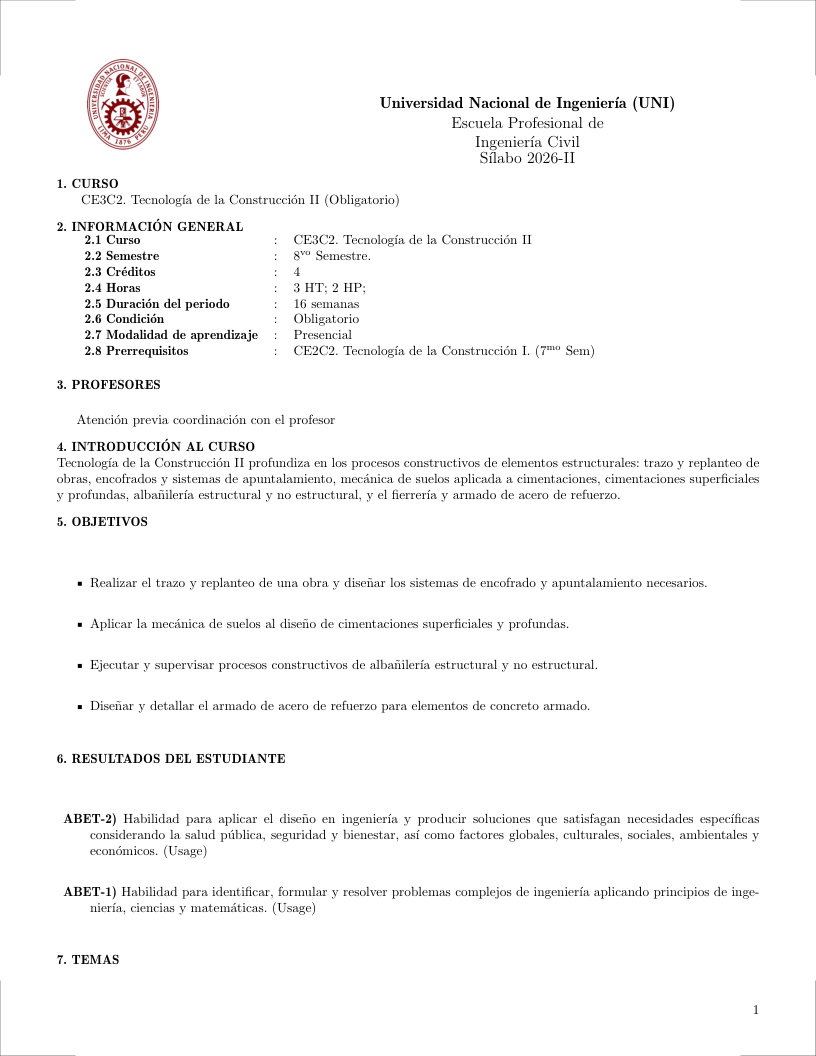
 Español (Latinoamérica)
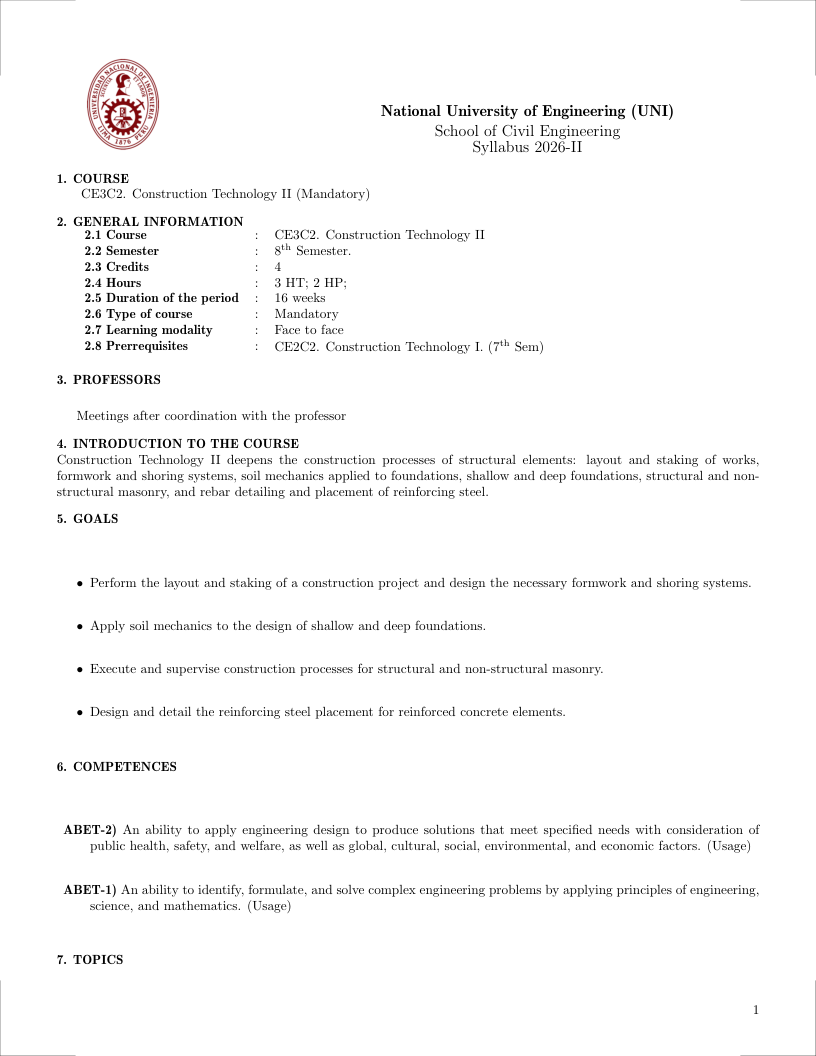 English
 - Prerrequisites:
- CE2C2 Construction Technology I (7th Sem)
7.46.1. Justification ↑ Back to top
Construction Technology II deepens the construction processes of structural elements: layout and staking of works, formwork and shoring systems, soil mechanics applied to foundations, shallow and deep foundations, structural and non-structural masonry, and rebar detailing and placement of reinforcing steel.
7.46.2. Generales Goals ↑ Back to top
- Perform the layout and staking of a construction project and design the necessary formwork and shoring systems.
- Apply soil mechanics to the design of shallow and deep foundations.
- Execute and supervise construction processes for structural and non-structural masonry.
- Design and detail the reinforcing steel placement for reinforced concrete elements.
7.46.3. Contribution to Outcomes ↑ Back to top
- ABET-2) An ability to apply engineering design to produce solutions that meet specified needs with consideration of public health, safety, and welfare, as well as global, cultural, social, environmental, and economic factors. (Usage)
- ABET-1) An ability to identify, formulate, and solve complex engineering problems by applying principles of engineering, science, and mathematics. (Usage)
7.46.4. Content ↑ Back to top
7.46.4.1. Construction Methods, Equipment, and Productivity (20 hours) [Skills ABET-2] ↑ Back to top
Bibliography: (Peurifoy et al., 2018)
Topics
- Earthwork operations: excavation, hauling, compaction, and mass diagrams
- Concrete construction: formwork, placing, finishing, and curing
- Steel erection, connection, and safety procedures
- Construction equipment types, capabilities, and selection criteria
- Productivity measurement, cycle time analysis, and crew balancing
- Heavy civil construction methods for tunnels, dams, and bridges
- Equipment economics: ownership vs. rental, depreciation, and operating cost
- Trenchless technologies and deep excavation support systems
- Automation and robotics in construction operations
Learning Outcomes
- Select appropriate construction equipment for common earthwork and material handling tasks [Usage]
- Design basic formwork and shoring for a concrete slab or wall [Assessment]
- Explain the sequence and safety considerations for steel erection [Familiarity]
- Calculate productivity rates and cycle times for equipment operations [Usage]
- Balance a construction crew to optimize productivity for a given task [Assessment]
- Compare construction methods for a heavy civil project like a cut-and-cover tunnel [Assessment]
- Analyze the economic life and hourly cost of a piece of construction equipment [Usage]
- Describe the applications and limitations of trenchless construction technologies [Familiarity]
- Evaluate the potential for automation to improve safety and productivity on a construction site [Assessment]
7.46.4.2. Shear Strength and Consolidation (6 hours) [Skills ABET-1] ↑ Back to top
Bibliography: (Das, 2019)
Topics
- Shear strength of soils and Mohr-Coulomb failure criterion
- Direct shear and triaxial testing methods
- Drained and undrained shear strength behavior
- Consolidation theory and settlement analysis
- Time-rate of consolidation and degree of consolidation
- Stress distribution in soil masses using elastic theory
- Critical state soil mechanics concepts
- Residual shear strength and sensitivity of clays
- Secondary compression and creep behavior
- Anisotropy and stress path effects on soil behavior
Learning Outcomes
- Apply Mohr-Coulomb criterion to determine shear strength parameters [Familiarity]
- Interpret direct shear and triaxial test results [Assessment]
- Distinguish between drained and undrained loading conditions [Usage]
- Calculate consolidation settlement using one-dimensional theory [Assessment]
- Predict time-rate of settlement for consolidating soils [Usage]
- Compute stress distribution beneath loaded areas using Boussinesq theory [Assessment]
- Explain critical state concepts and their application to soil behavior [Familiarity]
- Evaluate residual strength and sensitivity for slope stability problems [Assessment]
- Estimate secondary compression for highly plastic soils [Usage]
- Analyze the effects of stress paths and anisotropy on soil response [Familiarity]
7.46.4.3. Bearing Capacity and Design (3 hours) [Skills ABET-2] ↑ Back to top
Bibliography: (Das, 2019)
Topics
- Bearing capacity theory and failure mechanisms
- Ultimate bearing capacity equations for various conditions
- Settlement analysis using elastic and consolidation methods
- Isolated spread footing design
- Combined footings and strap footings
- Allowable bearing pressure and factor of safety selection
- Mat foundation analysis and design
- Eccentric and inclined loading effects
- Soil-structure interaction effects
- Differential settlement and tolerable limits
- Continuous (strip) footing design for basement and foundation walls
Learning Outcomes
- Explain bearing capacity failure mechanisms in shallow foundations [Familiarity]
- Calculate ultimate bearing capacity using Terzaghi and Meyerhof equations [Assessment]
- Predict total and differential settlements for shallow foundations [Usage]
- Design isolated spread footings for gravity loads [Assessment]
- Proportion combined and strap footings for column arrangements [Usage]
- Determine allowable bearing pressures based on strength and settlement criteria [Assessment]
- Analyze mat foundations using conventional and finite element methods [Assessment]
- Evaluate bearing capacity under eccentric and inclined loading [Usage]
- Consider soil-structure interaction in foundation design [Familiarity]
- Assess differential settlement and apply tolerable settlement criteria [Assessment]
- Design continuous strip footings for basement and foundation walls [Usage]
7.46.4.4. Deep Foundations (3 hours) [Skills ABET-2] ↑ Back to top
Bibliography: (Das, 2019)
Topics
- Pile types and installation methods
- Axial capacity of single piles in cohesive and cohesionless soils
- Lateral load capacity and p-y method
- Pile group behavior and group efficiency
- Drilled shaft design and construction considerations
- Negative skin friction and downdrag forces
Learning Outcomes
- Select appropriate pile types based on soil conditions and loading [Familiarity]
- Calculate axial capacity of piles using static methods [Assessment]
- Analyze laterally loaded piles using p-y curves [Usage]
- Evaluate pile group capacity and settlement [Assessment]
- Design drilled shaft foundations including shaft diameter and reinforcement [Usage]
- Interpret pile load test results and verify design assumptions [Assessment]
7.46.4.5. Masonry Structural Design (6 hours) [Skills ABET-2] ↑ Back to top
Bibliography: (Drysdale and Hamid, 2008)
Topics
- Masonry materials, units, and mortar properties
- Unreinforced masonry wall design for compression and flexure
- Reinforced masonry design and detailing
- Seismic design of masonry and timber structures
Learning Outcomes
- Identify masonry unit types and specify appropriate mortar for applications [Familiarity]
- Design unreinforced masonry walls for gravity and lateral loads [Assessment]
- Proportion reinforced masonry elements and specify reinforcement details [Usage]
- Implement seismic design provisions for masonry and timber buildings [Usage]
7.46.4.6. Reinforced Concrete Design (6 hours) [Skills ABET-2] ↑ Back to top
Bibliography: (Institute, 2019)
Topics
- Design philosophy and limit state methodology for concrete structures
- Flexural design of rectangular and T-beams
- Shear and torsion design of concrete members
- Compression members and column design
- Slab design including one-way and two-way systems
- Development length and splicing of reinforcement
- Deflection control and serviceability requirements for concrete beams and slabs
Learning Outcomes
- Explain limit state design philosophy and load factor combinations [Familiarity]
- Design reinforced concrete beams for flexure and check serviceability [Assessment]
- Calculate shear and torsional reinforcement requirements [Usage]
- Proportion columns for axial load and biaxial bending [Assessment]
- Design one-way and two-way slab systems with appropriate reinforcement [Usage]
- Determine development lengths and design lap splices for reinforcing bars [Assessment]
- Control deflections and verify serviceability requirements through adequate member sizing and reinforcement [Usage]
7.46.4.7. Construction Layout and Staking of Works (6 hours) [Skills ABET-2] ↑ Back to top
Bibliography: (Ghilani and Wolf, 2020)
Topics
- Establishment and preservation of horizontal and vertical control points
- Staking of building axes, column lines, and reference offsets
- Transfer of design elevations and benchmarks to excavation and formwork
- Layout instruments: total station, automatic/digital level, and GNSS/GPS receivers
Learning Outcomes
- Establish horizontal and vertical control points for a building site using a total station [Usage]
- Stake out building axes and column locations from a foundation layout plan [Usage]
- Explain the appropriate use of GNSS/GPS receivers for construction layout tasks [Familiarity]
7.46.4.8. Formwork Design and Shoring Systems (14 hours) [Skills ABET-2] ↑ Back to top
Bibliography: (Hurd, 2005; Peurifoy et al., 2018)
Topics
- Lateral pressure of fresh concrete on formwork and design loads
- Formwork systems for walls and columns: panel, ganged, and slip forms
- Formwork systems for slabs and beams: conventional, flying, and table forms
- Formwork materials: wood, plywood, engineered forms, and modular metal systems
- Shoring and falsework design: post shores, scaffold shoring, and heavy-duty shoring towers
- Reshoring and backshoring procedures for multistory construction
- Formwork removal and stripping time criteria based on concrete strength gain
- Safety considerations in formwork and shoring erection and dismantling
Learning Outcomes
- Calculate the lateral pressure of fresh concrete on wall formwork for a given pour rate [Assessment]
- Design wall or column formwork, including sheathing, studs, and ties, for a specified pressure [Assessment]
- Select an appropriate slab formwork system for a given floor plan and cycle time [Usage]
- Design a shoring system, including post shore spacing and load path, for an elevated slab [Assessment]
- Plan a reshoring sequence for a multistory concrete building [Usage]
- Determine the minimum stripping time for formwork based on concrete strength development [Assessment]
7.46.4.9. Rebar Detailing, Fabrication, and Placement (10 hours) [Skills ABET-2] ↑ Back to top
Bibliography: (Institute, 2020; Institute, 2019)
Topics
- Interpretation of structural drawings and bar bending schedules (BBS)
- Bar bending and cutting to standard hooks, bends, and fabrication tolerances
- Splicing methods: lap splices, mechanical couplers, and welded splices
- Placement, support (chairs/spacers), and tying of reinforcing bars
- Concrete cover and bar spacing tolerances for durability and structural performance
- Site quality control and inspection of reinforcement prior to concrete pour
Learning Outcomes
- Interpret a bar bending schedule and structural drawing to fabricate reinforcing bars [Usage]
- Select an appropriate splicing method for a given bar size and location [Assessment]
- Place and tie reinforcing steel to meet specified cover and spacing tolerances [Usage]
- Inspect a completed reinforcement placement for compliance before authorizing concrete pour [Assessment]
7.46.5. Bibliography ↑ Back to top
Peurifoy, R. L., Schexnayder, C. J., Shapira, A., and Jha, K. N. (2018). Construction Planning, Equipment, and Methods. McGraw-Hill, 9th edition.
Das, B. M. (2019). Principles of Geotechnical Engineering. Cengage Learning, 9th edition.
Drysdale, R. G. and Hamid, A. A. (2008). Masonry Structures: Behavior and Design. Masonry Society, 3rd edition.
Institute, A. C. (2019). Aci 318: Building code requirements for structural concrete. Technical report, American Concrete Institute.
Ghilani, C. D. and Wolf, P. R. (2020). Elementary Surveying: An Introduction to Geomatics. Pearson, 15th edition.
Hurd, M. K. (2005). Formwork for Concrete. American Concrete Institute, 7th edition. ACI SP-4.
Institute, C. R. S. (2020). Manual of standard practice. Technical report, Concrete Reinforcing Steel Institute.