- ES Español (Latinoamérica)

- EN English

7.37. Soil Mechanics I (Mandatory)
- Semester: 7th Sem. Credits: 4
- Hour of this course: Theory: 3 hours; Practice: 2 hours;
- Syllabus:
- htmlonly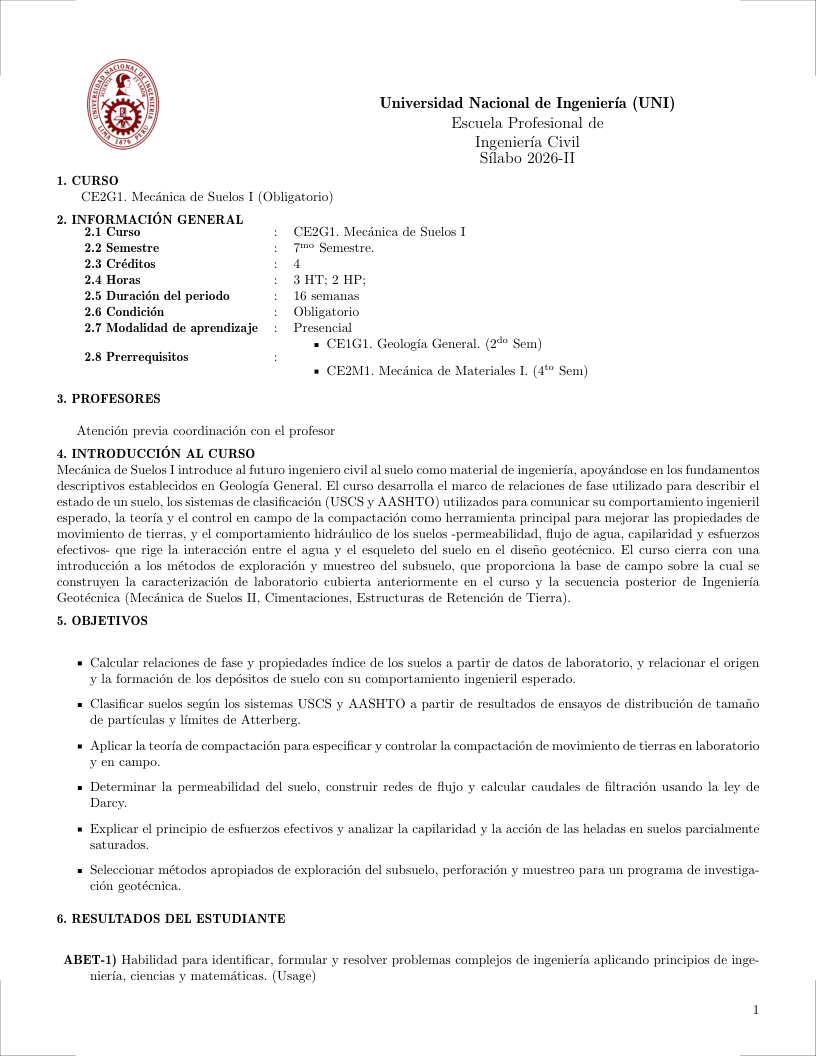
 Español (Latinoamérica)
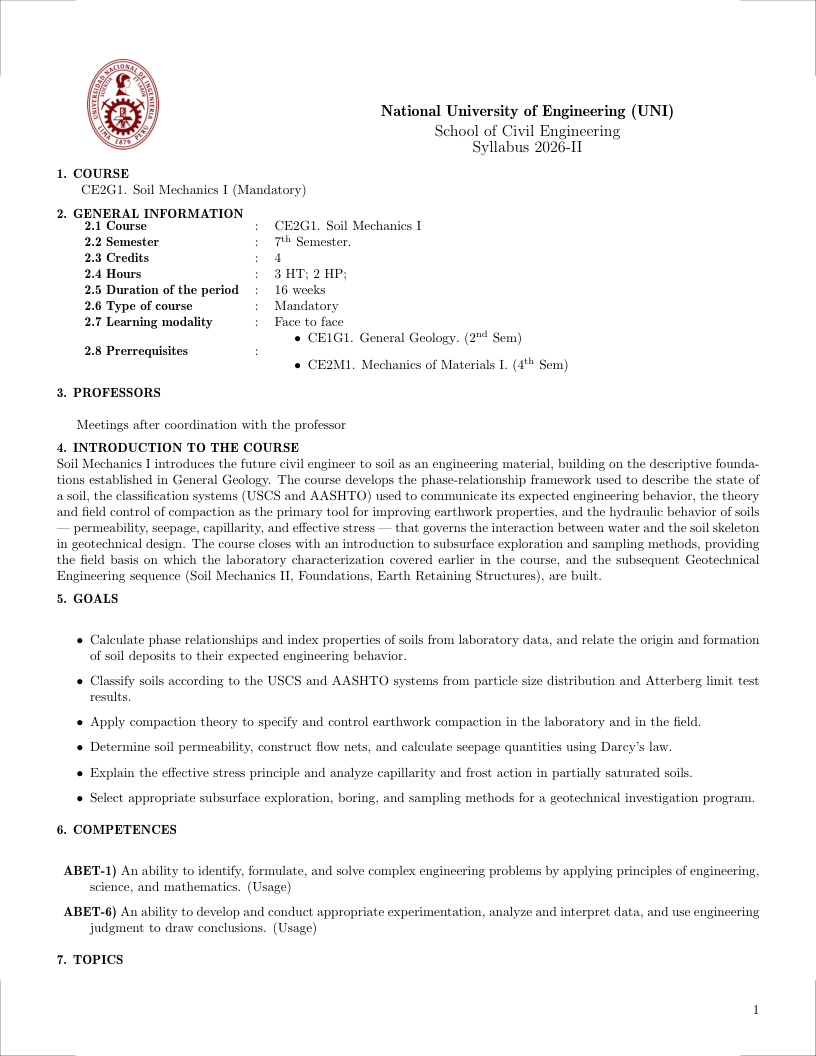 English
 - Prerrequisites:
- CE1G1 General Geology (2nd Sem)
- CE2M1 Mechanics of Materials I (4th Sem)
7.37.1. Justification ↑ Back to top
Soil Mechanics I introduces the future civil engineer to soil as an engineering material, building on the descriptive foundations established in General Geology. The course develops the phase-relationship framework used to describe the state of a soil, the classification systems (USCS and AASHTO) used to communicate its expected engineering behavior, the theory and field control of compaction as the primary tool for improving earthwork properties, and the hydraulic behavior of soils — permeability, seepage, capillarity, and effective stress — that governs the interaction between water and the soil skeleton in geotechnical design. The course closes with an introduction to subsurface exploration and sampling methods, providing the field basis on which the laboratory characterization covered earlier in the course, and the subsequent Geotechnical Engineering sequence (Soil Mechanics II, Foundations, Earth Retaining Structures), are built.
7.37.2. Generales Goals ↑ Back to top
- Calculate phase relationships and index properties of soils from laboratory data, and relate the origin and formation of soil deposits to their expected engineering behavior.
- Classify soils according to the USCS and AASHTO systems from particle size distribution and Atterberg limit test results.
- Apply compaction theory to specify and control earthwork compaction in the laboratory and in the field.
- Determine soil permeability, construct flow nets, and calculate seepage quantities using Darcy's law.
- Explain the effective stress principle and analyze capillarity and frost action in partially saturated soils.
- Select appropriate subsurface exploration, boring, and sampling methods for a geotechnical investigation program.
7.37.3. Contribution to Outcomes ↑ Back to top
- ABET-1) An ability to identify, formulate, and solve complex engineering problems by applying principles of engineering, science, and mathematics. (Usage)
- ABET-6) An ability to develop and conduct appropriate experimentation, analyze and interpret data, and use engineering judgment to draw conclusions. (Usage)
7.37.4. Content ↑ Back to top
7.37.4.1. Phase Relationships and Seepage (66 hours) [Skills ABET-1,ABET-6] ↑ Back to top
Bibliography: (Das, 2019)
Topics
- Phase relationships and index properties of soils
- Soil classification systems including USCS and AASHTO
- Particle size distribution and Atterberg limits
- Compaction theory and field control methods
- Permeability and Darcy's law
- Seepage analysis and flow nets
- Effective stress principle and pore water pressure
- Capillarity and soil suction
- Frost action and thermal properties of soils
Learning Outcomes
- Calculate phase relationships and derive index properties from laboratory data [Usage]
- Classify soils according to USCS and AASHTO classification systems [Assessment]
- Interpret particle size distribution curves and plasticity charts [Assessment]
- Apply compaction theory to field construction control [Usage]
- Determine soil permeability using laboratory and field methods [Assessment]
- Construct flow nets and calculate seepage quantities [Usage]
- Explain the effective stress principle and its engineering significance [Familiarity]
- Analyze capillary rise and soil suction effects in partially saturated soils [Assessment]
- Evaluate frost susceptibility and design frost protection measures [Familiarity]
7.37.4.2. Site Investigation and In-Situ Testing (4 hours) [Skills ABET-6] ↑ Back to top
Bibliography: (Das, 2019)
Topics
- Investigation planning and scope determination
- Boring methods and subsurface exploration techniques
- Sampling methods for disturbed and undisturbed samples
- Standard Penetration Test and correlations
- Laboratory testing program and test selection
- Cone Penetration Test and piezocone testing
- Vane shear test and pressuremeter testing
- Geophysical methods including seismic and resistivity surveys
- Groundwater monitoring and piezometer installation
- Report preparation and geotechnical data presentation
- In-situ permeability (Lugeon/packer) testing for foundation grouting and seepage assessment
- Borrow area investigation for embankment fill material quantity and quality
Learning Outcomes
- Develop appropriate site investigation programs based on project requirements [Assessment]
- Select appropriate boring and exploration methods for different soil conditions [Familiarity]
- Specify sampling techniques to obtain quality samples for testing [Usage]
- Interpret SPT data and apply empirical correlations for design parameters [Assessment]
- Design laboratory testing programs for geotechnical projects [Usage]
- Analyze CPT and piezocone data for soil profiling and parameter evaluation [Assessment]
- Apply vane shear and pressuremeter tests for soft clay characterization [Usage]
- Utilize geophysical methods to complement traditional investigation techniques [Assessment]
- Monitor groundwater conditions and interpret piezometric data [Usage]
- Prepare comprehensive geotechnical investigation reports [Assessment]
- Perform packer (Lugeon) testing and interpret results for foundation grouting curtain design [Usage]
- Characterize borrow areas for embankment fill material quantity and quality [Assessment]
7.37.5. Bibliography ↑ Back to top
Das, B. M. (2019). Principles of Geotechnical Engineering. Cengage Learning, 9th edition.