- ES Español (Latinoamérica)

- EN English

7.4. Learning Methodology Workshop (Mandatory)
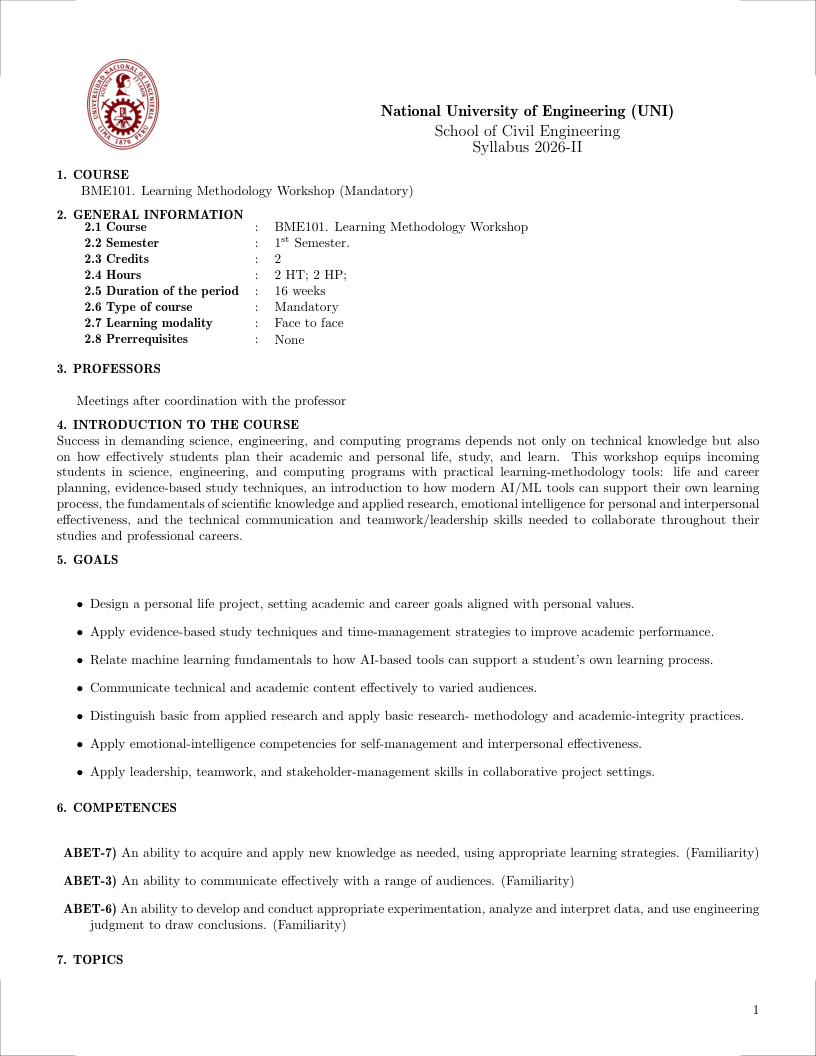
- Semester: 1st Sem. Credits: 2
- Hour of this course: Theory: 2 hours; Practice: 2 hours;
- Syllabus:
- htmlonly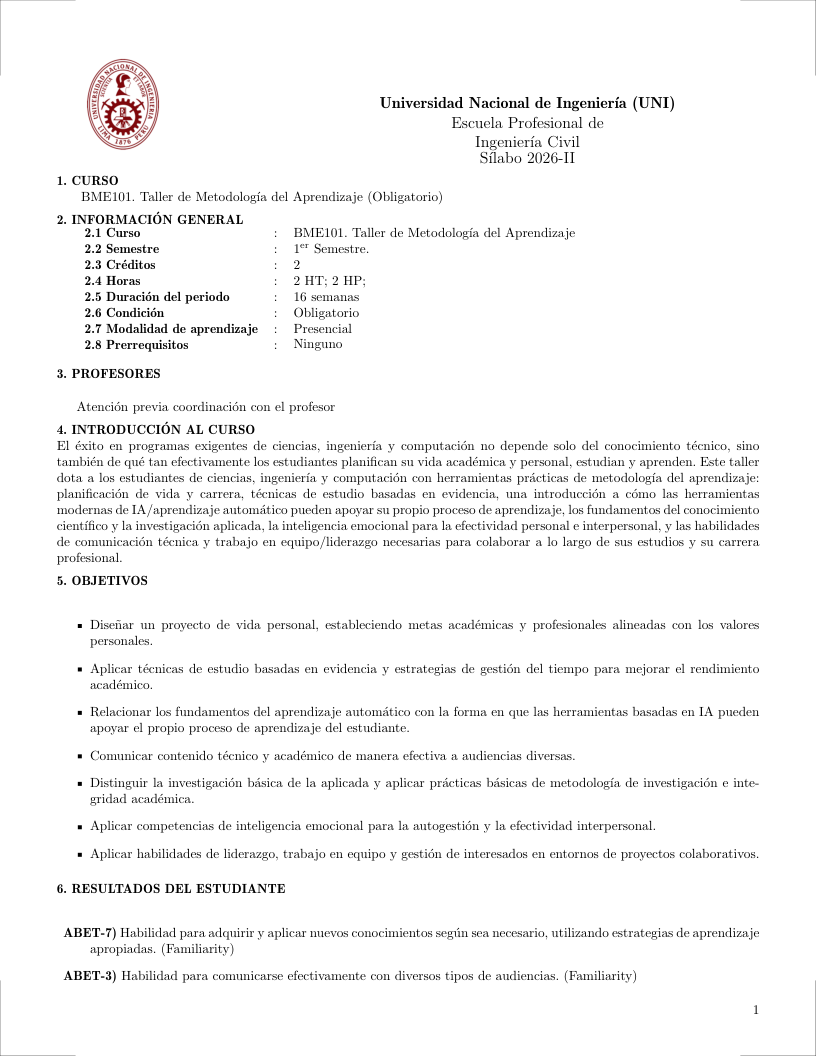
 Español (Latinoamérica)
 English
 - Prerrequisites: None
7.4.1. Justification ↑ Back to top
Success in demanding science, engineering, and computing programs depends not only on technical knowledge but also on how effectively students plan their academic and personal life, study, and learn. This workshop equips incoming students in science, engineering, and computing programs with practical learning-methodology tools: life and career planning, evidence-based study techniques, an introduction to how modern AI/ML tools can support their own learning process, the fundamentals of scientific knowledge and applied research, emotional intelligence for personal and interpersonal effectiveness, and the technical communication and teamwork/leadership skills needed to collaborate throughout their studies and professional careers.
7.4.2. Generales Goals ↑ Back to top
- Design a personal life project, setting academic and career goals aligned with personal values.
- Apply evidence-based study techniques and time-management strategies to improve academic performance.
- Relate machine learning fundamentals to how AI-based tools can support a student's own learning process.
- Communicate technical and academic content effectively to varied audiences.
- Distinguish basic from applied research and apply basic research- methodology and academic-integrity practices.
- Apply emotional-intelligence competencies for self-management and interpersonal effectiveness.
- Apply leadership, teamwork, and stakeholder-management skills in collaborative project settings.
7.4.3. Contribution to Outcomes ↑ Back to top
- ABET-7) An ability to acquire and apply new knowledge as needed, using appropriate learning strategies. (Familiarity)
- ABET-3) An ability to communicate effectively with a range of audiences. (Familiarity)
- ABET-6) An ability to develop and conduct appropriate experimentation, analyze and interpret data, and use engineering judgment to draw conclusions. (Familiarity)
7.4.4. Content ↑ Back to top
7.4.4.1. Life Project (8 hours) [Skills ABET-7] ↑ Back to top
Bibliography: (Burnett and Evans, 2016)
Topics
- Personal-values clarification as the foundation for life planning.
- Short-, medium-, and long-term goal setting using SMART criteria.
- From academic path to professional career: mapping academic studies in science, engineering, or computing onto career goals.
- Self-assessment tools: strengths, interests, and personality inventories.
- Elaboration of a personal life-project plan with milestones and review points.
Learning Outcomes
- Formulate personal values and goals to build a coherent life project [Usage].
- Design short-, medium-, and long-term academic and career goals using structured planning tools [Usage].
- Apply self-assessment techniques to identify personal strengths and areas for improvement [Familiarity].
7.4.4.2. Study Techniques and Habits (12 hours) [Skills ABET-7] ↑ Back to top
Bibliography: (Dunlosky et al., 2013; Newport, 2007)
Topics
- Active learning techniques: active recall, spaced repetition, and elaborative interrogation.
- Note-taking systems: the Cornell method, mapping, and outlining.
- Time management and time-blocking; the Pomodoro technique.
- Exam-preparation strategies and self-testing.
- Building sustainable study habits and routines.
Learning Outcomes
- Apply active-recall and spaced-repetition techniques to improve long-term retention of course material [Usage].
- Use structured note-taking systems (e.g., the Cornell method) to organize academic content [Usage].
- Design a personal time-management plan using time-blocking and the Pomodoro technique [Usage].
- Apply self-testing and exam-preparation strategies to evaluate personal learning progress [Assessment].
7.4.4.3. Machine Learning Fundamentals (4 hours) [Skills ABET-7] ↑ Back to top
Bibliography: (Russell and Norvig, 2020)
Topics
- Definition and examples of a broad variety of machine learning tasks:
- Supervised learning:
- Classification
- Regression
- Reinforcement learning
- Unsupervised learning:
- Clustering
- Supervised learning:
- Fundamental ideas:
- No free lunch theorem: no one learner can solve all problems; representational design decisions have consequences.
- Sources of error and undecidability in machine learning
- A simple statistical-based supervised learning such as linear regression or decision trees:
- Focus on how they work without going into mathematical or optimization details; enough to understand and use existing implementations correctly
- The overfitting problem/controlling solution complexity (regularization, pruning - intuition only):
- The bias (underfitting) - variance (overfitting) tradeoff
Learning Outcomes
- Describe the differences among the three main styles of learning (supervised, reinforcement, and unsupervised) and determine which is appropriate to a particular problem domain [Explain]
- Differentiate the terms of AI, machine learning, and deep learning [Evaluate]
- Frame an application as a classification problem, including the available input features and output to be predicted (e.g., identifying alphabetic characters from pixel grid input) [Apply]
- Identify overfitting in the context of a problem and learning curves and describe solutions to overfitting [Evaluate]
- Explain how machine learning works as an optimization/search process [Explain]
7.4.4.4. Written and Technical Communication (2 hours) [Skills ABET-3] ↑ Back to top
Bibliography: (Gurak and Lannon, 2013)
Topics
- Audience analysis and adaptation of technical content
- Written communication: technical reports, memos, emails, and specifications
- Visual communication: graphs, charts, diagrams, and effective slide design
Learning Outcomes
- Write a clear, concise, and well-organized technical report on a laboratory experiment or design project [Usage]
- Create effective graphs and diagrams to present engineering data [Assessment]
7.4.4.5. Oral Presentation and Professional Communication (1 hours) [Skills ABET-3] ↑ Back to top
Bibliography: (Gurak and Lannon, 2013)
Topics
- Oral presentations: structure, delivery techniques, and handling Q&A
- Proposal writing: technical approach, management plan, and cost estimating
- Executive summaries and communicating with non-technical stakeholders
Learning Outcomes
- Deliver a structured oral presentation on a technical topic using appropriate visual aids [Usage]
- Outline the key sections of a competitive engineering proposal [Familiarity]
- Develop an executive summary that conveys key project findings to a senior management audience [Usage]
7.4.4.6. Digital and Collaborative Communication (1 hours) [Skills ABET-3] ↑ Back to top
Bibliography: (Gurak and Lannon, 2013)
Topics
- Collaborative writing and document management in team settings
- Digital communication: web content, social media guidelines for engineers
- Persuasive communication and negotiation techniques
Learning Outcomes
- Manage a collaborative document (e.g., on Google Docs or SharePoint) for a team project [Assessment]
- Explain the professional risks and opportunities associated with engineers using social media [Familiarity]
- Employ basic negotiation tactics to resolve a simulated conflict over project scope [Usage]
7.4.4.7. Scientific Knowledge and Applied Research (16 hours) [Skills ABET-6] ↑ Back to top
Bibliography: (Booth et al., 2016b; Leedy and Ormrod, 2019a)
Topics
- Nature and scope of scientific knowledge: definitions and limits.
- Basic versus applied research; the role of applied research in engineering, computing, and scientific practice.
- Research-methodology basics: problem formulation and literature review.
- Formulating hypotheses and research questions.
- Basics of data collection and data analysis for engineering, computing, and scientific research.
- Academic integrity and citation norms: avoiding plagiarism and properly citing sources.
- Introduction to research practice in engineering, computing, and science: reading and using academic papers.
Learning Outcomes
- Distinguish between basic and applied research and identify their role in engineering, computing, and scientific practice [Usage].
- Formulate a research problem and a supporting literature review for a topic in engineering, computing, or science [Usage].
- Formulate testable hypotheses and research questions [Usage].
- Apply basic data-collection and data-analysis procedures to a simple research exercise [Familiarity].
- Apply academic-integrity principles and standard citation norms when using external sources [Usage].
7.4.4.8. Emotional Intelligence (8 hours) [Skills ABET-3] ↑ Back to top
Bibliography: (Goleman, 1995)
Topics
- Goleman's model of emotional intelligence: self-awareness, self-regulation, motivation, empathy, and social skills.
- Self-awareness and self-regulation techniques.
- Empathy and social-skills development for interpersonal effectiveness.
- Stress-management and resilience-building strategies for academic life.
Learning Outcomes
- Identify the five components of emotional intelligence and relate them to personal behavior [Usage].
- Apply self-regulation and stress-management techniques to cope with academic pressure [Usage].
- Apply empathy and social-skills strategies to improve interpersonal interactions [Familiarity].
7.4.4.9. Leadership, Team Dynamics, and Stakeholder Management (4 hours) [Skills ABET-3] ↑ Back to top
Bibliography: (Robbins and Coulter, 2017)
Topics
- Leadership styles, traits, and the difference between leadership and management
- Team dynamics: forming, storming, norming, performing stages and roles
- Conflict resolution strategies and negotiation
- Stakeholder identification, analysis, and engagement planning
- Motivation theories and their application to engineering teams
- Cultural intelligence and leading diverse, global teams
- Change management and leading organizational transformation
- Emotional intelligence and its role in effective leadership
- Ethical leadership and creating an ethical organizational culture
Learning Outcomes
- Describe different leadership styles and identify situations where each might be effective [Familiarity]
- Diagnose the stage of development of a project team and propose appropriate interventions [Assessment]
- Resolve a simulated interpersonal conflict within a project team using a structured approach [Usage]
- Develop a stakeholder engagement plan for a project with community opposition [Assessment]
- Adapt communication and leadership approach when working with a team from a different cultural background [Assessment]
- Explain the key steps in a change management process for implementing a new technology [Familiarity]
- Evaluate one's own emotional intelligence and identify areas for development [Assessment]
- Model ethical leadership behavior in a team-based project simulation [Usage]
7.4.5. Bibliography ↑ Back to top
Burnett, B. and Evans, D. (2016). Designing Your Life: How to Build a Well-Lived, Joyful Life. Alfred A. Knopf.
Dunlosky, J., Rawson, K. A., Marsh, E. J., Nathan, M. J., and Willingham, D. T. (2013). Improving students' learning with effective learning techniques: Promising directions from cognitive and educational psychology. Psychological Science in the Public Interest, 14(1):4–58.
Newport, C. (2007). How to Become a Straight-A Student. Broadway Books.
Russell, S. and Norvig, P. (2020). Artificial Intelligence: A Modern Approach. Pearson, 4th edition.
Gurak, L. J. and Lannon, J. M. (2013). A Concise Guide to Technical Communication. Pearson, 4th edition.
Booth, W. C., Colomb, G. G., Williams, J. M., Bizup, J., and FitzGerald, W. T. (2016b). The Craft of Research. University of Chicago Press, 4th edition.
Leedy, P. D. and Ormrod, J. E. (2019a). Practical Research: Planning and Design. Pearson, 12th edition.
Goleman, D. (1995). Emotional Intelligence: Why It Can Matter More Than IQ. Bantam Books.
Robbins, S. P. and Coulter, M. (2017). Management. Pearson, 14th edition.