- ES Español (Latinoamérica)

- EN English

7.54. Integrated Construction Management (Mandatory)
- Semester: 9th Sem. Credits: 3
- Hour of this course: Theory: 4 hours; Laboratory: 2 hours;
- Syllabus:
- htmlonly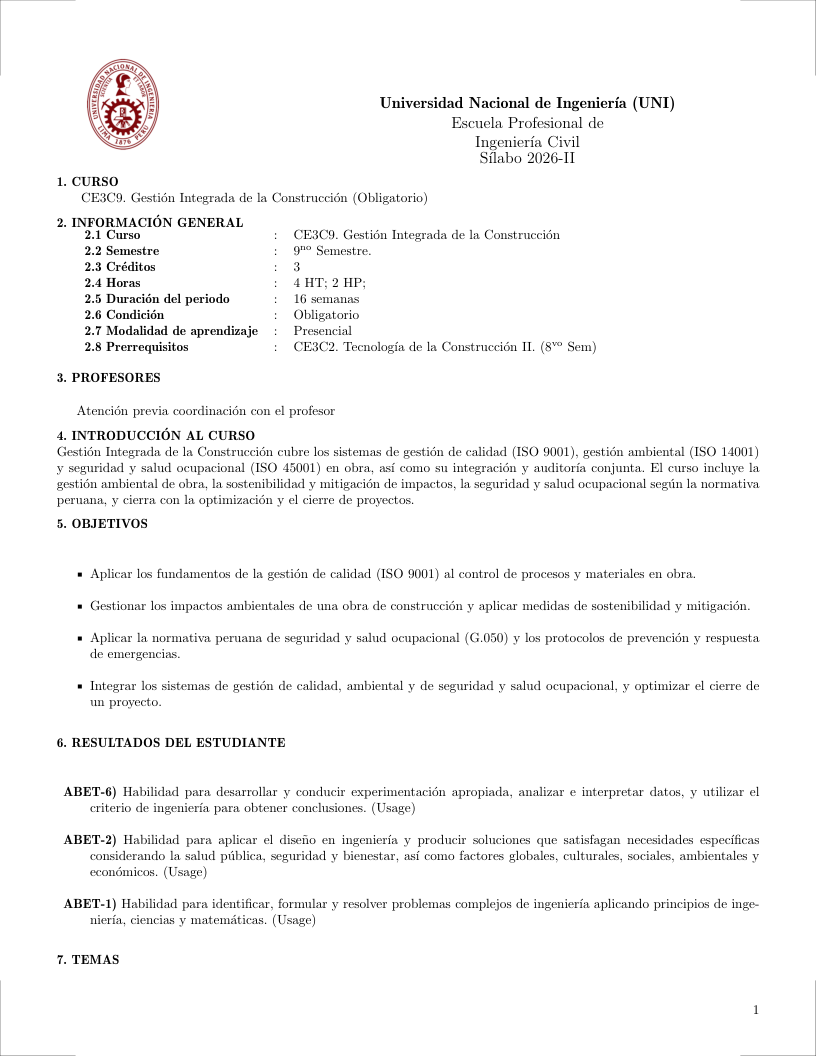
 Español (Latinoamérica)
 English
 - Prerrequisites:
- CE3C2 Construction Technology II (8th Sem)
7.54.1. Justification ↑ Back to top
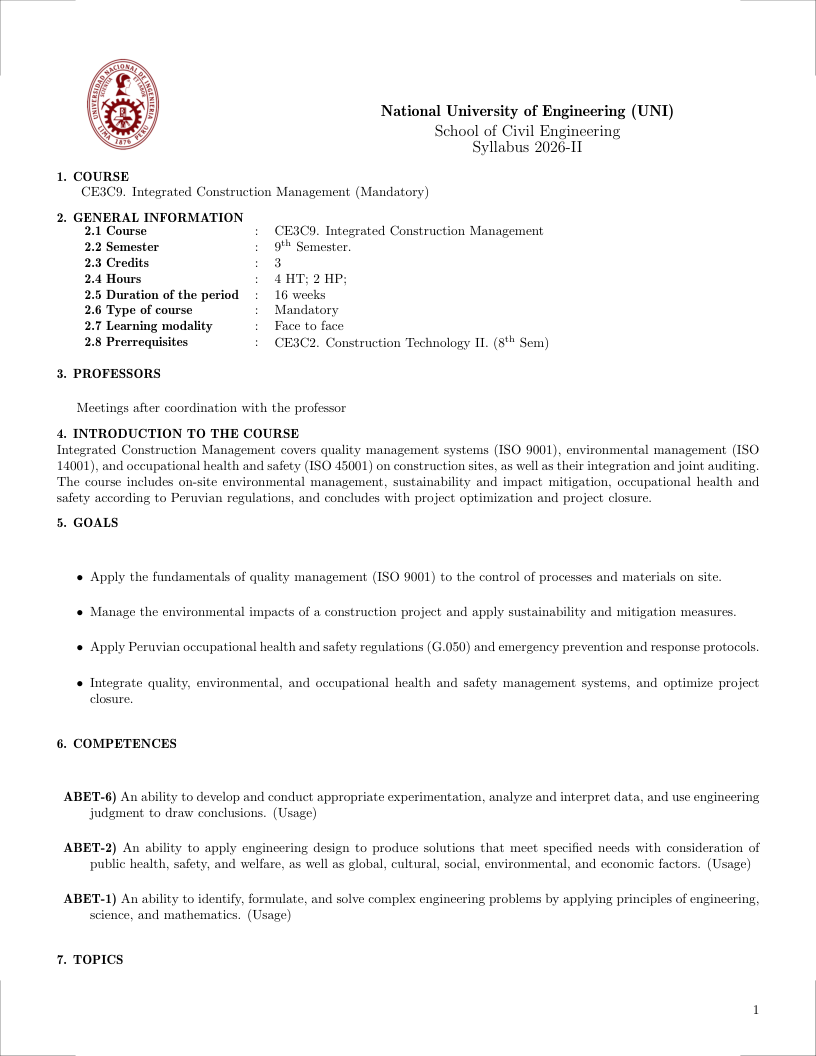
Integrated Construction Management covers quality management systems (ISO 9001), environmental management (ISO 14001), and occupational health and safety (ISO 45001) on construction sites, as well as their integration and joint auditing. The course includes on-site environmental management, sustainability and impact mitigation, occupational health and safety according to Peruvian regulations, and concludes with project optimization and project closure.
7.54.2. Generales Goals ↑ Back to top
- Apply the fundamentals of quality management (ISO 9001) to the control of processes and materials on site.
- Manage the environmental impacts of a construction project and apply sustainability and mitigation measures.
- Apply Peruvian occupational health and safety regulations (G.050) and emergency prevention and response protocols.
- Integrate quality, environmental, and occupational health and safety management systems, and optimize project closure.
7.54.3. Contribution to Outcomes ↑ Back to top
- ABET-6) An ability to develop and conduct appropriate experimentation, analyze and interpret data, and use engineering judgment to draw conclusions. (Usage)
- ABET-2) An ability to apply engineering design to produce solutions that meet specified needs with consideration of public health, safety, and welfare, as well as global, cultural, social, environmental, and economic factors. (Usage)
- ABET-1) An ability to identify, formulate, and solve complex engineering problems by applying principles of engineering, science, and mathematics. (Usage)
7.54.4. Content ↑ Back to top
7.54.4.1. Quality Management (28 hours) [Skills ABET-6] ↑ Back to top
Bibliography: (for Standardization, 2015b; Institute, 2021b)
Topics
- Total Quality Management: Deming's 14 points, continuous improvement (kaizen), and quality culture
- Six Sigma methodology (DMAIC): process capability, control charts, and defects per million opportunities
- Quality standards and certification: ISO 9001 framework, quality cost categories (prevention, appraisal, failure)
- Quality function deployment (QFD) and voice of the customer: House of Quality matrix, customer requirement translation, and design prioritization
Learning Outcomes
- Explain the TQM philosophy and the key tools used in the DMAIC improvement cycle [Familiarity]
- Apply basic statistical process control methods to monitor process quality [Usage]
- Evaluate the quality performance of a process and recommend improvement priorities using cost-of-quality analysis [Assessment]
7.54.4.2. Integrated Quality, Environmental, and Safety Management Systems (12 hours) [Skills ABET-6] ↑ Back to top
Bibliography: (for Standardization, 2015b; for Standardization, 2015a; for Standardization, 2018)
Topics
- Common high-level structure (Annex SL) shared by ISO 9001, 14001, and 45001: aligned clauses for context, leadership, planning, support, operation, performance evaluation, and improvement
- Integrated management policy and objectives spanning quality, environmental, and OH&S goals; a single integrated management manual and shared documented information
- Integrated internal and external audit programs covering multiple standards in a single audit cycle: combined checklists, joint findings, and non-conformance tracking
- Synergies between the three systems (shared risk-based thinking, PDCA cycle, documented information) versus potential conflicts (competing priorities, resource allocation), and approaches to resolve them
Learning Outcomes
- Explain the common high-level structure shared by ISO 9001, 14001, and 45001 and how it enables management system integration [Familiarity]
- Design an integrated audit checklist covering quality, environmental, and occupational health and safety requirements for a construction site [Usage]
- Evaluate the effectiveness of an integrated management system on a construction project, identifying synergies and unresolved conflicts between its component systems [Assessment]
7.54.4.3. Environmental Impact Assessment and Sustainability Metrics (12 hours) [Skills ABET-2] ↑ Back to top
Bibliography: (Glasson and Therivel, 2019)
Topics
- EIA process: screening, scoping, impact analysis, mitigation, and public participation
- Impact prediction methods for air, water, soil, noise, and ecological systems
- Mitigation hierarchy and design of environmental management plans
- Legal and institutional frameworks for EIA
- Sustainability concepts and the triple bottom line (environment, economy, society)
- Cumulative impact assessment and strategic environmental assessment (SEA)
- Social impact assessment and stakeholder engagement methods
- Sustainability metrics and indicator frameworks (e.g., SDGs, Envision)
- Decision-support tools and multi-criteria analysis for sustainable design
Learning Outcomes
- Outline the key stages of a standardized Environmental Impact Assessment (EIA) process [Familiarity]
- Predict primary environmental impacts of a proposed infrastructure project on local air and water quality [Usage]
- Develop mitigation measures for identified significant environmental impacts [Assessment]
- Explain the legal requirements and purpose of EIA in the project approval process [Familiarity]
- Apply the triple bottom line framework to evaluate a simple engineering project [Assessment]
- Conduct a scoping exercise to define the boundaries and key issues for a cumulative impact assessment [Assessment]
- Design a stakeholder engagement plan for a controversial development project [Usage]
- Select appropriate sustainability metrics to track the performance of a green infrastructure project [Assessment]
- Use a simple multi-criteria decision analysis (MCDA) tool to compare alternative project designs [Usage]
7.54.4.4. Air Quality and Pollution Control Engineering (12 hours) [Skills ABET-2] ↑ Back to top
Bibliography: (Davis and Cornwell, 2010)
Topics
- Atmospheric structure, composition, and basic meteorology
- Pollutant types, sources, and health/environmental effects
- Monitoring techniques and ambient air quality standards
- Dispersion modeling fundamentals and Gaussian plume model
- Control technologies for particulate matter: cyclones, baghouses, and ESPs
- Gaseous pollutant control: absorption, adsorption, and catalytic systems
- Mobile source emissions and control strategies
- Indoor air quality and ventilation
- Climate change and greenhouse gas mitigation engineering
Learning Outcomes
- Describe the major classes of air pollutants, their sources, and impacts [Familiarity]
- Apply the Gaussian plume model to estimate ground-level concentrations from a point source [Usage]
- Select appropriate particulate control devices based on particle size distribution and efficiency requirements [Assessment]
- Interpret ambient air quality monitoring data relative to regulatory standards [Familiarity]
- Design a basic absorption tower for removing a gaseous pollutant from a flue gas stream [Assessment]
- Explain the engineering approaches for controlling emissions from mobile sources [Familiarity]
- Evaluate indoor air quality parameters and propose mitigation measures for a building [Assessment]
- Propose engineering strategies for reducing greenhouse gas emissions from an industrial facility [Usage]
7.54.4.5. Construction Safety, Health, and Risk Management (24 hours) [Skills ABET-1] ↑ Back to top
Bibliography: (Hinze, 2005; de Trabajo y Promoción del Empleo del Perú, 2010)
Topics
- Safety management systems and the role of safety culture
- Common construction hazards: falls, struck-by, electrocution, caught-in/between
- Occupational Safety and Health Administration (OSHA) regulations and compliance
- Risk identification and assessment techniques (e.g., JSA, checklists)
- Hierarchy of controls: elimination, substitution, engineering, administrative, PPE
- Occupational health: silica, noise, ergonomics, and industrial hygiene
- Emergency response planning and incident investigation
- Insurance and bonding principles for construction risk transfer
- Proactive safety leading indicators and predictive analytics
Learning Outcomes
- Identify the "Fatal Four" construction hazards and basic OSHA requirements for each [Familiarity]
- Conduct a Job Safety Analysis (JSA) for a common construction task [Assessment]
- Develop a site-specific safety plan for a given project scenario [Usage]
- Apply the hierarchy of controls to mitigate an identified safety risk [Familiarity]
- Evaluate occupational health exposures (e.g., noise, dust) and recommend monitoring strategies [Assessment]
- Create an emergency response plan for a construction site [Usage]
- Explain the purpose and types of insurance (e.g., CGL, workers' comp) in construction risk management [Familiarity]
- Propose leading safety indicators to track and predict site safety performance [Assessment]
7.54.4.6. Lean Construction and Integrated Project Delivery (IPD) (4 hours) [Skills ABET-1] ↑ Back to top
Bibliography: (Ballard, 2000)
Topics
- Lean thinking principles: value, value stream, flow, pull, perfection
- Identification and elimination of the eight wastes in construction
- Last Planner System (LPS) for production planning and control
- Visual management tools: 5S, Kanban, and Andon
- Integrated Project Delivery (IPD) principles and multi-party agreements
- Target Value Delivery (TVD) and Set-Based Design
- Collaboration technologies and Big Room co-location
- Performance measurement: Percent Plan Complete (PPC), Takt time
- Culture change and implementation strategies for lean transformation
Learning Outcomes
- Define the seven (or eight) types of waste (Muda) in a construction context [Familiarity]
- Apply the Last Planner System to develop a reliable weekly work plan [Usage]
- Identify opportunities to apply visual management (5S) on a construction site [Assessment]
- Explain how Integrated Project Delivery (IPD) aligns goals and shares risk among project stakeholders [Familiarity]
- Use Target Value Delivery principles to guide design decisions within a cost target [Assessment]
- Facilitate a collaborative pull planning session with multiple trades [Usage]
- Calculate and interpret Percent Plan Complete (PPC) as a lean performance metric [Assessment]
- Develop a basic implementation plan for introducing lean practices to a project team [Assessment]
7.54.4.7. Key Performance Indicators (6 hours) [Skills ABET-6] ↑ Back to top
Bibliography: (Institute, 2021b)
Topics
- Selecting KPIs: relevance to project objectives, measurability, and actionability
- Balanced metric sets: leading and lagging indicators, outcome and output metrics
- Setting KPI thresholds and alert levels for triggering corrective action
- Reviewing and adapting the KPI set as the project evolves and stakeholder priorities shift
Learning Outcomes
- Define a balanced KPI set for monitoring a project across multiple performance dimensions [Usage]
- Evaluate a given set of KPIs for balance, relevance, and potential for metric dysfunction [Assessment]
- Design a KPI review cycle that keeps performance metrics aligned with evolving project objectives [Assessment]
7.54.4.8. Kickoff and Closure Activities (6 hours) [Skills ABET-6] ↑ Back to top
Bibliography: (Institute, 2021b)
Topics
- Project kickoff: aligning team and stakeholders on objectives, approach, and working agreements
- Phase transition activities: reviews, approvals, and handoffs between phases
- Project closure: final deliverable acceptance, lessons learned, and team release
- Integrating lessons learned from closure into organizational knowledge assets
Learning Outcomes
- Conduct an effective project kickoff that aligns team and stakeholders on goals and approach [Usage]
- Execute project closure activities including final acceptance and lessons learned archiving [Usage]
- Design a comprehensive project closure checklist ensuring all administrative, contractual, and knowledge capture obligations are met [Assessment]
7.54.5. Bibliography ↑ Back to top
for Standardization, I. O. (2015b). Iso 9001: Quality management systems – requirements. Technical report, ISO.
Institute, P. M. (2021b). A Guide to the Project Management Body of Knowledge (PMBOK Guide). Project Management Institute, 7th edition.
for Standardization, I. O. (2015a). Iso 14001: Environmental management systems – requirements with guidance for use. Technical report, ISO.
for Standardization, I. O. (2018). Iso 45001: Occupational health and safety management systems – requirements with guidance for use. Technical report, ISO.
Glasson, J. and Therivel, R. (2019). Introduction to Environmental Impact Assessment. Routledge, 5th edition.
Davis, M. L. and Cornwell, D. A. (2010). Introduction to Environmental Engineering. McGraw-Hill, 5th edition.
Hinze, J. W. (2005). Construction Safety. Prentice Hall, 2nd edition.
de Trabajo y Promoción del Empleo del Perú, M. (2010). Norma g.050: Seguridad durante la construcción. Technical report, Reglamento Nacional de Edificaciones del Perú.
Ballard, G. (2000). The last planner system of production control. PhD Thesis, University of Birmingham.