- ES Español (Latinoamérica)

- EN English

7.42. Concrete Technology I (Mandatory)
- Semester: 8th Sem. Credits: 4
- Hour of this course: Theory: 3 hours; Laboratory: 2 hours;
- Syllabus:
- htmlonly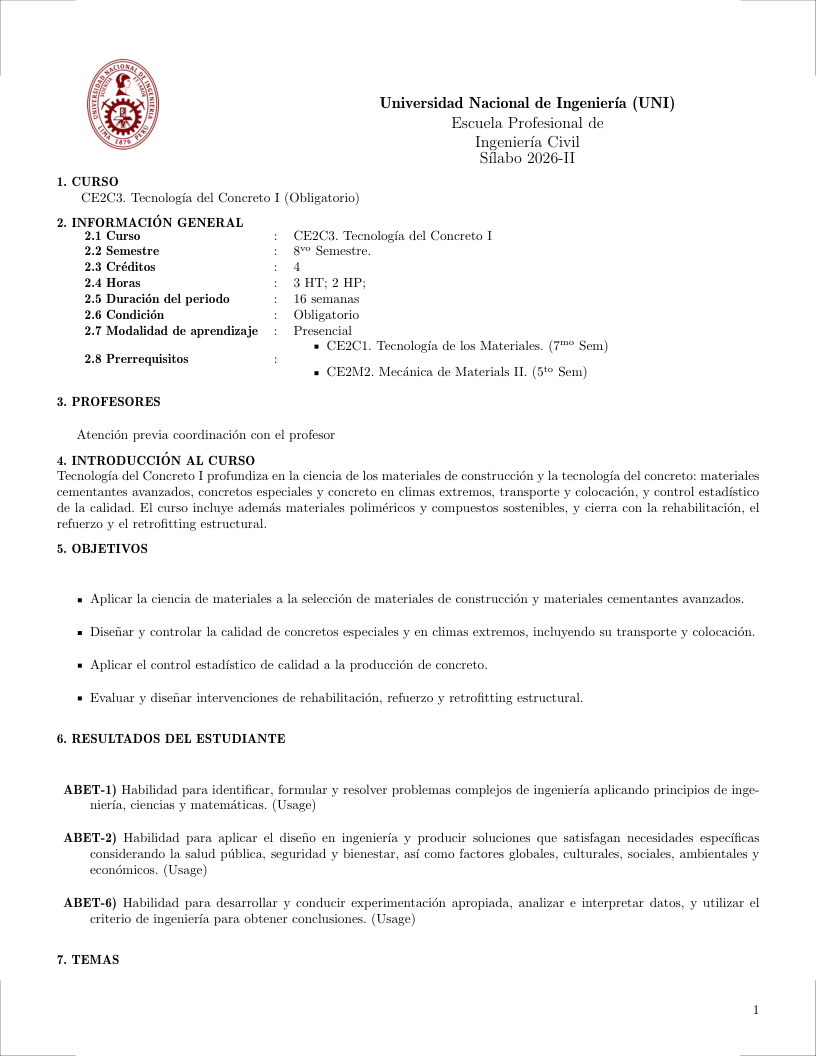
 Español (Latinoamérica)
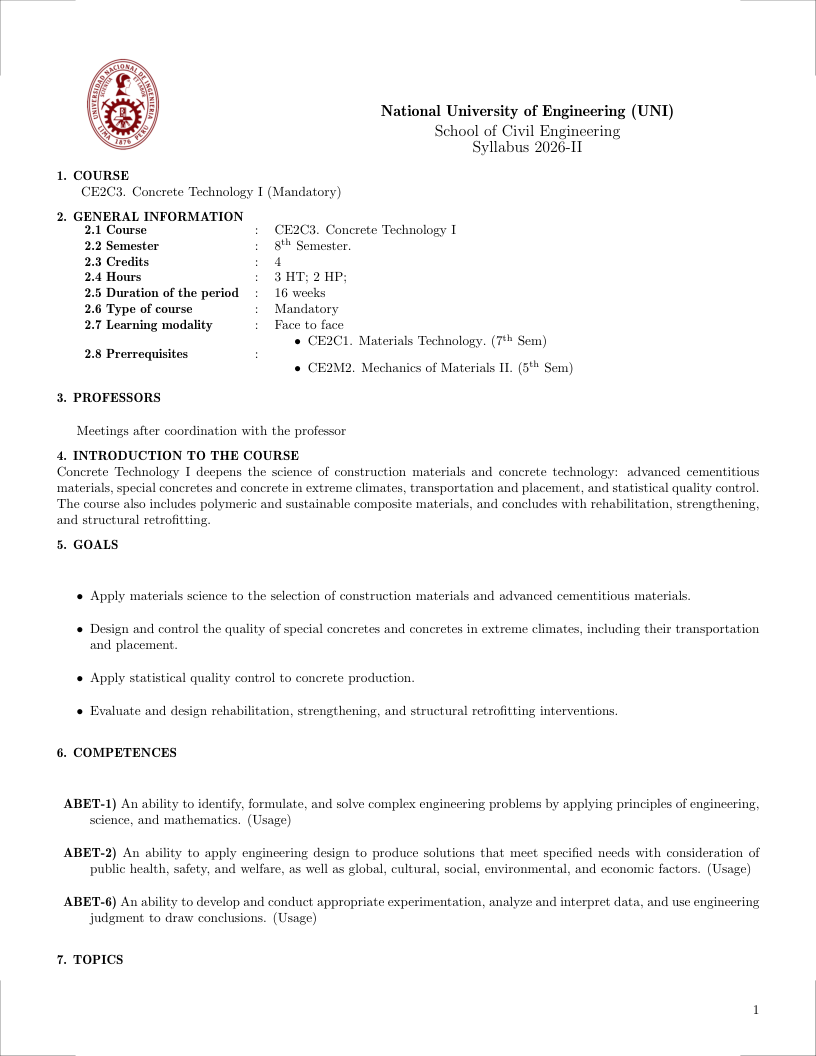 English
 - Prerrequisites:
- CE2C1 Materials Technology (7th Sem)
- CE2M2 Mechanics of Materials II (5th Sem)
7.42.1. Justification ↑ Back to top
Concrete Technology I deepens the science of construction materials and concrete technology: advanced cementitious materials, special concretes and concrete in extreme climates, transportation and placement, and statistical quality control. The course also includes polymeric and sustainable composite materials, and concludes with rehabilitation, strengthening, and structural retrofitting.
7.42.2. Generales Goals ↑ Back to top
- Apply materials science to the selection of construction materials and advanced cementitious materials.
- Design and control the quality of special concretes and concretes in extreme climates, including their transportation and placement.
- Apply statistical quality control to concrete production.
- Evaluate and design rehabilitation, strengthening, and structural retrofitting interventions.
7.42.3. Contribution to Outcomes ↑ Back to top
- ABET-1) An ability to identify, formulate, and solve complex engineering problems by applying principles of engineering, science, and mathematics. (Usage)
- ABET-2) An ability to apply engineering design to produce solutions that meet specified needs with consideration of public health, safety, and welfare, as well as global, cultural, social, environmental, and economic factors. (Usage)
- ABET-6) An ability to develop and conduct appropriate experimentation, analyze and interpret data, and use engineering judgment to draw conclusions. (Usage)
7.42.4. Content ↑ Back to top
7.42.4.1. Construction Materials Science (12 hours) [Skills ABET-1] ↑ Back to top
Bibliography: (Neville, 2011)
Topics
- Physical and mechanical properties of construction materials including density, porosity, strength, and elasticity
- Microstructure and phase composition of construction materials
- Durability mechanisms including weathering, chemical attack, and environmental degradation
- Thermal and moisture properties of construction materials
- Crystalline and amorphous structures in construction materials
- Material selection criteria based on performance requirements
- Degradation mechanisms and service life prediction
Learning Outcomes
- Describe the fundamental physical and mechanical properties of major construction materials [Familiarity]
- Analyze the relationship between microstructure and macroscopic properties of materials [Assessment]
- Evaluate the durability performance of materials under specific environmental conditions [Usage]
- Explain the effects of thermal and moisture variations on material behavior [Familiarity]
- Select appropriate construction materials based on design specifications and performance criteria [Assessment]
- Predict service life and degradation patterns of materials in various environments [Usage]
7.42.4.2. Concrete Technology and Advanced Cementitious Materials (25 hours) [Skills ABET-1] ↑ Back to top
Bibliography: (Neville, 2011)
Topics
- Portland cement chemistry and hydration process
- Aggregates properties and grading requirements
- Mix design methodology for normal strength concrete
- Fresh concrete properties including workability, slump, and setting time
- Hardened concrete properties including strength, modulus, and shrinkage
- Chemical and mineral admixtures for concrete
- High-performance and high-strength concrete design
- Self-consolidating concrete and fiber-reinforced concrete
- Durability aspects including alkali-silica reaction, sulfate attack, and freeze-thaw
- Sustainable and low-carbon concrete technologies including supplementary cementitious materials such as fly ash, slag, and silica fume
Learning Outcomes
- Describe the chemistry of portland cement and the hydration process [Familiarity]
- Evaluate aggregate quality and suitability for concrete production [Assessment]
- Design concrete mixes for specified strength and workability requirements [Usage]
- Test and interpret fresh concrete properties using standard procedures [Assessment]
- Predict hardened concrete properties based on mix proportions and curing conditions [Usage]
- Explain the function and effects of various concrete admixtures [Familiarity]
- Formulate high-performance concrete mixes for demanding applications [Usage]
- Select appropriate special concretes for specific construction scenarios [Assessment]
- Incorporate supplementary cementitious materials to optimize concrete performance [Usage]
- Analyze durability risks and specify protective measures for concrete structures [Assessment]
- Compare environmental impacts and carbon footprints of different concrete formulations [Familiarity]
7.42.4.3. Polymeric, Composite, and Sustainable Construction Materials (4 hours) [Skills ABET-1] ↑ Back to top
Bibliography: (Callister and Rethwisch, 2020)
Topics
- Polymer chemistry and classification of construction polymers
- Mechanical and thermal behavior of polymeric materials
- Fiber-reinforced polymer composites and their structural applications
- Adhesives, sealants, and waterproofing materials
- Composite material mechanics and laminate theory
- FRP strengthening and rehabilitation of concrete and masonry structures
- Bio-based and recycled materials for sustainable construction
- Geopolymers and alternative binder systems
- Environmental degradation and long-term performance of polymers and composites
Learning Outcomes
- Classify polymers used in construction and describe their basic properties [Familiarity]
- Characterize the mechanical and thermal behavior of polymeric materials [Assessment]
- Apply fiber-reinforced polymers in structural design and retrofitting applications [Usage]
- Select appropriate adhesives and sealants for specific construction applications [Familiarity]
- Analyze composite laminates using classical lamination theory [Usage]
- Design FRP strengthening systems for existing concrete or masonry structures [Assessment]
- Evaluate the sustainability and life-cycle performance of bio-based construction materials [Assessment]
- Compare geopolymer binders with traditional portland cement systems [Familiarity]
- Predict long-term degradation of polymers and composites under environmental exposure [Usage]
7.42.4.4. Special Concretes and Concrete in Extreme Climates (6 hours) [Skills ABET-1] ↑ Back to top
Bibliography: (Neville, 2011)
Topics
- Hot-weather concrete: heat effects on hydration, retarding admixtures, and curing methods
- Cold-weather concrete: freeze protection, accelerating admixtures, and enclosure protection methods
- Structural lightweight concrete: materials, properties, and mix design
- Mass and heavyweight concrete: heat of hydration control and applications
- Shotcrete: mix design, application process, and quality control
- Concrete for underwater structures: antiwashout mixes and placement methods
- Pervious and architectural concrete: properties and applications
Learning Outcomes
- Identify the effects of hot and cold weather on fresh and hardened concrete properties [Familiarity]
- Apply preventive and corrective measures for concrete production and placement in adverse weather conditions [Usage]
- Select the appropriate special concrete type according to project functional and environmental requirements [Assessment]
- Design lightweight concrete mixes meeting specified strength and density requirements [Usage]
- Specify shotcrete mixing, transport, and placement procedures for tunnel and slope applications [Usage]
- Evaluate the suitability of special concretes for extreme exposure conditions [Assessment]
- Develop specifications for concrete in extreme temperature conditions following ACI 305 and ACI 306 standards [Usage]
7.42.4.5. Concrete Transport and Placement (4 hours) [Skills ABET-2] ↑ Back to top
Bibliography: (Neville, 2011)
Topics
- Transit mixer transport: maximum delivery time, slump verification, and admissible conditions
- Concrete pumping: pumpable mix design, operating pressure, reach, and blockage prevention
- Placement methods: direct discharge, chutes, buckets, and crane placement
- Concrete consolidation: internal and external vibration, frequency, amplitude, and insertion depth
- Underwater concrete placement by tremie method and in restricted-access conditions
- Belt conveyor and pneumatic transport systems for large-volume concrete
- Concrete surface finishing: leveling, troweling, texturing, and immediate curing
Learning Outcomes
- Plan concrete transport considering delivery distance, setting time, and environmental conditions [Usage]
- Execute standardized concrete placement procedures for different types of structural elements [Usage]
- Apply correct vibration techniques to achieve uniform concrete consolidation [Usage]
- Evaluate concrete placement quality and identify deficiencies such as segregation, honeycombs, and cold joints [Assessment]
- Design pumpable concrete mixes for specific pumping height and distance conditions [Usage]
- Specify placement methods for restricted-access structures or underwater placement conditions [Assessment]
- Develop placement plans minimizing cold joints and ensuring concrete continuity in large structural elements [Usage]
7.42.4.6. Statistical Quality Control of Concrete (3 hours) [Skills ABET-6] ↑ Back to top
Bibliography: (Neville, 2011)
Topics
- Sampling procedures and fresh concrete specimen preparation according to ASTM standards
- Compressive strength testing: procedure, minimum frequency, and testing conditions
- Basic statistics applied to concrete: mean, standard deviation, and coefficient of variation
- Concrete acceptance criteria according to ACI 318 and equivalent standards
- Statistical control charts (\(\bar{X}\), \(R\)) for continuous monitoring of concrete production
- Non-conforming results analysis: investigation procedures, additional tests, and structural decisions
- Process capability indices (\(C_p\), \(C_{pk}\)) and target mean strength adjustment
Learning Outcomes
- Apply standardized sampling and specimen fabrication procedures for concrete on site [Usage]
- Interpret compressive strength test results and determine their validity [Assessment]
- Calculate basic statistical parameters from series of concrete strength test results [Usage]
- Evaluate concrete acceptance or rejection applying ACI 318 normative criteria [Assessment]
- Construct statistical control charts for continuous monitoring of concrete production [Usage]
- Diagnose causes of excessive variability and propose corrective actions in concrete production [Assessment]
- Determine the target mean strength (\(f'_{cr}\)) considering the statistical variability of the production process [Usage]
7.42.4.7. Structural Rehabilitation, Strengthening, and Retrofit (3 hours) [Skills ABET-2] ↑ Back to top
Bibliography: (Institute, 2021a)
Topics
- Condition assessment and structural evaluation procedures
- Load rating and capacity evaluation of existing structures
- Concrete repair materials and techniques
- Strengthening techniques using external reinforcement
- FRP strengthening systems for flexure and shear
- Seismic retrofit strategies for buildings and bridges
- Steel jacketing and external post-tensioning
- Masonry rehabilitation and historic structure preservation
- Performance-based assessment and retrofit design
- Nondestructive evaluation and structural health monitoring
Learning Outcomes
- Conduct comprehensive condition assessments of existing structures [Assessment]
- Evaluate load-carrying capacity of existing structural members [Usage]
- Select appropriate concrete repair materials and application methods [Familiarity]
- Design strengthening interventions using conventional techniques [Assessment]
- Apply FRP systems for flexural and shear strengthening of concrete members [Usage]
- Develop seismic retrofit strategies for deficient structures [Assessment]
- Implement steel jacketing and external post-tensioning systems [Usage]
- Rehabilitate masonry structures while preserving historic character [Assessment]
- Perform performance-based assessment and design retrofit interventions [Usage]
- Utilize nondestructive testing and monitoring technologies for damage assessment [Familiarity]
7.42.5. Bibliography ↑ Back to top
Neville, A. M. (2011). Properties of Concrete. Pearson, 5th edition.
Callister, W. D. and Rethwisch, D. G. (2020). Materials Science and Engineering: An Introduction. Wiley, 10th edition.
Institute, A. C. (2021a). Aci 562: Code requirements for assessment, repair, and rehabilitation of existing concrete structures. Technical report, American Concrete Institute.