- ES Español (Latinoamérica)

- EN English

7.75. Research Workshop (Mandatory)
- Semester: 10th Sem. Credits: 3
- Hour of this course: Theory: 2 hours; Practice: 4 hours;
- Syllabus:
- htmlonly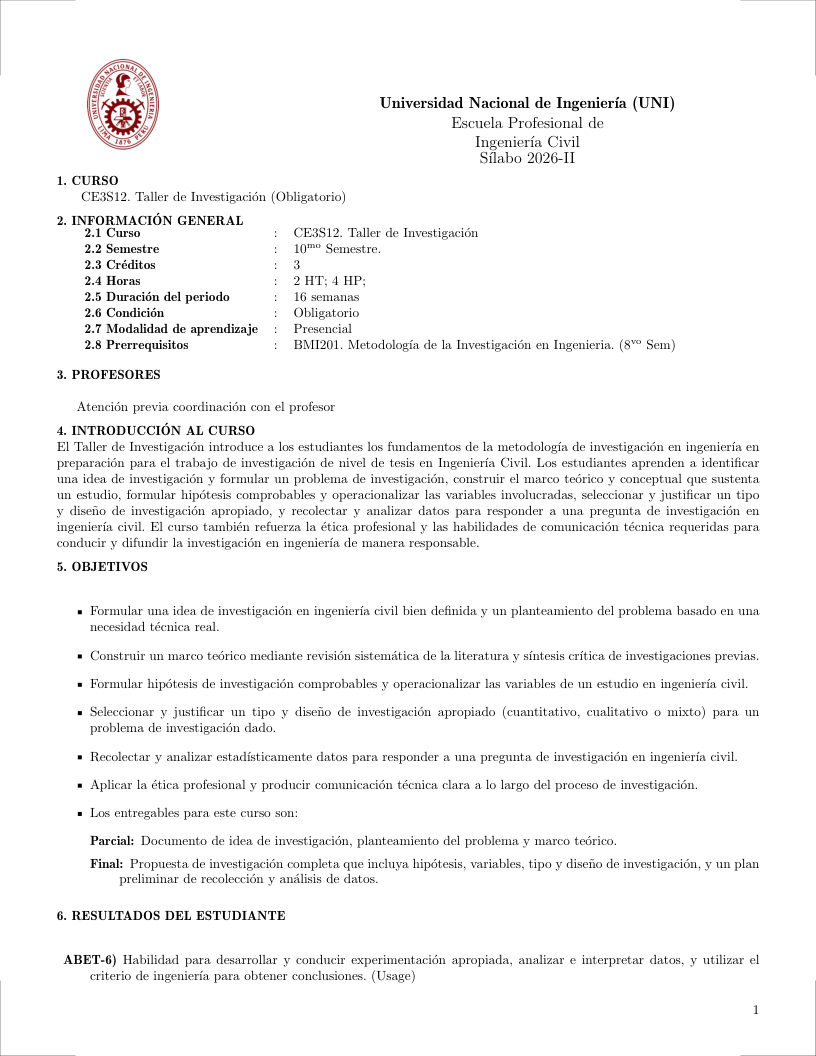
 Español (Latinoamérica)
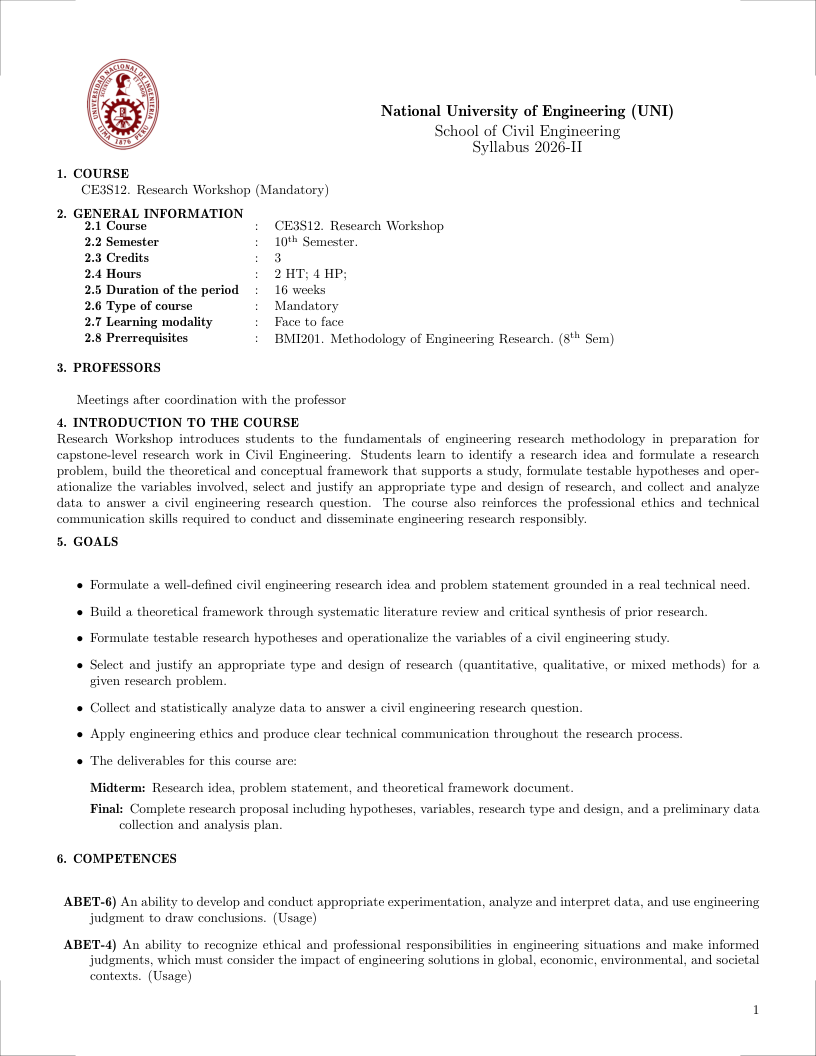 English
 - Prerrequisites:
- BMI201 Methodology of Engineering Research (8th Sem)
7.75.1. Justification ↑ Back to top
Research Workshop introduces students to the fundamentals of engineering research methodology in preparation for capstone-level research work in Civil Engineering. Students learn to identify a research idea and formulate a research problem, build the theoretical and conceptual framework that supports a study, formulate testable hypotheses and operationalize the variables involved, select and justify an appropriate type and design of research, and collect and analyze data to answer a civil engineering research question. The course also reinforces the professional ethics and technical communication skills required to conduct and disseminate engineering research responsibly.
7.75.2. Generales Goals ↑ Back to top
- Formulate a well-defined civil engineering research idea and problem statement grounded in a real technical need.
- Build a theoretical framework through systematic literature review and critical synthesis of prior research.
- Formulate testable research hypotheses and operationalize the variables of a civil engineering study.
- Select and justify an appropriate type and design of research (quantitative, qualitative, or mixed methods) for a given research problem.
- Collect and statistically analyze data to answer a civil engineering research question.
- Apply engineering ethics and produce clear technical communication throughout the research process.
- The deliverables for this course are:
- [Midterm:] Research idea, problem statement, and theoretical framework document.
- [Final:] Complete research proposal including hypotheses, variables, research type and design, and a preliminary data collection and analysis plan.
7.75.3. Contribution to Outcomes ↑ Back to top
- ABET-6) An ability to develop and conduct appropriate experimentation, analyze and interpret data, and use engineering judgment to draw conclusions. (Usage)
- ABET-4) An ability to recognize ethical and professional responsibilities in engineering situations and make informed judgments, which must consider the impact of engineering solutions in global, economic, environmental, and societal contexts. (Usage)
- ABET-3) An ability to communicate effectively with a range of audiences. (Usage)
7.75.4. Content ↑ Back to top
7.75.4.1. Research Design and Methodologies (28 hours) [Skills ABET-6] ↑ Back to top
Bibliography: (Creswell, 2018; Leedy and Ormrod, 2019b)
Topics
- Formulating research questions in architecture: descriptive, relational, causal; turning design problems into researchable questions
- Choosing a research methodology: quantitative (hypothesis testing, statistical), qualitative (interpretive, case study), mixed methods,
- Validity and reliability in architectural research: internal validity, external validity (generalizability), construct validity,
- Research ethics in architectural research: informed consent, privacy (anonymization of building users), institutional review board (IRB) protocols,
- Mixed methods research: sequential (qualitative then quantitative) and concurrent designs; integrating qualitative findings (user interviews) with quantitative data (occupancy
Learning Outcomes
- Describe the main research methodologies in architecture - quantitative, qualitative, mixed methods, practice-based - and explain their appropriate applications [Familiarity]
- Develop a research design for an architectural inquiry, including research question, literature review, methodology selection, data collection protocol, and analysis plan [Usage]
- Evaluate the research design of a published architectural study for validity, reliability, and ethical soundness, identifying methodological strengths and weaknesses [Assessment]
7.75.4.2. Theoretical Framework and Literature Review (16 hours) [Skills ABET-6] ↑ Back to top
Bibliography: (Booth et al., 2016a; Creswell, 2018)
Topics
- Systematic search of scientific and technical literature: specialized databases (Scopus, Web of Science, ASCE Library), keywords, and Boolean operators
- Critical reading and synthesis of scientific articles, technical standards, and prior research reports
- Building the conceptual and theoretical framework: defining key concepts, relationships between variables, and reference theoretical models
- Identifying knowledge gaps (research gap) and justifying the originality of the proposed contribution
- Bibliographic reference management and citation styles (APA, IEEE) using tools such as Zotero or Mendeley
Learning Outcomes
- Explain the structure and purpose of a theoretical framework within a civil engineering research project [Familiarity]
- Conduct a systematic search of scientific and technical literature on a chosen research topic using specialized databases [Usage]
- Synthesize the state of the art of a research topic into a coherent theoretical framework that identifies a knowledge gap [Assessment]
7.75.4.3. Research Hypotheses and Variables (16 hours) [Skills ABET-6] ↑ Back to top
Bibliography: (Montgomery and Runger, 2018; Kumar, 2019)
Topics
- Types of hypotheses: null, alternative, directional, and non-directional, and their relationship to research questions
- Classification of variables: independent, dependent, control, and confounding
- Operationalizing variables: defining measurable indicators and measurement scales (nominal, ordinal, interval, ratio)
- Relationship between hypotheses, variables, and statistical significance tests: significance level, Type I and Type II error
- Graphical representation of the relationship between variables through conceptual or operational models
Learning Outcomes
- Distinguish between null and alternative hypotheses, and between independent, dependent, and control variables, in a civil engineering research problem [Familiarity]
- Formulate a testable research hypothesis and operationalize its variables for a specific problem in the chosen specialization area [Usage]
- Evaluate the consistency between the theoretical framework, the stated hypothesis, and the proposed data-collection design [Assessment]
7.75.4.4. Quantitative Methods in Architectural Research (12 hours) [Skills ABET-6] ↑ Back to top
Bibliography: (Montgomery and Runger, 2018; Creswell, 2018)
Topics
- Survey design for architectural research: sampling methods (probability, convenience), questionnaire design (Likert scales, semantic differential), response rate optimization,
- Experimental designs: true experiments (random assignment, control group), quasi-experiments (non-randomized, pre-post, time series),
- Descriptive statistics: measures of central tendency (mean, median, mode), dispersion (standard deviation, range, interquartile range),
- Inferential statistics: hypothesis testing (t-test, ANOVA, chi-square), correlation and regression (linear, multiple), and interpretation of p-values
- Instrumentation for quantitative data collection: environmental sensors (temperature, light, \(CO_{2}\)), occupancy counters, objective performance measures (task completion time
Learning Outcomes
- Describe the main quantitative methods in architectural research - surveys, experiments, quasi-experiments - [Familiarity]
- Design a survey or experiment to test a hypothesis about the effect of a design variable (lighting, color, layout) on user satisfaction, task performance, or behavior [Usage]
- Evaluate a quantitative architectural study for sampling validity, statistical analysis appropriateness, and correct interpretation of p-values and effect sizes [Assessment]
7.75.4.5. Engineering Ethics and Professional Responsibility (4 hours) [Skills ABET-4] ↑ Back to top
Bibliography: (Harris et al., 2013; Fleddermann, 2020)
Topics
- Ethical theories: utilitarianism, duty ethics, virtue ethics
- Professional codes of conduct (e.g., ASCE, NSPE) and their fundamental canons
- Engineer's paramount responsibility to public safety, health, and welfare
- Ethical dilemmas in practice: conflicts of interest, whistleblowing, gift-giving
- Ethical decision-making frameworks and case study analysis
- Global engineering ethics and cross-cultural challenges
- Ethical obligations for sustainable development and environmental stewardship
- Ethical implications of emerging technologies (AI, automation, data privacy)
- Ethical conduct in dispute resolution and litigation
Learning Outcomes
- Explain the primary tenets of the engineer's code of ethics [Familiarity]
- Apply an ethical decision-making framework to a hypothetical engineering scenario [Assessment]
- Identify conflicts of interest and other common ethical pitfalls in project work [Familiarity]
- Analyze a historical engineering failure case from an ethical perspective [Assessment]
- Evaluate the ethical dimensions of a project with significant social or environmental impacts in a different cultural context [Assessment]
- Articulate the ethical argument for incorporating sustainability into all engineering work [Familiarity]
- Discuss the ethical responsibilities related to data collection and use in smart infrastructure projects [Assessment]
- Describe the role of ethics in alternative dispute resolution processes [Familiarity]
7.75.4.6. Written and Technical Communication (3 hours) [Skills ABET-3] ↑ Back to top
Bibliography: (Gurak and Lannon, 2013)
Topics
- Audience analysis and adaptation of technical content
- Written communication: technical reports, memos, emails, and specifications
- Visual communication: graphs, charts, diagrams, and effective slide design
Learning Outcomes
- Write a clear, concise, and well-organized technical report on a laboratory experiment or design project [Usage]
- Create effective graphs and diagrams to present engineering data [Assessment]
7.75.4.7. Oral Presentation and Professional Communication (3 hours) [Skills ABET-3] ↑ Back to top
Bibliography: (Gurak and Lannon, 2013)
Topics
- Oral presentations: structure, delivery techniques, and handling Q&A
- Proposal writing: technical approach, management plan, and cost estimating
- Executive summaries and communicating with non-technical stakeholders
Learning Outcomes
- Deliver a structured oral presentation on a technical topic using appropriate visual aids [Usage]
- Outline the key sections of a competitive engineering proposal [Familiarity]
- Develop an executive summary that conveys key project findings to a senior management audience [Usage]
7.75.4.8. Digital and Collaborative Communication (2 hours) [Skills ABET-3] ↑ Back to top
Bibliography: (Gurak and Lannon, 2013)
Topics
- Collaborative writing and document management in team settings
- Digital communication: web content, social media guidelines for engineers
- Persuasive communication and negotiation techniques
Learning Outcomes
- Manage a collaborative document (e.g., on Google Docs or SharePoint) for a team project [Assessment]
- Explain the professional risks and opportunities associated with engineers using social media [Familiarity]
- Employ basic negotiation tactics to resolve a simulated conflict over project scope [Usage]
7.75.5. Bibliography ↑ Back to top
Creswell, J. W. (2018). Research Design: Qualitative, Quantitative, and Mixed Methods Approaches. SAGE Publications, 5th edition.
Leedy, P. D. and Ormrod, J. E. (2019b). Practical Research: Planning and Design. Pearson, 12th edition.
Booth, W. C., Colomb, G. G., and Williams, J. M. (2016a). The Craft of Research. University of Chicago Press, 4th edition.
Montgomery, D. C. and Runger, G. C. (2018). Applied Statistics and Probability for Engineers. Wiley, 7th edition.
Kumar, R. (2019). Research Methodology: A Step-by-Step Guide for Beginners. SAGE Publications, 5th edition.
Harris, C. E., Pritchard, M. S., and Rabins, M. J. (2013). Engineering Ethics: Concepts and Cases. Cengage Learning, 5th edition.
Fleddermann, C. B. (2020). Engineering Ethics. Pearson, 5th edition.
Gurak, L. J. and Lannon, J. M. (2013). A Concise Guide to Technical Communication. Pearson, 4th edition.