- ES Español (Latinoamérica)

- EN English

7.66. Law and Legislation (Mandatory)
- Semester: 9th Sem. Credits: 4
- Hour of this course: Theory: 1 hours; Practice: 1 hours;
- Syllabus:
- htmlonly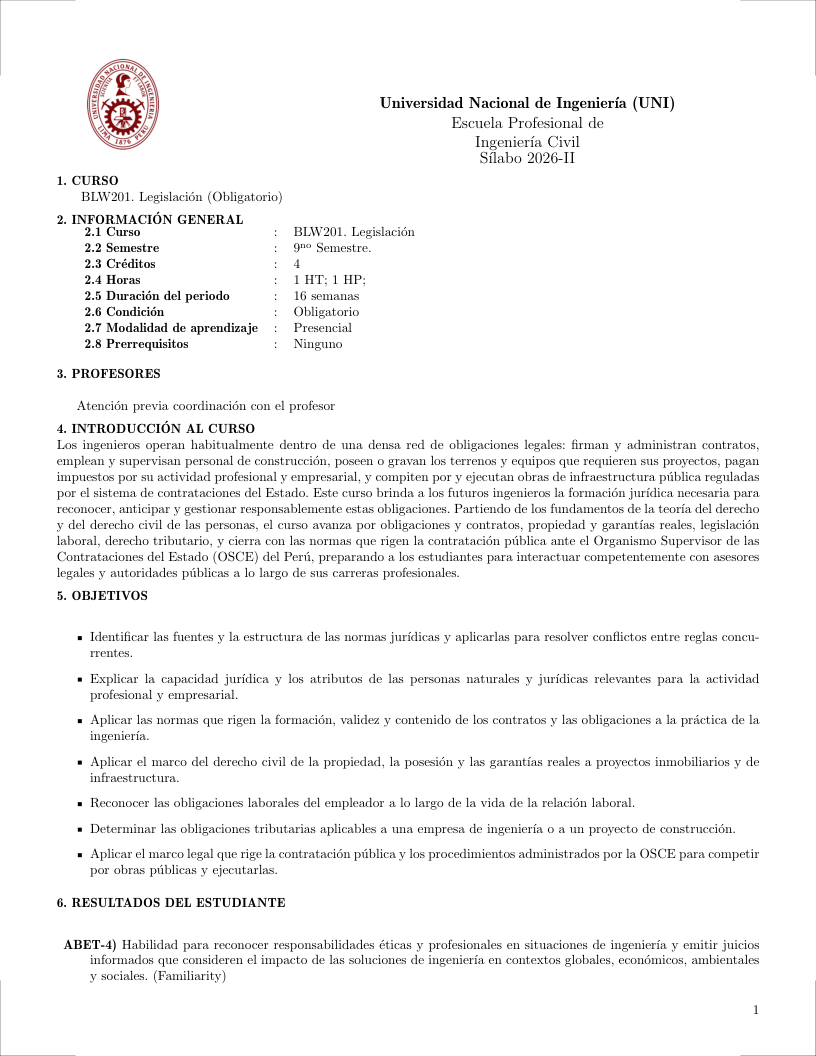
 Español (Latinoamérica)
 English
 - Prerrequisites: None
7.66.1. Justification ↑ Back to top
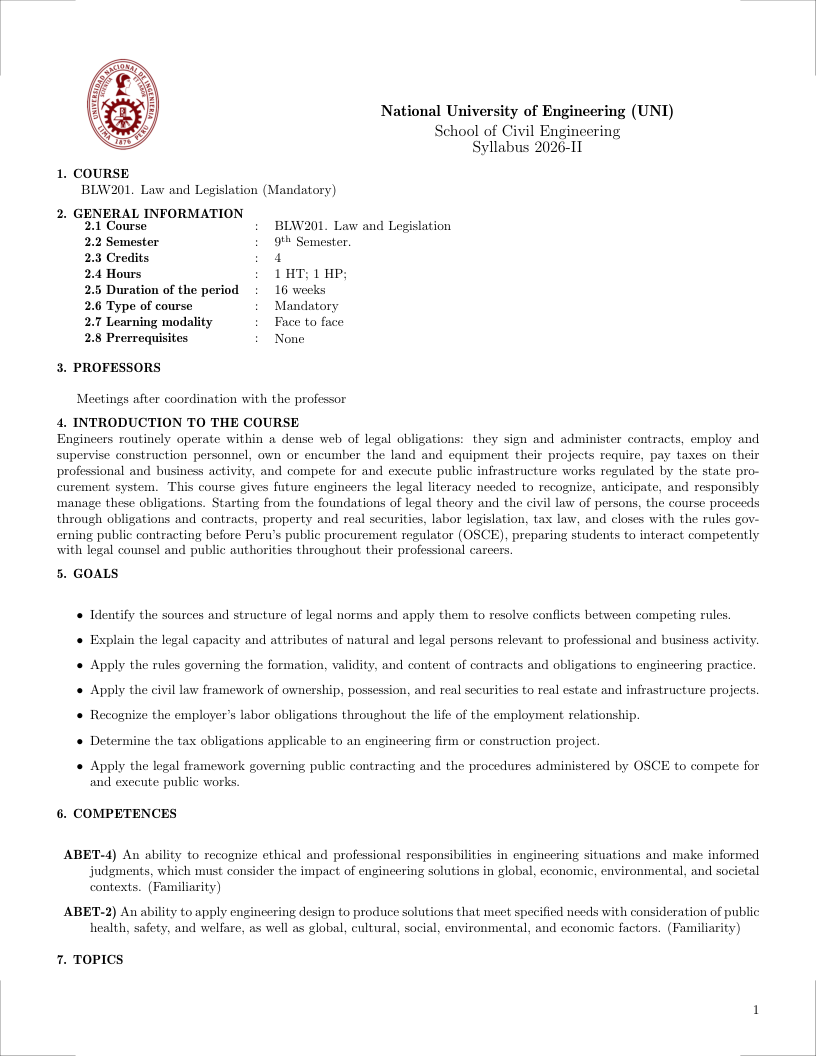
Engineers routinely operate within a dense web of legal obligations: they sign and administer contracts, employ and supervise construction personnel, own or encumber the land and equipment their projects require, pay taxes on their professional and business activity, and compete for and execute public infrastructure works regulated by the state procurement system. This course gives future engineers the legal literacy needed to recognize, anticipate, and responsibly manage these obligations. Starting from the foundations of legal theory and the civil law of persons, the course proceeds through obligations and contracts, property and real securities, labor legislation, tax law, and closes with the rules governing public contracting before Peru's public procurement regulator (OSCE), preparing students to interact competently with legal counsel and public authorities throughout their professional careers.
7.66.2. Generales Goals ↑ Back to top
- Identify the sources and structure of legal norms and apply them to resolve conflicts between competing rules.
- Explain the legal capacity and attributes of natural and legal persons relevant to professional and business activity.
- Apply the rules governing the formation, validity, and content of contracts and obligations to engineering practice.
- Apply the civil law framework of ownership, possession, and real securities to real estate and infrastructure projects.
- Recognize the employer's labor obligations throughout the life of the employment relationship.
- Determine the tax obligations applicable to an engineering firm or construction project.
- Apply the legal framework governing public contracting and the procedures administered by OSCE to compete for and execute public works.
7.66.3. Contribution to Outcomes ↑ Back to top
- ABET-4) An ability to recognize ethical and professional responsibilities in engineering situations and make informed judgments, which must consider the impact of engineering solutions in global, economic, environmental, and societal contexts. (Familiarity)
- ABET-2) An ability to apply engineering design to produce solutions that meet specified needs with consideration of public health, safety, and welfare, as well as global, cultural, social, environmental, and economic factors. (Familiarity)
7.66.4. Content ↑ Back to top
7.66.4.1. Sources of Law (2 hours) [Skills ABET-4] ↑ Back to top
Bibliography: (Correa, 2009; Vásquez, 2014)
Topics
- Formal sources: constitution, legislation, delegated legislation, international treaties, custom, and general principles of law
- Kelsenian hierarchy of norms; constitutional supremacy; conflicts between norms; derogation and abrogation
- Role of case law and judicial precedent in civil law systems vs. stare decisis in common law; doctrine as a persuasive source
- Soft law instruments: codes of conduct, guidelines, recommendations, and their legal significance
Learning Outcomes
- Identify the formal sources of law applicable in a given legal system and explain their hierarchical relationship [Familiarity]
- Apply the hierarchy of norms to resolve conflicts between competing legal rules of different rank [Usage]
- Compare the role of judicial decisions as a source of law in civil law and common law systems [Assessment]
7.66.4.2. Structure and Validity of Legal Norms (2 hours) [Skills ABET-4] ↑ Back to top
Bibliography: (Correa, 2009; Vásquez, 2014)
Topics
- Hart's distinction between primary duty-imposing rules and secondary power-conferring rules (recognition, change, adjudication)
- Dworkin's rules vs. principles distinction; weight and balance in hard cases; integrity in law
- Formal validity (enacted by competent authority), substantive validity (constitutional conformity), and sociological efficacy
- Deontic operators: obligation, permission, prohibition; normative conflicts and their resolution (lex superior, lex posterior, lex specialis)
Learning Outcomes
- Describe the structural difference between legal rules and legal principles and explain how each operates in legal reasoning [Familiarity]
- Distinguish valid from efficacious norms and apply criteria of formal and substantive validity to a given legal provision [Usage]
- Resolve normative conflicts using lex superior, lex posterior, and lex specialis criteria and justify the chosen solution [Assessment]
7.66.4.3. Natural Persons: Capacity and Civil Status (2 hours) [Skills ABET-4] ↑ Back to top
Bibliography: (Sessarego, 2015)
Topics
- Beginning of personhood: live birth and the protection of the conceived (nasciturus); end of personhood: death, presumption of death, and declaration of absence
- Capacity to enjoy rights (capacidad de goce) vs. capacity to exercise them (capacidad de ejercicio); restrictions affecting minors and judicially interdicted persons; emancipation
- Name, domicile, and civil registry (Registro Civil) as attributes of the person; acts subject to mandatory registration (birth, marriage, death)
- Rights of the personality: right to life, physical integrity, honor, image, and privacy; civil remedies for their infringement
Learning Outcomes
- Describe the requirements for the beginning and end of legal personhood and distinguish capacity to enjoy rights from capacity to exercise them [Familiarity]
- Apply the rules on capacity to determine whether a minor or a judicially interdicted person may validly perform a given legal act [Usage]
- Analyze a dispute over a person's civil status or personal rights and assess the civil remedies available [Assessment]
7.66.4.4. Legal Persons: Formation, Attributes, and Extinction (2 hours) [Skills ABET-4] ↑ Back to top
Bibliography: (Sessarego, 2015)
Topics
- Legal person defined and distinguished from natural persons; main types: associations, foundations, committees, and corporations of private and public law
- Constitutive act and registration; attributes of the legal person: name, domicile, nationality, and patrimony autonomous from that of its members
- Legal representation through organs and representatives; capacity limited by corporate purpose (objeto social); liability of representatives for acts beyond that purpose
- Causes of dissolution, the liquidation process, and extinction of legal personality; protection of creditors during liquidation
Learning Outcomes
- Identify the main types of legal persons recognized by civil law and describe the attributes that distinguish them from natural persons [Familiarity]
- Apply the rules on legal representation and corporate purpose to determine whether an act performed by a representative binds the legal person [Usage]
- Evaluate the dissolution and liquidation process of a legal person and assess the protections available to its creditors [Assessment]
7.66.4.5. Fundamentals of Obligations (2 hours) [Skills ABET-2,ABET-4] ↑ Back to top
Bibliography: (Parodi and Freyre, 2008)
Topics
- Obligation defined: legal bond (vinculum iuris), debtor and creditor, object (conduct or performance), and the patrimonial interest of the creditor
- Classification by object (to give, to do, not to do), by plurality (joint, several, solidary), and by condition (pure, conditional, modal, term)
- Modes of extinguishment: payment/performance, novation, compensation (set-off), confusion, remission, impossibility, and prescription
- Plurality of parties: joint obligations (mancomunadas) vs. solidary obligations (solidarias); active and passive solidarity
Learning Outcomes
- Describe the essential elements of a civil law obligation and classify a given obligation by its object and structure [Familiarity]
- Apply the rules on modes of extinguishment to determine whether a specific obligation has been discharged [Usage]
- Analyze a complex obligational relationship involving solidarity and indivisibility and determine each party's rights and duties [Assessment]
7.66.4.6. Contract Formation and Validity (2 hours) [Skills ABET-2,ABET-4] ↑ Back to top
Bibliography: (de la Puente y Lavalle, 2001)
Topics
- Essential elements: offer and acceptance, free and informed consent, legal capacity of the parties, licit and possible object, and lawful cause
- Vices of consent: error (substance and person), fraud (dolo), duress (intimidación), and unconscionable advantage (lesión); effect on contract validity
- Absolute nullity (nulidad absoluta): grounds and effects; relative nullity/voidability (anulabilidad): grounds, confirmation, and the action for annulment
- Electronic contracts: formation via digital platforms, click-wrap and browse-wrap agreements, e-signature validity under UNCITRAL Model Law
Learning Outcomes
- Explain the essential elements required for a valid contract in civil law and identify the consequences when each element is absent or defective [Familiarity]
- Assess whether a contract is void or voidable given a set of facts involving defective consent or lack of capacity [Usage]
- Evaluate the policy rationale for distinguishing absolute from relative nullity and analyze its practical consequences for third-party rights [Assessment]
7.66.4.7. Concept and Content of Ownership (2 hours) [Skills ABET-2,ABET-4] ↑ Back to top
Bibliography: (Valdez and Arana, 2017)
Topics
- Ownership as the fullest real right: ius utendi, fruendi, abutendi; absolute, exclusive, and perpetual character; object of ownership (corporeal and incorporeal things)
- Constitutional limits on ownership: social and ecological function; expropriation for public interest (requirements, indemnification, and procedure)
- Neighbourhood relations: restrictions on immissions, right of passage, boundaries and encroachments; abuse of right (abuso del derecho) doctrine
- Indigenous communal property and collective territorial rights under ILO Convention 169: inalienability of ancestral lands, prior consultation,
Learning Outcomes
- Describe the attributes of ownership in civil law and explain the constitutional and statutory limitations on the exercise of property rights [Familiarity]
- Apply the rules on neighbourhood law and abuse of right to resolve a dispute between adjoining landowners [Usage]
- Evaluate the tension between the absolute character of ownership and the social function doctrine as expressed in Latin American constitutional law [Assessment]
7.66.4.8. Limited Real Rights: Usufruct, Easements, and Securities (2 hours) [Skills ABET-2,ABET-4] ↑ Back to top
Bibliography: (Valdez and Arana, 2017)
Topics
- Usufruct: content, duration, obligations of the usufructuary (inventory, bond, conservation), and modes of extinction; use and habitation as lesser personal servitudes
- Predial servitudes (servidumbres): positive and negative; apparent and non-apparent; continuous and discontinuous; creation by title, prescription, and destination
- Mortgage (hipoteca): accessory character, registration requirement, enforcement by judicial sale; pledge (prenda): possession requirement, non-possessory pledge; antichresis
- Fiduciary transfer (fideicomiso / patrimonio autónomo): structure as a separate estate, uses in project finance and estate planning, obligations of the trustee,
Learning Outcomes
- Describe the main categories of limited real rights and explain how each affects the owner's bundle of rights [Familiarity]
- Distinguish usufruct from a lease and predial easements from personal servitudes, identifying the legal consequences of each classification [Usage]
- Evaluate the adequacy of a mortgage as a security device compared to a pledge in a commercial financing transaction [Assessment]
7.66.4.9. The Individual Employment Relationship (2 hours) [Skills ABET-2,ABET-4] ↑ Back to top
Bibliography: (Mujica, 2009)
Topics
- Employment contract defined: subordination (dependencia), personal service, and remuneration; indicators of subordination: schedule, instructions, tools, exclusivity
- Types: indefinite, fixed-term, part-time, seasonal, apprenticeship, telework; formal requirements and written contract obligation; probationary period
- Sham contracting (desnaturalización): conversion of fixed-term to indefinite; triangular relationships: labor supply (tercerización/outsourcing), employer's joint
- Non-standard forms of employment: part-time, fixed-term, temporary agency work, and telework/remote work - applicable legal frameworks, rights, and employer obligations
Learning Outcomes
- Define the individual employment contract and identify the element of subordination that distinguishes it from an independent contractor relationship [Familiarity]
- Identify the indicators of a sham contracting arrangement and determine whether a worker is entitled to the protections of employment law [Usage]
- Analyze the legal consequences of triangular labor relationships for the principal employer's liability toward outsourced workers [Assessment]
7.66.4.10. Termination of Employment (2 hours) [Skills ABET-2,ABET-4] ↑ Back to top
Bibliography: (Mujica, 2009)
Topics
- Just cause for dismissal: types (serious misconduct, poor performance, objective economic causes); procedural requirements: written notice, prior hearing
- Unfair (arbitrary) dismissal: reinstatement vs. compensation options; special protection against dismissal: pregnant workers, union representatives, disabled persons
- Severance pay (indemnización por años de servicios) and CTS compensation fund (compensación por tiempo de servicios): calculation, payment, and forfeiture conditions
- Individual dismissal: causas justas de despido, procedural requirements (prior written notice and hearing), severance pay calculation,
Learning Outcomes
- Explain the grounds for justified dismissal and the procedural steps an employer must follow before terminating an employment contract [Familiarity]
- Apply severance pay rules to calculate the total liquidation benefit owed to a worker dismissed without just cause [Usage]
- Assess the adequacy of special dismissal protection for vulnerable categories of workers and evaluate its effect on employer flexibility [Assessment]
7.66.4.11. Fundamentals of Taxation (4 hours) [Skills ABET-2,ABET-4] ↑ Back to top
Bibliography: (Cucci, 2015)
Topics
- Tax obligation (obligación tributaria): taxable event (hecho imponible), taxpayer, tax base, and tax rate; birth, determination, and extinction of the obligation
- Classification of taxes: impuestos, tasas, and contribuciones; income tax and value-added tax (IGV/VAT); municipal taxes relevant to construction and real estate (predial, alcabala)
- Powers of the tax administration: assessment (fiscalización) and collection; taxpayer obligations: filing, payment, and bookkeeping; withholding obligations applicable to contractors
- Tax infractions and penalties; administrative tax procedure and appeals (reclamación, apelación) before the tax administration and tax courts
Learning Outcomes
- Describe the essential elements of the tax obligation and classify the main types of taxes applicable to a professional or business activity [Familiarity]
- Apply income, value-added, and municipal tax rules to determine the tax obligations of an engineering firm or construction project [Usage]
- Analyze a tax dispute scenario and assess the administrative remedies available against a tax administration's determination [Assessment]
7.66.4.12. Public Contracting and Concessions (6 hours) [Skills ABET-2,ABET-4] ↑ Back to top
Bibliography: (Linares, 2019; Ordóñez, 2016)
Topics
- Principles of public procurement: publicity, competition, equal treatment, and transparency; award procedures: open tender, restricted tender, direct contracting
- Exorbitant clauses of public contracts: right to modify (ius variandi), right to terminate for public interest, direction and control powers; maintenance of financial equilibrium
- Concession contracts: public service concession, infrastructure concession; public-private partnerships (APP): risk allocation, investment recovery, and regulatory framework
- Claims and disputes in public contracts: contractual claims mechanism, dispute boards, and administrative arbitration as alternative to judicial review of public contract conflicts
Learning Outcomes
- Describe the main public procurement procedures and identify the legal principles that govern the award of public contracts [Familiarity]
- Apply the rules on exorbitant clauses to assess the state's right to modify a public contract and the contractor's right to financial rebalancing [Usage]
- Compare the legal regime of public contracts with private law contracts, identifying the special rules and exorbitant clauses that characterize the public contract [Assessment]
7.66.5. Bibliography ↑ Back to top
Correa, M. R. (2009). El Sistema Jurídico: Introducción al Derecho. Fondo Editorial de la Pontificia Universidad Católica del Perú, 10th edition.
Vásquez, A. T. (2014). Introducción al Derecho: Teoría General del Derecho. Instituto Pacífico, 4th edition.
Sessarego, C. F. (2015). Derecho de las Personas: Exposición de Motivos y Comentarios al Libro Primero del Código Civil Peruano. Editorial Motivensa, 11th edition.
Parodi, F. O. and Freyre, M. C. (2008). Compendio de Derecho de las Obligaciones. Palestra Editores.
de la Puente y Lavalle, M. (2001). El Contrato en General: Comentarios a la Sección Primera del Libro VII del Código Civil. Palestra Editores.
Valdez, J. A. and Arana, F. A. (2017). Derechos Reales. Fondo Editorial de la Pontificia Universidad Católica del Perú.
Mujica, J. N. (2009). Introducción al Derecho del Trabajo. Fondo Editorial de la Pontificia Universidad Católica del Perú, 2nd edition.
Cucci, J. B. (2015). Fundamentos de Derecho Tributario. Jurista Editores, 6th edition.
Linares, A. R. (2019). Contrataciones y Adquisiciones del Estado y Normas de Control: Análisis y Comentarios. Gaceta Jurídica, 16th edition.
Ordóñez, J. D. (2016). El Régimen de la Contratación Estatal en el Perú. Palestra Editores.