- ES Español (Latinoamérica)

- EN English

7.12. Calculus II (Mandatory)
- Semester: 2nd Sem. Credits: 5
- Hour of this course: Theory: 3 hours; Practice: 4 hours;
- Syllabus:
- htmlonly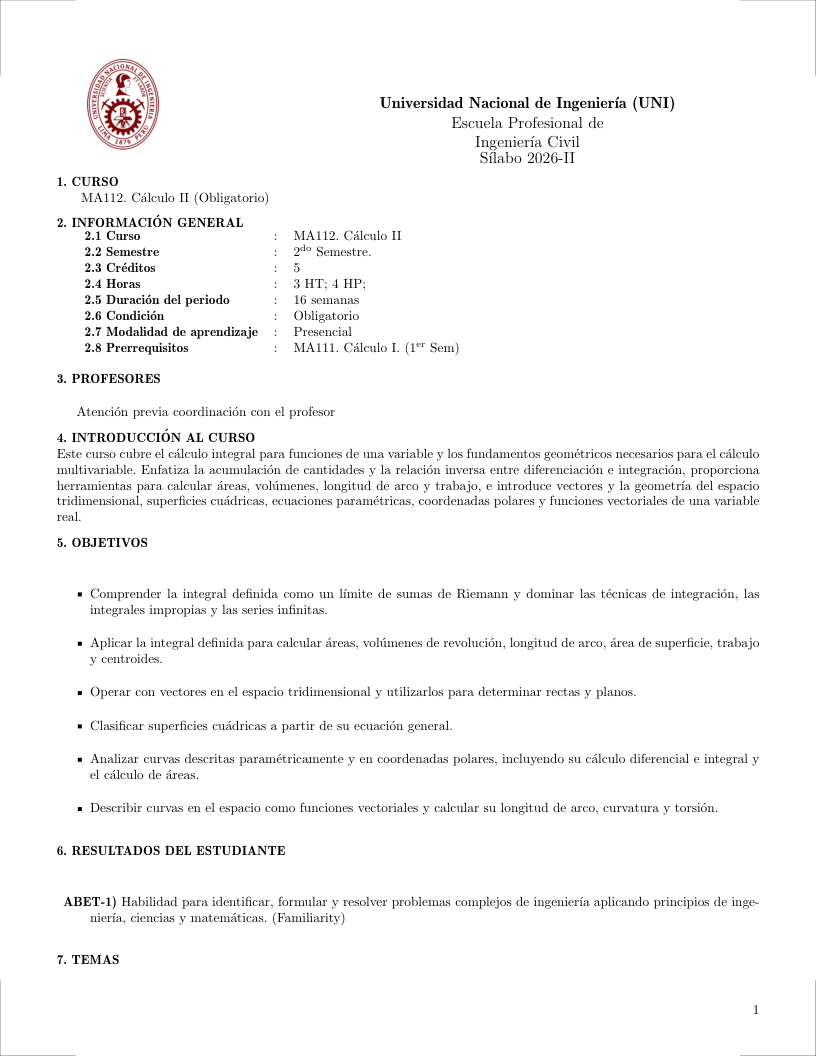
 Español (Latinoamérica)
 English
 - Prerrequisites:
- MA111 Calculus I (1st Sem)
7.12.1. Justification ↑ Back to top
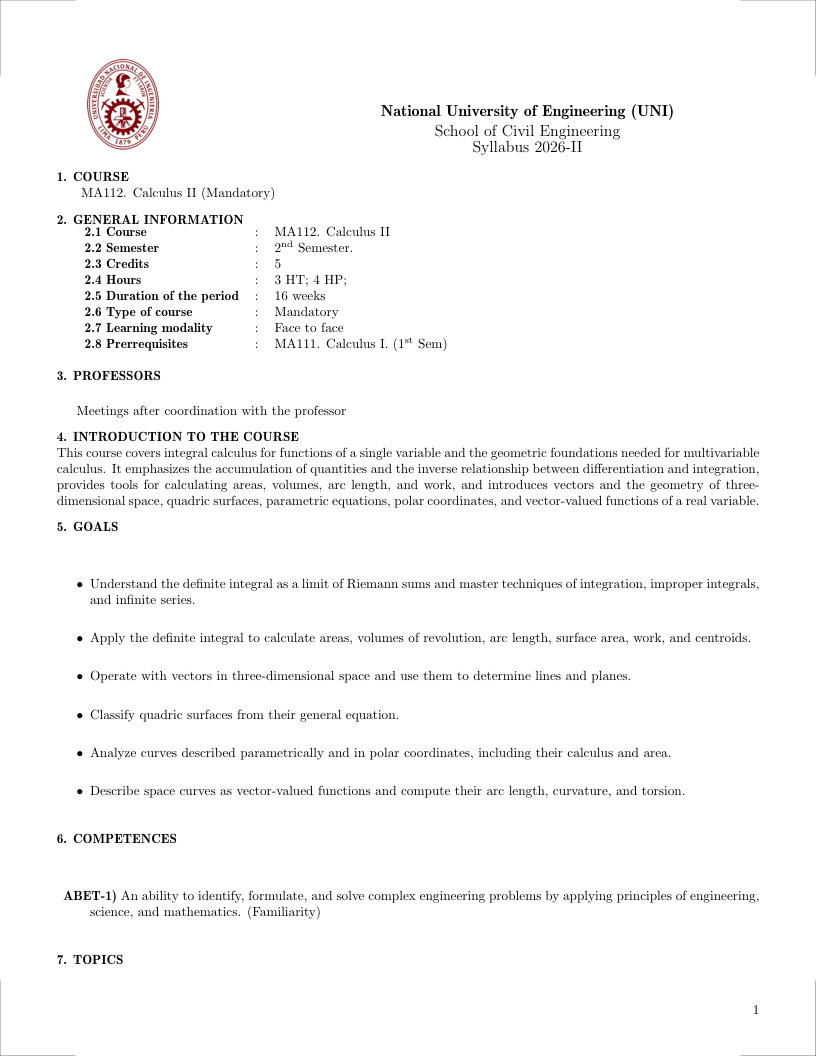
This course covers integral calculus for functions of a single variable and the geometric foundations needed for multivariable calculus. It emphasizes the accumulation of quantities and the inverse relationship between differentiation and integration, provides tools for calculating areas, volumes, arc length, and work, and introduces vectors and the geometry of three-dimensional space, quadric surfaces, parametric equations, polar coordinates, and vector-valued functions of a real variable.
7.12.2. Generales Goals ↑ Back to top
- Understand the definite integral as a limit of Riemann sums and master techniques of integration, improper integrals, and infinite series.
- Apply the definite integral to calculate areas, volumes of revolution, arc length, surface area, work, and centroids.
- Operate with vectors in three-dimensional space and use them to determine lines and planes.
- Classify quadric surfaces from their general equation.
- Analyze curves described parametrically and in polar coordinates, including their calculus and area.
- Describe space curves as vector-valued functions and compute their arc length, curvature, and torsion.
7.12.3. Contribution to Outcomes ↑ Back to top
- ABET-1) An ability to identify, formulate, and solve complex engineering problems by applying principles of engineering, science, and mathematics. (Familiarity)
7.12.4. Content ↑ Back to top
7.12.4.1. Integral Calculus (14 hours) [Skills ABET-1] ↑ Back to top
Bibliography: (Stewart, 2016; Larson and Edwards, 2018; Thomas et al., 2014)
Topics
- The Fundamental Theorem of Calculus
- Integration techniques including substitution and parts
- Engineering applications of integration: areas, volumes, centroids, and moments of inertia
Learning Outcomes
- State and explain the Fundamental Theorem of Calculus [Familiarity]
- Calculate definite integrals arising from engineering problems such as work, fluid pressure, and heat transfer [Usage]
7.12.4.2. Improper Integrals (6 hours) [Skills ABET-1] ↑ Back to top
Bibliography: (Stewart, 2016; Larson and Edwards, 2018; Thomas et al., 2014)
Topics
- Improper integrals over unbounded intervals
- Improper integrals of unbounded (discontinuous) integrands
- Convergence criteria and comparison tests for improper integrals
Learning Outcomes
- Determine whether an improper integral arising from an engineering model converges, using comparison and other convergence tests [Assessment]
- Evaluate an improper integral by taking the appropriate limit, when it converges [Usage]
7.12.4.3. Sequences, Series, and Power Series (14 hours) [Skills ABET-1] ↑ Back to top
Bibliography: (Stewart, 2016; Larson and Edwards, 2018; Thomas et al., 2014)
Topics
- Sequences and series: convergence tests (ratio, root, comparison, integral)
- Power series, radius of convergence, and Taylor/Maclaurin series
- Engineering use of Taylor polynomials for linearization and numerical approximation
Learning Outcomes
- Determine convergence of a power series and construct a Taylor series for a standard engineering function [Assessment]
- Apply a Taylor polynomial to approximate or linearize an engineering function [Usage]
7.12.4.4. Applications of the Definite Integral (16 hours) [Skills ABET-1] ↑ Back to top
Bibliography: (Stewart, 2016; Thomas et al., 2014)
Topics
- Area between curves by integrating with respect to \(x\) or \(y\)
- Volume of solids of revolution by the disk and washer method
- Volume of solids of revolution by the cylindrical shell method
- Work via integration (springs, pumping fluids, cables)
- Moments and centroid of a plane region or solid
Learning Outcomes
- Calculate the volume of a solid of revolution using the disk, washer, or cylindrical shell method [Usage]
- Calculate the work done by a variable force using integration [Usage]
7.12.4.5. Vectors and the Geometry of Space (6 hours) [Skills ABET-1] ↑ Back to top
Bibliography: (Stewart, 2016; Larson and Edwards, 2018)
Topics
- Dot and cross products: definition, properties, and geometric interpretation
- Equations of lines and planes in space
Learning Outcomes
- Compute the dot and cross products of vectors to solve engineering force and moment problems [Usage]
- Determine equations of lines and planes in space from the geometric data of an engineering problem [Usage]
7.12.4.6. Quadric Surfaces (6 hours) [Skills ABET-1] ↑ Back to top
Bibliography: (Stewart, 2016; Larson and Edwards, 2018)
Topics
- Classification of quadrics (ellipsoids, paraboloids, hyperboloids) from their general equation
Learning Outcomes
- Classify a quadric surface and identify its geometry for engineering component modeling [Usage]
7.12.4.7. Parametric Equations and Polar Coordinates (12 hours) [Skills ABET-1] ↑ Back to top
Bibliography: (Stewart, 2016; Thomas et al., 2014)
Topics
- Parametric curves and their calculus, applied to trajectories in kinematics
- Polar coordinates and their conversion to Cartesian coordinates
Learning Outcomes
- Calculate the velocity and acceleration of a trajectory described parametrically [Usage]
- Convert between polar and Cartesian coordinates when modeling engineering geometries [Usage]
7.12.4.8. Vector Functions of a Real Variable (10 hours) [Skills ABET-1] ↑ Back to top
Bibliography: (Stewart, 2016; Thomas et al., 2014)
Topics
- Definition, domain, and range of vector functions of a real variable
- Limits, continuity, and derivatives of vector functions
- Arc length and natural parametrization of a curve
- Tangent, normal, and binormal vectors; moving Frenet frame
- Curvature, torsion, and Frenet-Serret formulas
Learning Outcomes
- Identify limits, continuity, and derivatives of vector functions of a real variable [Familiarity]
- Compute tangent, normal, and binormal vectors and reparametrize a curve by arc length [Usage]
- Calculate curvature and torsion using the Frenet-Serret formulas [Assessment]
7.12.5. Bibliography ↑ Back to top
Stewart, J. (2016). Cálculo de una variable: Trascendentes tempranas. Cengage Learning, 8th edition.
Larson, R. and Edwards, B. H. (2018). Cálculo. Cengage Learning, 10th edition.
Thomas, G. B., Weir, M. D., and Hass, J. (2014). Cálculo de una variable. Pearson, 13th edition.