- ES Español (Latinoamérica)

- EN English

7.53. Costs and Budgeting (Mandatory)
- Semester: 9th Sem. Credits: 3
- Hour of this course: Theory: 4 hours; Laboratory: 2 hours;
- Syllabus:
- htmlonly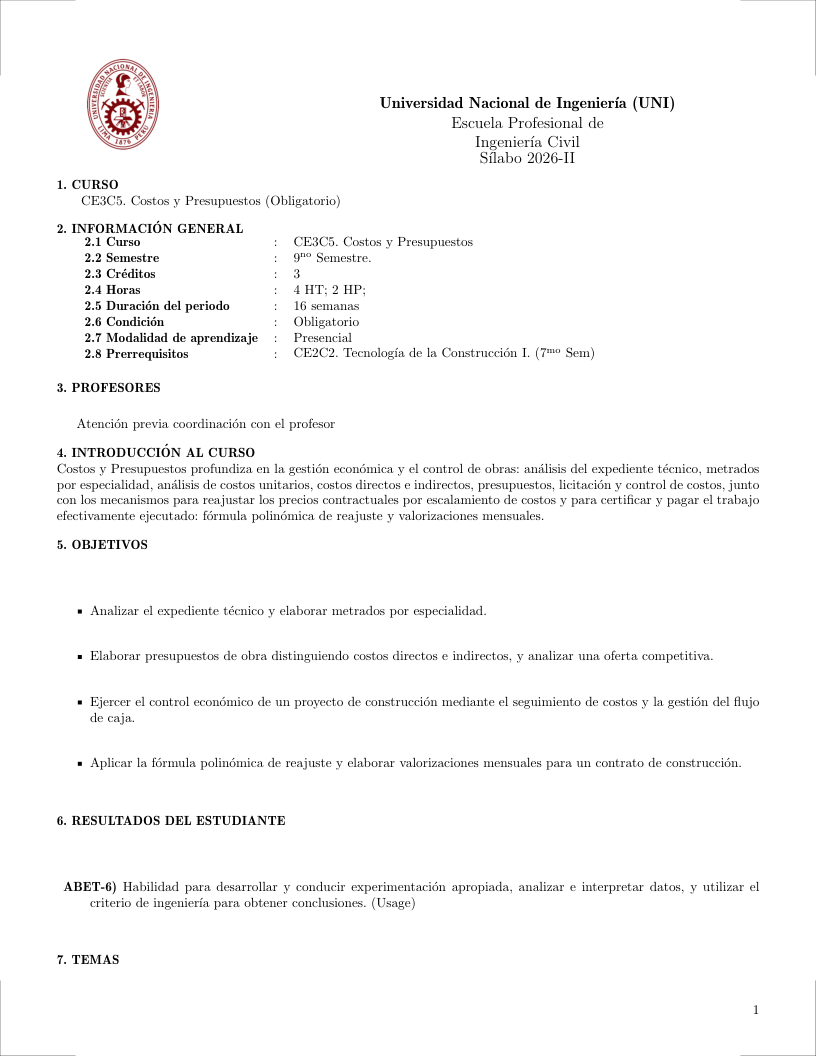
 Español (Latinoamérica)
 English
 - Prerrequisites:
- CE2C2 Construction Technology I (7th Sem)
7.53.1. Justification ↑ Back to top
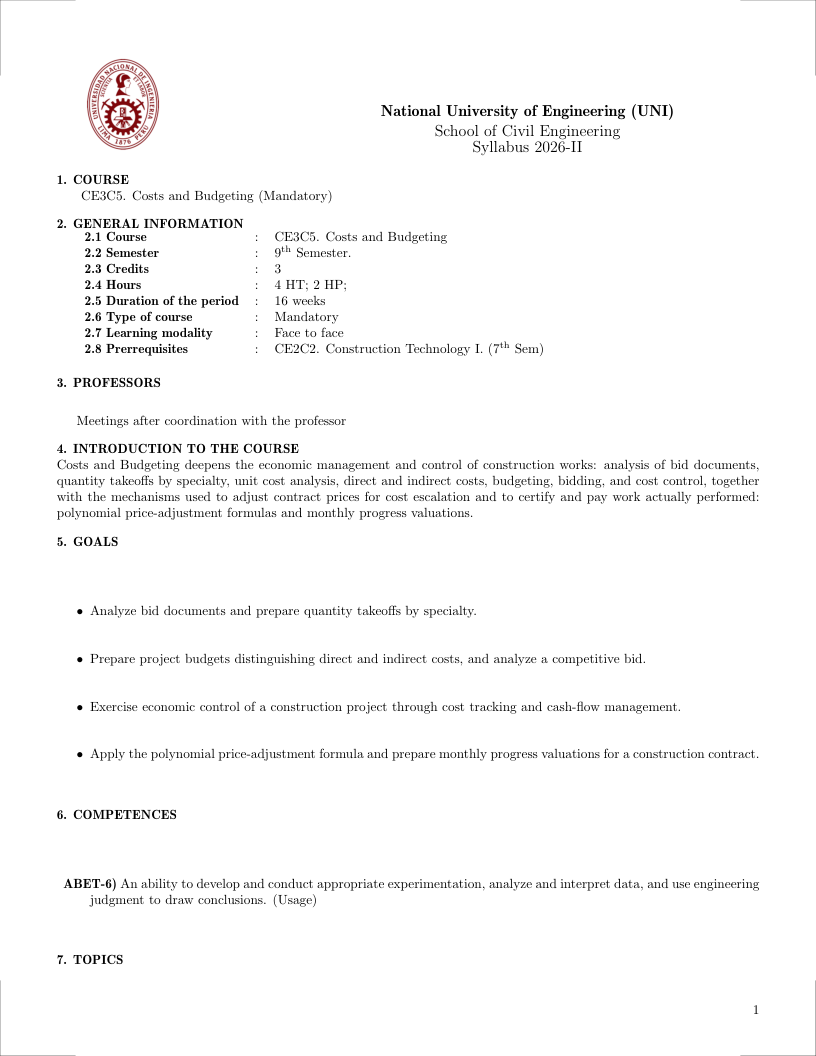
Costs and Budgeting deepens the economic management and control of construction works: analysis of bid documents, quantity takeoffs by specialty, unit cost analysis, direct and indirect costs, budgeting, bidding, and cost control, together with the mechanisms used to adjust contract prices for cost escalation and to certify and pay work actually performed: polynomial price-adjustment formulas and monthly progress valuations.
7.53.2. Generales Goals ↑ Back to top
- Analyze bid documents and prepare quantity takeoffs by specialty.
- Prepare project budgets distinguishing direct and indirect costs, and analyze a competitive bid.
- Exercise economic control of a construction project through cost tracking and cash-flow management.
- Apply the polynomial price-adjustment formula and prepare monthly progress valuations for a construction contract.
7.53.3. Contribution to Outcomes ↑ Back to top
- ABET-6) An ability to develop and conduct appropriate experimentation, analyze and interpret data, and use engineering judgment to draw conclusions. (Usage)
7.53.4. Content ↑ Back to top
7.53.4.1. Construction Cost Estimating and Quantification (54 hours) [Skills ABET-6] ↑ Back to top
Bibliography: (Peurifoy et al., 2018; de la Construcción (CAPECO), 2020)
Topics
- Estimating types: conceptual, preliminary, and detailed
- Quantity takeoff methods from drawings and digital models
- Pricing components: labor, material, equipment, and overhead
- Parametric and probabilistic estimating techniques
- Life-cycle cost analysis for building systems
Learning Outcomes
- Perform a detailed quantity takeoff for concrete, formwork, and reinforcement from construction drawings [Usage]
- Prepare a unit price estimate for a defined work package [Assessment]
- Apply parametric models to develop a conceptual cost estimate for a building [Assessment]
- Conduct a life-cycle cost analysis to compare two alternative building envelope systems [Usage]
7.53.4.2. Construction Budgeting, Bidding, and Financial Control (44 hours) [Skills ABET-6] ↑ Back to top
Bibliography: (Peurifoy et al., 2018; de la Construcción (CAPECO), 2020)
Topics
- Bid preparation, submission, and analysis processes
- Cash flow forecasting and management for construction projects
- Value engineering and constructability analysis
- Financial statements and performance metrics for construction firms
Learning Outcomes
- Explain the components and typical markup structure of a competitive bid [Familiarity]
- Develop a monthly cash flow forecast for a construction project [Usage]
- Perform a value engineering workshop to identify cost-saving alternatives without sacrificing function [Assessment]
- Interpret key financial ratios for assessing a construction company's health [Familiarity]
7.53.4.3. Price Adjustment and Progress Valuations (32 hours) [Skills ABET-6] ↑ Back to top
Bibliography: (de la Construcción (CAPECO), 2020)
Topics
- Polynomial price-adjustment formula: structure, incidence coefficients (coeficientes de incidencia), and representative unit-cost components
- Official unified construction cost indices: publication cycle, sourcing, and application to the adjustment formula
- Monthly progress valuations: measurement of completed quantities and certification for payment
- Advance payments and retentions: calculation and amortization schedule within progress valuations
- Disputed price-adjustment and valuation calculations: common sources of disagreement and resolution mechanisms
Learning Outcomes
- Calculate the adjusted contract price for a work item using a polynomial price-adjustment formula and official cost indices [Usage]
- Prepare a monthly progress valuation certifying completed quantities for payment [Usage]
- Explain the role of advance payments and retentions in a progress-payment schedule [Familiarity]
- Resolve a disputed price-adjustment calculation by correctly applying index-based escalation rules [Assessment]
7.53.5. Bibliography ↑ Back to top
Peurifoy, R. L., Schexnayder, C. J., Shapira, A., and Jha, K. N. (2018). Construction Planning, Equipment, and Methods. McGraw-Hill, 9th edition.
de la Construcción (CAPECO), C. P. (2020). Costos y presupuestos en edificación. Technical report, CAPECO.