- ES Español (Latinoamérica)

- EN English

7.20. Physics II (Mandatory)
- Semester: 3rd Sem. Credits: 5
- Hour of this course: Theory: 4 hours; Laboratory: 2 hours;
- Syllabus:
- htmlonly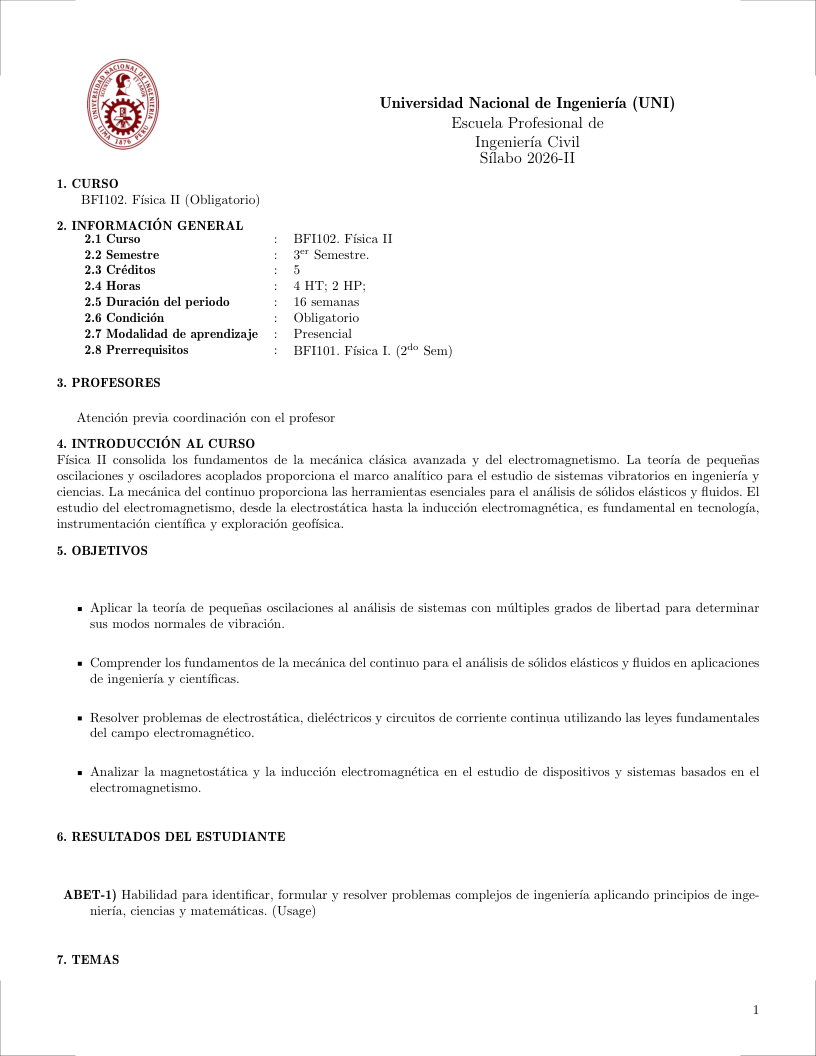
 Español (Latinoamérica)
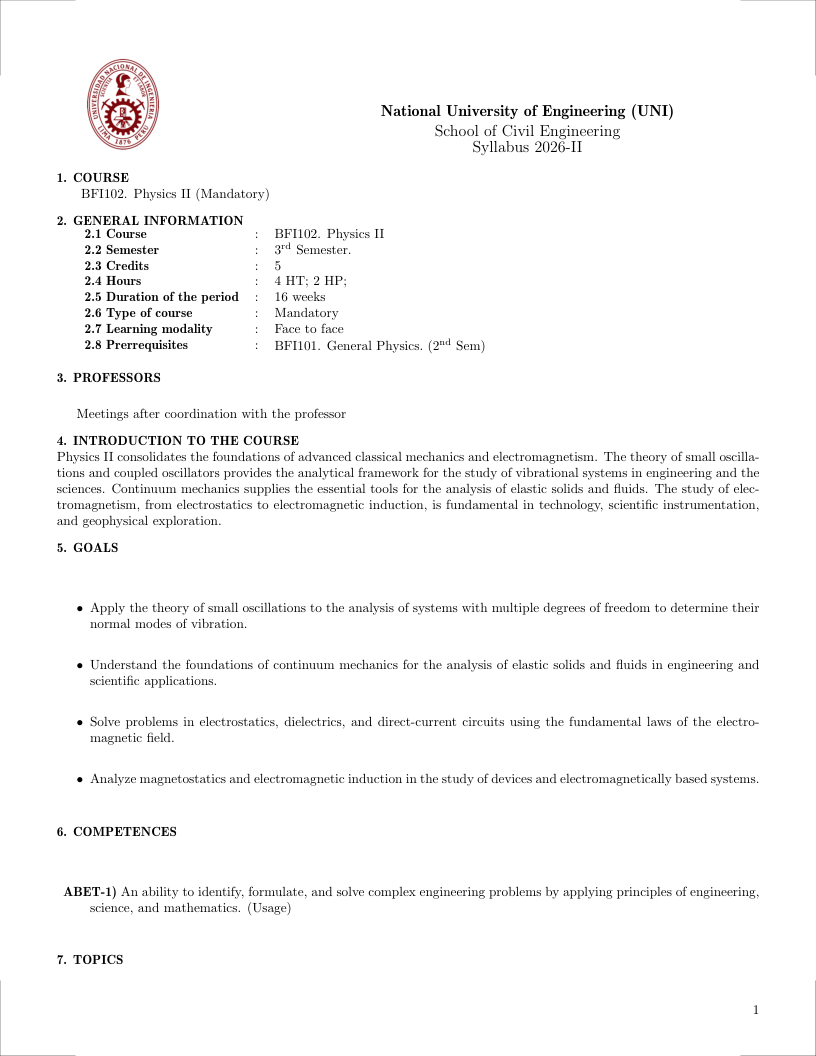 English
 - Prerrequisites:
- BFI101 General Physics (2nd Sem)
7.20.1. Justification ↑ Back to top
Physics II consolidates the foundations of advanced classical mechanics and electromagnetism. The theory of small oscillations and coupled oscillators provides the analytical framework for the study of vibrational systems in engineering and the sciences. Continuum mechanics supplies the essential tools for the analysis of elastic solids and fluids. The study of electromagnetism, from electrostatics to electromagnetic induction, is fundamental in technology, scientific instrumentation, and geophysical exploration.
7.20.2. Generales Goals ↑ Back to top
- Apply the theory of small oscillations to the analysis of systems with multiple degrees of freedom to determine their normal modes of vibration.
- Understand the foundations of continuum mechanics for the analysis of elastic solids and fluids in engineering and scientific applications.
- Solve problems in electrostatics, dielectrics, and direct-current circuits using the fundamental laws of the electromagnetic field.
- Analyze magnetostatics and electromagnetic induction in the study of devices and electromagnetically based systems.
7.20.3. Contribution to Outcomes ↑ Back to top
- ABET-1) An ability to identify, formulate, and solve complex engineering problems by applying principles of engineering, science, and mathematics. (Usage)
7.20.4. Content ↑ Back to top
7.20.4.1. Theory of Small Oscillations and Coupled Oscillators (24 hours) [Skills ABET-1] ↑ Back to top
Bibliography: (Marion and Thornton, 2003; French, 1971)
Topics
- Small oscillation approximation via Taylor expansion about a stable equilibrium
- Coupled oscillators and the formulation of equations of motion in matrix form
- Normal modes and eigenfrequencies derived from the eigenvalue problem
- Damped oscillators: underdamped, critically damped, and overdamped regimes
Learning Outcomes
- Linearize equations of motion about a stable equilibrium point [Usage]
- Find normal mode frequencies and eigenvectors for systems of Two coupled oscillators [Usage]
7.20.4.2. Continuum Mechanics Foundations (18 hours) [Skills ABET-1] ↑ Back to top
Bibliography: (Marion and Thornton, 2003; Serway and Jewett, 2018)
Topics
- Continuum hypothesis and the definition of density fields
- Stress tensor \(\sigma_{ij}\) and the concept of force per unit area
- Strain tensor \(\epsilon_{ij}\) as a measure of local deformation
- Hooke's law for isotropic materials: \(\sigma_{ij} = \lambda\epsilon_{kk}\delta_{ij} + 2\mu\epsilon_{ij}\)
- Navier-Stokes equation for viscous fluids: \(\rho\left(\frac{\partial \vec{v}}{\partial t} + \vec{v}\cdot\nabla\vec{v}\right) = -\nabla p + \mu\nabla^2\vec{v} + \vec{f}\)
- Bernoulli's principle for inviscid and incompressible fluid flow
- Conservation of mass and the continuity equation: \(\frac{\partial\rho}{\partial t} + \nabla\cdot(\rho\vec{v}) = 0\)
- Conservation of momentum expressed in continuum mechanics form
- Wave propagation in elastic media including P-waves and S-waves
- Viscosity and the rheology of non-Newtonian fluids
Learning Outcomes
- Interpret the physical meaning of the components of the stress tensor [Familiarity]
- Calculate strain tensor components for simple deformations [Usage]
- Apply Hooke's law to relate stress and strain for isotropic elastic materials [Usage]
- Simplify the Navier-Stokes equation for special cases such as steady or inviscid flow [Usage]
- Apply Bernoulli's principle to calculate pressure variations in fluid flow [Usage]
- Derive the continuity equation from the principle of mass conservation [Usage]
- Analyze different wave propagation modes in elastic solids [Assessment]
7.20.4.3. Electrostatics: Electric Field and Gauss's Law (6 hours) [Skills ABET-1] ↑ Back to top
Bibliography: (Griffiths, 2017; Young and Freedman, 2015)
Topics
- Coulomb's law for point charges and the principle of linear superposition
- The electric field vector \(\vec{E}\) for discrete and continuous charge distributions
- Gauss's Law in integral form and its relation to enclosed charge
- Differential form of Gauss's Law: \(\nabla \cdot \vec{E} = \rho/\epsilon_0\)
- Applications of Gauss's Law to spherical and cylindrical symmetry
- The Divergence Theorem applied to electrostatic fields
Learning Outcomes
- Calculate the electrostatic force on a charge distribution using superposition [Usage]
- Apply Gauss's Law to find the electric field for systems with high symmetry [Usage]
- Evaluate the electric flux through surfaces of engineering interest [Assessment]
- Determine volume charge density from a given expression of the electric field [Usage]
7.20.4.4. Electric Potential and Poisson/Laplace Equations (6 hours) [Skills ABET-1] ↑ Back to top
Bibliography: (Griffiths, 2017)
Topics
- Definition of the scalar potential \(V\) and \(\vec{E} = -\nabla V\)
- Calculating potential for continuous charge distributions
- Poisson's equation \(\nabla^2 V = -\rho/\epsilon_0\) and Laplace's equation
- Solution of Laplace's equation via separation of variables for engineering geometries
- The method of images for computing fields near conducting boundaries
Learning Outcomes
- Compute the electrostatic potential energy of a charge configuration [Usage]
- Derive the electric field vector from a given scalar potential [Usage]
- Solve Laplace's equation for a practical engineering geometry with specified boundary conditions [Assessment]
- Apply the method of images to engineering problems involving grounded conductors [Usage]
7.20.4.5. Electrostatic Energy and Dielectrics (6 hours) [Skills ABET-1] ↑ Back to top
Bibliography: (Griffiths, 2017; Serway and Jewett, 2018)
Topics
- Energy density in the electric field: \(u = \frac{1}{2}\epsilon_0 E^2\)
- Capacitance \(C = Q/V\) for standard engineering geometries
- The displacement vector \(\vec{D}\) and Gauss's Law in dielectric materials
- Linear dielectrics, susceptibility, and relative permittivity \(\epsilon_r\)
- Boundary conditions for \(\vec{E}\) and \(\vec{D}\) at material interfaces
Learning Outcomes
- Calculate the capacitance of parallel-plate and coaxial capacitors filled with dielectrics [Usage]
- Evaluate bound charge distributions in polarized dielectric materials [Assessment]
- Solve for electric fields on both sides of a dielectric interface using boundary conditions [Usage]
- Analyze the force on a dielectric slab in a partially inserted capacitor [Assessment]
7.20.4.6. Electric Current, Circuits, and Kirchhoff's Laws (4 hours) [Skills ABET-1] ↑ Back to top
Bibliography: (Serway and Jewett, 2018; Young and Freedman, 2015)
Topics
- Definition of current, current density, and the continuity equation
- Ohm's law, resistivity, and temperature dependence of resistance
- Kirchhoff's Current Law (KCL) for circuit node analysis
- Kirchhoff's Voltage Law (KVL) for circuit loop analysis
- Series and parallel circuit simplification and equivalent resistance
- RC and RL circuit transients and engineering time constants
Learning Outcomes
- Apply KCL and KVL to solve multi-loop DC engineering circuits [Usage]
- Calculate power dissipated in resistive circuit elements [Assessment]
- Analyze the transient response of RC and RL circuits and determine the time constant [Usage]
- Design a resistor network to meet specified voltage division or current distribution requirements [Assessment]
7.20.4.7. Magnetostatics: Biot-Savart and Ampere's Laws (7 hours) [Skills ABET-1] ↑ Back to top
Bibliography: (Griffiths, 2017; Young and Freedman, 2015)
Topics
- Lorentz force law: \(\vec{F} = q(\vec{E} + \vec{v} \times \vec{B})\)
- Magnetic force on current-carrying wires and loops
- Biot-Savart Law for the magnetic field of a current element
- Ampere's Law in integral form for high-symmetry engineering configurations
- The magnetic vector potential \(\vec{A}\) and \(\vec{B} = \nabla \times \vec{A}\)
Learning Outcomes
- Calculate the magnetic field of solenoids and toroids using Ampere's Law [Usage]
- Compute the magnetic field on the axis of a current loop using the Biot-Savart Law [Usage]
- Verify that a given magnetic field satisfies \(\nabla \cdot \vec{B} = 0\) [Assessment]
- Analyze the torque on a current loop in a non-uniform magnetic field [Assessment]
7.20.4.8. Magnetic Properties of Matter (7 hours) [Skills ABET-1] ↑ Back to top
Bibliography: (Griffiths, 2017)
Topics
- The magnetization vector \(\vec{M}\) as magnetic dipole moment per unit volume
- The magnetic field intensity \(\vec{H}\) and Ampere's Law in matter
- Physical principles of diamagnetism, paramagnetism, and ferromagnetism
- Ferromagnetic domains and the hysteresis loop for engineering material selection
- Linear magnetic media and magnetic permeability \(\mu\)
Learning Outcomes
- Find bound current distributions for magnetized engineering materials [Usage]
- Classify materials as diamagnetic, paramagnetic, or ferromagnetic for engineering application suitability [Assessment]
- Analyze energy loss per cycle from a ferromagnetic hysteresis loop for transformer core selection [Assessment]
7.20.4.9. Electrodynamics: Faraday's Law and Induction (6 hours) [Skills ABET-1] ↑ Back to top
Bibliography: (Griffiths, 2017; Serway and Jewett, 2018)
Topics
- Faraday's Law of induction and Lenz's Law
- Self-inductance \(L\) and the back-EMF in engineering inductors
- Mutual inductance \(M\) and transformer principles
- Energy stored in the magnetic field of inductors
- Eddy currents, magnetic braking, and core loss in electrical machines
Learning Outcomes
- Calculate the induced EMF in a rotating coil and relate it to generator operation [Usage]
- Apply Lenz's Law to determine the direction of induced currents in engineering scenarios [Assessment]
- Compute the magnetic energy stored in a solenoid or toroidal inductor [Usage]
- Evaluate mutual inductance between coupled coils for transformer design [Assessment]
7.20.5. Bibliography ↑ Back to top
Marion, J. B. and Thornton, S. T. (2003). Classical Dynamics of Particles and Systems. Thomson Brooks/Cole, 5th edition.
French, A. P. (1971). Vibrations and Waves. W. W. Norton & Company.
Serway, R. A. and Jewett, J. W. (2018). Physics for Scientists and Engineers with Modern Physics. Cengage Learning, 10th edition.
Griffiths, D. J. (2017). Introduction to Electrodynamics. Cambridge University Press, 4th edition.
Young, H. D. and Freedman, R. A. (2015). Sears and Zemansky's University Physics with Modern Physics. Pearson Education, 14th edition.