- ES Español (Latinoamérica)

- EN English

7.63. Earthquake-Resistant Engineering and Disaster Prevention (Mandatory)
- Semester: 9th Sem. Credits: 4
- Hour of this course: Theory: 4 hours; Practice: 2 hours;
- Syllabus:
- htmlonly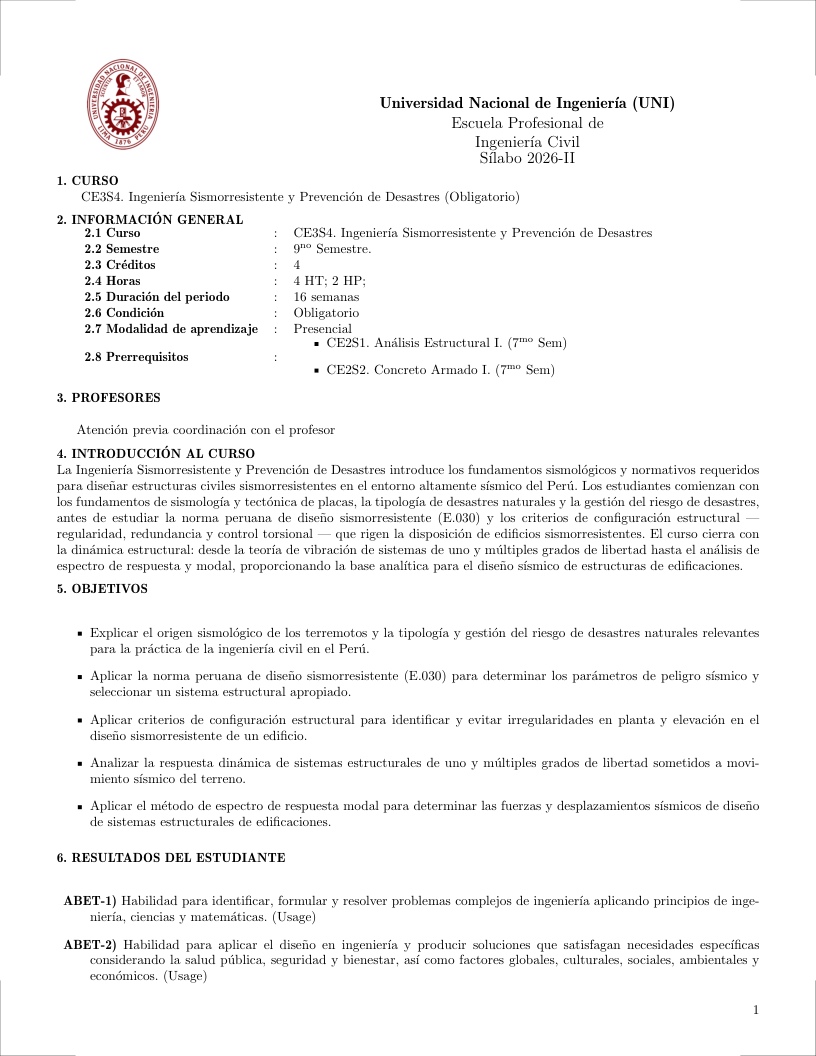
 Español (Latinoamérica)
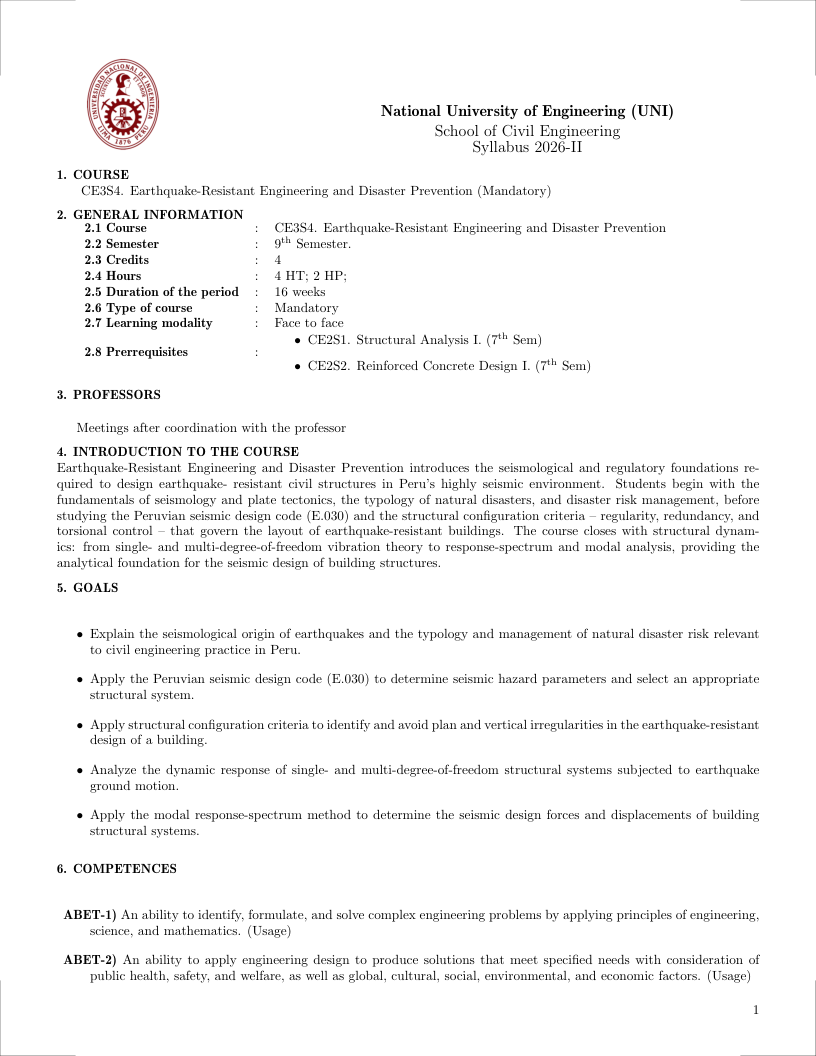 English
 - Prerrequisites:
- CE2S1 Structural Analysis I (7th Sem)
- CE2S2 Reinforced Concrete Design I (7th Sem)
7.63.1. Justification ↑ Back to top
Earthquake-Resistant Engineering and Disaster Prevention introduces the seismological and regulatory foundations required to design earthquake- resistant civil structures in Peru's highly seismic environment. Students begin with the fundamentals of seismology and plate tectonics, the typology of natural disasters, and disaster risk management, before studying the Peruvian seismic design code (E.030) and the structural configuration criteria – regularity, redundancy, and torsional control – that govern the layout of earthquake-resistant buildings. The course closes with structural dynamics: from single- and multi-degree-of-freedom vibration theory to response-spectrum and modal analysis, providing the analytical foundation for the seismic design of building structures.
7.63.2. Generales Goals ↑ Back to top
- Explain the seismological origin of earthquakes and the typology and management of natural disaster risk relevant to civil engineering practice in Peru.
- Apply the Peruvian seismic design code (E.030) to determine seismic hazard parameters and select an appropriate structural system.
- Apply structural configuration criteria to identify and avoid plan and vertical irregularities in the earthquake-resistant design of a building.
- Analyze the dynamic response of single- and multi-degree-of-freedom structural systems subjected to earthquake ground motion.
- Apply the modal response-spectrum method to determine the seismic design forces and displacements of building structural systems.
7.63.3. Contribution to Outcomes ↑ Back to top
- ABET-1) An ability to identify, formulate, and solve complex engineering problems by applying principles of engineering, science, and mathematics. (Usage)
- ABET-2) An ability to apply engineering design to produce solutions that meet specified needs with consideration of public health, safety, and welfare, as well as global, cultural, social, environmental, and economic factors. (Usage)
7.63.4. Content ↑ Back to top
7.63.4.1. Seismology and Natural Hazards (17 hours) [Skills ABET-1] ↑ Back to top
Bibliography: (Bolt, 2005; Kramer, 1996)
Topics
- Plate tectonics and earthquake generation mechanisms through fault rupture
- Seismic waves: types (P, S, surface) and their propagation
- Magnitude (seismic moment) and intensity (Modified Mercalli) scales
- Historical seismicity and subduction tectonic context of Peru
- Typology of natural disasters: seismic, volcanic, tsunami, and mass movement
- Disaster risk management: prevention, mitigation, preparedness, and response (SINAGERD framework)
- Seismological instrumentation: seismographs, accelerographs, and national monitoring networks
Learning Outcomes
- Explain plate tectonics and earthquake generation mechanisms through fault rupture [Familiarity]
- Differentiate types of seismic waves and their effects on buildings [Usage]
- Interpret and distinguish between earthquake magnitude and intensity scales [Usage]
- Describe the historical seismicity and subduction context of Peru [Familiarity]
- Classify the main types of natural disasters affecting Peruvian territory [Familiarity]
- Analyze the disaster risk management framework for earthquake prevention and response [Assessment]
7.63.4.2. Seismic Design Code and Structural Configuration Criteria (11 hours) [Skills ABET-2] ↑ Back to top
Bibliography: (Servicio Nacional de Capacitación para la Industria de la Construcción (SENCICO) / Ministerio de Vivienda, 2018a; Bazán and Meli, 2002)
Topics
- Scope and structure of the Peruvian seismic design code E.030
- Seismic hazard parameters: seismic zonation (Z), usage factor (U), and soil profile (S)
- Structural systems and seismic force reduction coefficient (R)
- Plan structural irregularities: torsional irregularity, re-entrant corners, and diaphragm discontinuity
- Vertical structural irregularities: soft story, weak story, and mass irregularity
- Structuring principles: symmetry, redundancy, hyperstaticity, and continuity
- Minimum base shear and inter-story drift limits
Learning Outcomes
- Explain the scope and structure of the Peruvian seismic design code E.030 [Familiarity]
- Determine the seismic hazard parameters (Z, U, S) applicable to a given site [Usage]
- Select the structural system and corresponding reduction coefficient R [Usage]
- Classify the plan and vertical structural irregularities of a building [Assessment]
- Apply structuring principles to propose a regular structural configuration [Usage]
- Verify the minimum base shear and inter-story drift limits [Assessment]
7.63.4.3. Structural Dynamics and Earthquake Engineering (56 hours) [Skills ABET-1,ABET-2] ↑ Back to top
Bibliography: (Chopra, 2017)
Topics
- Single-degree-of-freedom systems and free vibration
- Forced vibration and harmonic excitation
- Damping models and energy dissipation mechanisms
- Response spectrum analysis
- Earthquake ground motion characteristics and seismicity
- Multi-degree-of-freedom systems and modal analysis
- Time-history analysis and numerical integration methods
- Seismic design philosophy and capacity design principles
- Base isolation and energy dissipation devices
- Performance-based seismic design methodology
Learning Outcomes
- Analyze free vibration of single-degree-of-freedom systems and determine natural frequencies [Assessment]
- Calculate structural response to harmonic and periodic loads [Usage]
- Explain the role of damping in reducing dynamic response [Familiarity]
- Apply response spectrum method for seismic analysis [Usage]
- Interpret earthquake ground motion parameters and seismic hazard maps [Familiarity]
- Perform modal analysis for multi-degree-of-freedom systems [Assessment]
- Conduct time-history analysis using numerical integration techniques [Usage]
- Design structures following capacity design and ductile detailing principles [Assessment]
- Evaluate the effectiveness of base isolation and damping systems [Familiarity]
- Implement performance-based seismic design procedures [Assessment]
7.63.5. Bibliography ↑ Back to top
Bolt, B. A. (2005). Earthquakes. W.H. Freeman, 5th edition.
Kramer, S. L. (1996). Geotechnical Earthquake Engineering. Prentice Hall.
Servicio Nacional de Capacitación para la Industria de la Construcción (SENCICO) / Ministerio de Vivienda, C. y. S. d. P. (2018a). Norma técnica e.030: Diseño sismorresistente. Technical report, Reglamento Nacional de Edificaciones del Perú.
Bazán, E. and Meli, R. (2002). Diseño Sísmico de Edificios. Editorial Limusa.
Chopra, A. K. (2017). Dynamics of Structures: Theory and Applications to Earthquake Engineering. Pearson, 5th edition.