- ES Español (Latinoamérica)

- EN English

7.68. Soil Dynamics (Mandatory)
- Semester: 10th Sem. Credits: 3
- Hour of this course: Theory: 3 hours;
- Syllabus:
- htmlonly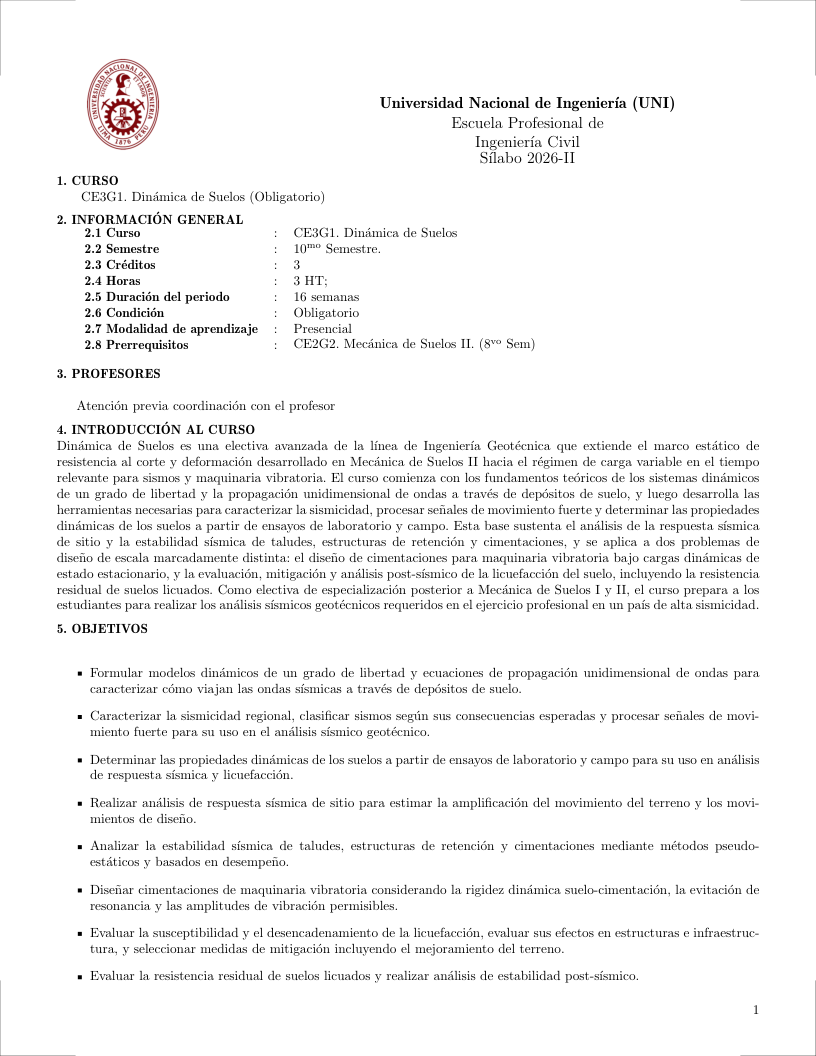
 Español (Latinoamérica)
 English
 - Prerrequisites:
- CE2G2 Soil Mechanics II (8th Sem)
7.68.1. Justification ↑ Back to top
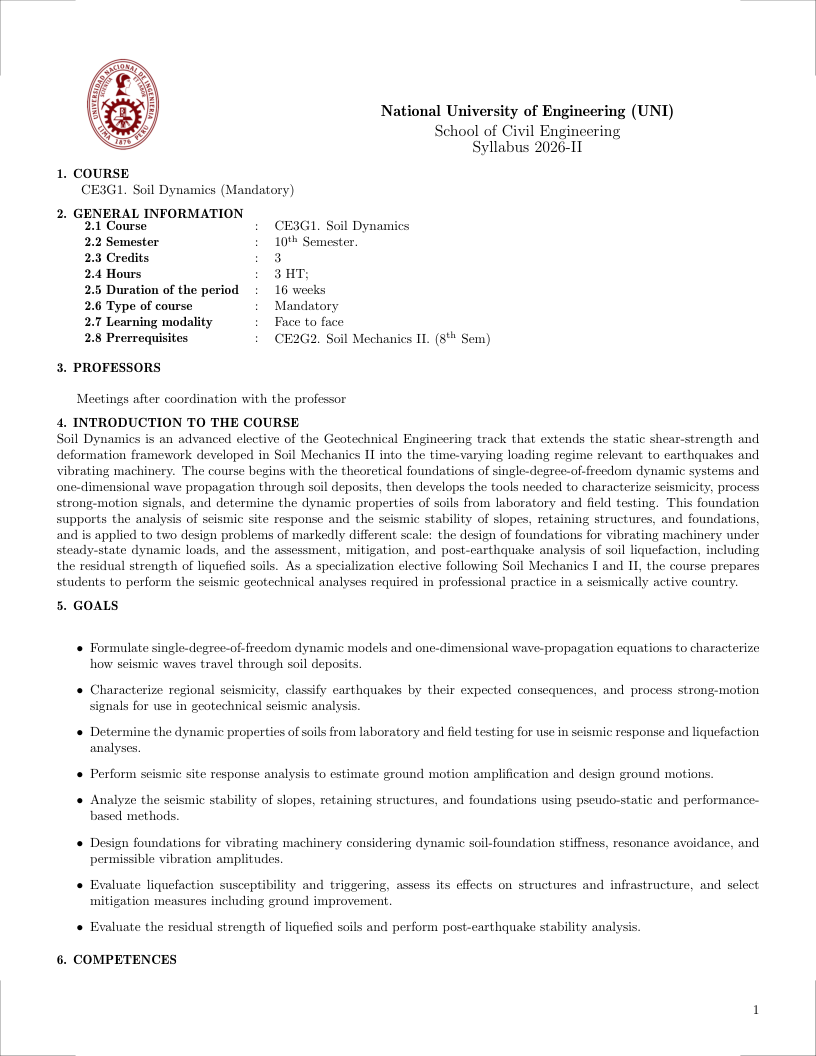
Soil Dynamics is an advanced elective of the Geotechnical Engineering track that extends the static shear-strength and deformation framework developed in Soil Mechanics II into the time-varying loading regime relevant to earthquakes and vibrating machinery. The course begins with the theoretical foundations of single-degree-of-freedom dynamic systems and one-dimensional wave propagation through soil deposits, then develops the tools needed to characterize seismicity, process strong-motion signals, and determine the dynamic properties of soils from laboratory and field testing. This foundation supports the analysis of seismic site response and the seismic stability of slopes, retaining structures, and foundations, and is applied to two design problems of markedly different scale: the design of foundations for vibrating machinery under steady-state dynamic loads, and the assessment, mitigation, and post-earthquake analysis of soil liquefaction, including the residual strength of liquefied soils. As a specialization elective following Soil Mechanics I and II, the course prepares students to perform the seismic geotechnical analyses required in professional practice in a seismically active country.
7.68.2. Generales Goals ↑ Back to top
- Formulate single-degree-of-freedom dynamic models and one-dimensional wave-propagation equations to characterize how seismic waves travel through soil deposits.
- Characterize regional seismicity, classify earthquakes by their expected consequences, and process strong-motion signals for use in geotechnical seismic analysis.
- Determine the dynamic properties of soils from laboratory and field testing for use in seismic response and liquefaction analyses.
- Perform seismic site response analysis to estimate ground motion amplification and design ground motions.
- Analyze the seismic stability of slopes, retaining structures, and foundations using pseudo-static and performance-based methods.
- Design foundations for vibrating machinery considering dynamic soil-foundation stiffness, resonance avoidance, and permissible vibration amplitudes.
- Evaluate liquefaction susceptibility and triggering, assess its effects on structures and infrastructure, and select mitigation measures including ground improvement.
- Evaluate the residual strength of liquefied soils and perform post-earthquake stability analysis.
7.68.3. Contribution to Outcomes ↑ Back to top
- ABET-1) An ability to identify, formulate, and solve complex engineering problems by applying principles of engineering, science, and mathematics. (Usage)
- ABET-2) An ability to apply engineering design to produce solutions that meet specified needs with consideration of public health, safety, and welfare, as well as global, cultural, social, environmental, and economic factors. (Usage)
- ABET-6) An ability to develop and conduct appropriate experimentation, analyze and interpret data, and use engineering judgment to draw conclusions. (Usage)
7.68.4. Content ↑ Back to top
7.68.4.1. Geotechnical Earthquake Engineering (42 hours) [Skills ABET-1,ABET-2,ABET-6] ↑ Back to top
Bibliography: (Kramer, 1996; Das, 1983; Prakash, 1981)
Topics
- Single-degree-of-freedom dynamic systems and one-dimensional wave propagation through soil deposits
- Site response and ground motion amplification
- Seismic hazard analysis and design ground motions
- Liquefaction susceptibility and triggering mechanisms
- Cyclic stress ratio and liquefaction evaluation procedures
- Effects of liquefaction on structures and infrastructure
- Dynamic soil properties and laboratory testing
- Design of foundations for vibrating machinery under dynamic loading
- Ground improvement methods for liquefaction mitigation
- Lateral spreading and flow failures
- Seismically induced settlement and bearing capacity
- Performance-based design for geotechnical earthquake engineering
Learning Outcomes
- Formulate single-degree-of-freedom models and one-dimensional wave-propagation equations to characterize seismic wave transmission through soil deposits [Usage]
- Explain site response effects and ground motion characteristics [Familiarity]
- Determine design ground motions for geotechnical seismic analysis [Assessment]
- Evaluate liquefaction susceptibility using field investigation data [Usage]
- Calculate cyclic stress ratios and assess liquefaction potential [Assessment]
- Assess the consequences of liquefaction on foundations and structures [Familiarity]
- Characterize dynamic soil properties from laboratory and field tests [Usage]
- Proportion machine foundations considering dynamic soil-foundation stiffness, resonance avoidance, and permissible vibration amplitudes [Assessment]
- Select and design ground improvement methods to mitigate liquefaction [Assessment]
- Predict lateral spreading displacements and flow failure potential [Usage]
- Analyze seismically induced settlement and reduced bearing capacity [Assessment]
- Implement performance-based approaches for seismic geotechnical design [Assessment]
7.68.5. Bibliography ↑ Back to top
Kramer, S. L. (1996). Geotechnical Earthquake Engineering. Prentice Hall.
Das, B. M. (1983). Fundamentals of Soil Dynamics. Elsevier.
Prakash, S. (1981). Soil Dynamics. McGraw-Hill.