- ES Español (Latinoamérica)

- EN English

7.15. Ethics and Political Philosophy (Mandatory)
- Semester: 2nd Sem. Credits: 2
- Hour of this course: Theory: 1 hours; Practice: 2 hours;
- Syllabus:
- htmlonly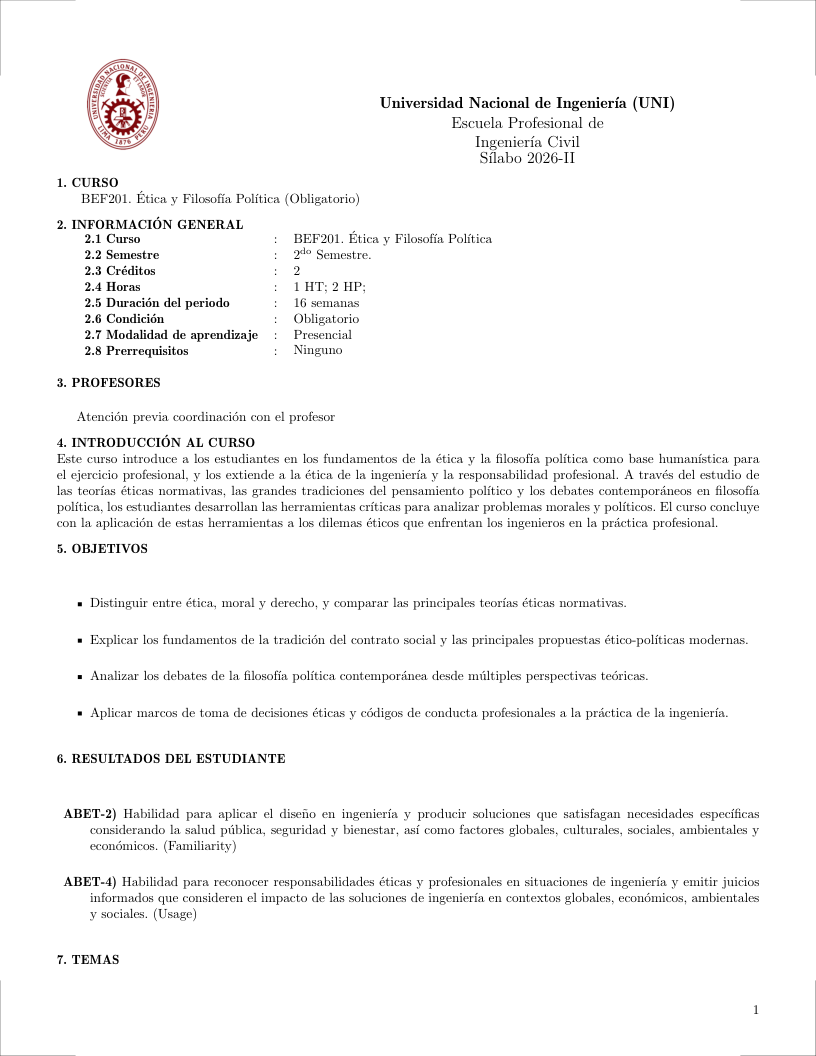
 Español (Latinoamérica)
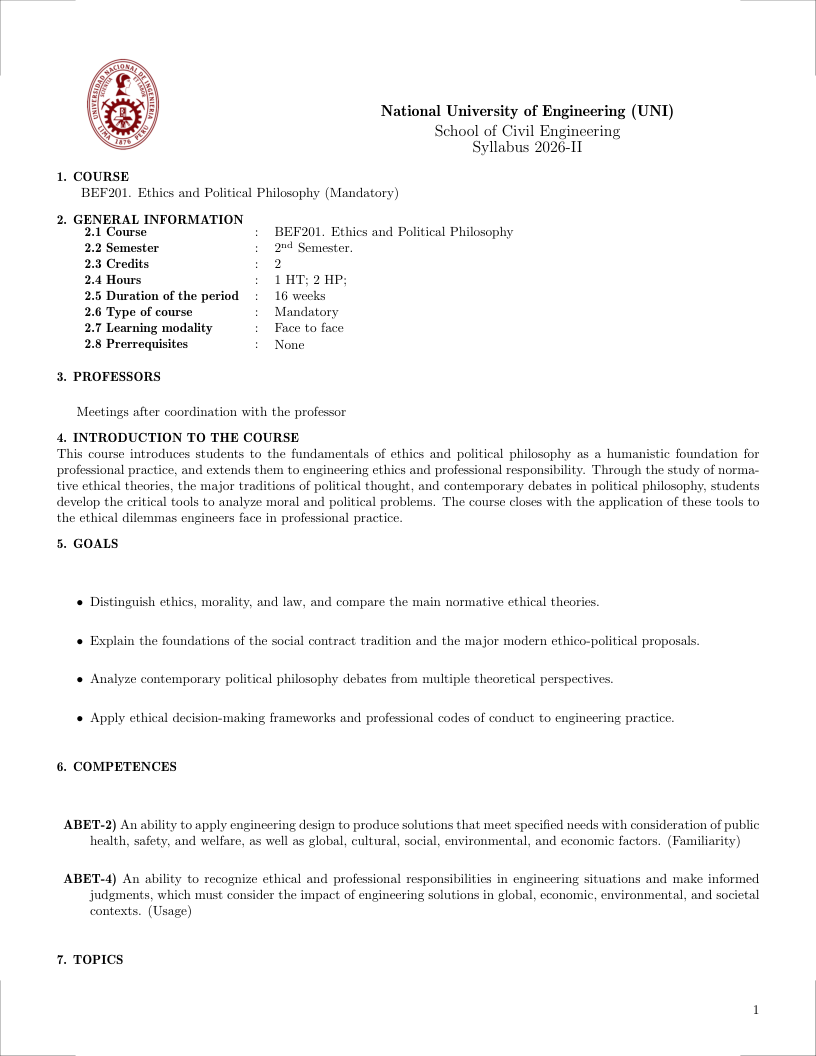 English
 - Prerrequisites: None
7.15.1. Justification ↑ Back to top
This course introduces students to the fundamentals of ethics and political philosophy as a humanistic foundation for professional practice, and extends them to engineering ethics and professional responsibility. Through the study of normative ethical theories, the major traditions of political thought, and contemporary debates in political philosophy, students develop the critical tools to analyze moral and political problems. The course closes with the application of these tools to the ethical dilemmas engineers face in professional practice.
7.15.2. Generales Goals ↑ Back to top
- Distinguish ethics, morality, and law, and compare the main normative ethical theories.
- Explain the foundations of the social contract tradition and the major modern ethico-political proposals.
- Analyze contemporary political philosophy debates from multiple theoretical perspectives.
- Apply ethical decision-making frameworks and professional codes of conduct to engineering practice.
7.15.3. Contribution to Outcomes ↑ Back to top
- ABET-2) An ability to apply engineering design to produce solutions that meet specified needs with consideration of public health, safety, and welfare, as well as global, cultural, social, environmental, and economic factors. (Familiarity)
- ABET-4) An ability to recognize ethical and professional responsibilities in engineering situations and make informed judgments, which must consider the impact of engineering solutions in global, economic, environmental, and societal contexts. (Usage)
7.15.4. Content ↑ Back to top
7.15.4.1. Basic Notions of Ethics and Political Philosophy (15 hours) [Skills ABET-2] ↑ Back to top
Bibliography: (Rachels and Rachels, 2015; Kymlicka, 2002)
Topics
- What is ethics? Distinguishing ethics, morality, and law as normative systems
- Main normative ethical theories: consequentialism, deontology, and virtue ethics
- What is political philosophy? Fundamental questions about power, legitimacy, and the state
- The social contract tradition: Hobbes, Locke, and Rousseau
- Conceptions of justice: distributive, procedural, and retributive
Learning Outcomes
- Distinguish ethics, morality, and law as normative systems [Familiarity]
- Compare the main normative ethical theories and their criteria for moral evaluation [Usage]
- Explain the foundations of the social contract tradition and its main proponents [Familiarity]
- Identify different conceptions of justice and apply them to concrete cases [Assessment]
7.15.4.2. Major Ethico-Political Proposals (6 hours) [Skills ABET-2] ↑ Back to top
Bibliography: (Kymlicka, 2002)
Topics
- Political and economic liberalism: individual liberty and the limits of the state
- Socialism and Marxist thought: the critique of private property and exploitation
- Civic republicanism and liberty understood as non-domination
- Communitarianism and its critique of liberal individualism
Learning Outcomes
- Compare liberal, socialist, republican, and communitarian proposals in response to a concrete social problem [Usage]
- Identify the philosophical foundations of a given ethico-political position [Assessment]
7.15.4.3. Engineering Ethics and Professional Responsibility (12 hours) [Skills ABET-4] ↑ Back to top
Bibliography: (Harris et al., 2013; Fleddermann, 2020)
Topics
- Ethical theories applied to engineering: utilitarianism, deontological ethics, virtue ethics
- Professional codes of conduct (e.g. NSPE, IEEE, ASME, and national engineering boards) and their fundamental canons
- The engineer's paramount responsibility to public safety, health, and welfare
- Ethical dilemmas in practice: conflicts of interest, whistleblowing, gifts
- Ethical decision-making frameworks and case-study analysis
- Global engineering ethics and cross-cultural challenges
- Ethical obligations toward sustainable development and environmental stewardship
- Ethical implications of emerging technologies (AI, automation, data privacy)
- Ethical conduct in dispute resolution and litigation
Learning Outcomes
- Explain the fundamental principles of an engineer's code of ethics [Familiarity]
- Apply an ethical decision-making framework to a hypothetical engineering scenario [Assessment]
- Identify conflicts of interest and other common ethical pitfalls in project work [Familiarity]
- Analyze a historical engineering failure from an ethical perspective [Assessment]
- Evaluate the ethical dimensions of a project with significant social or environmental impacts in a different cultural context [Assessment]
- Articulate the ethical argument for incorporating sustainability into all engineering work [Familiarity]
- Discuss the ethical responsibilities related to the collection and use of data in smart infrastructure projects [Assessment]
- Describe the role of ethics in alternative dispute resolution processes [Familiarity]
7.15.4.4. Currents in Contemporary Political Philosophy (9 hours) [Skills ABET-2] ↑ Back to top
Bibliography: (Rawls, 1999; Kymlicka, 2002)
Topics
- Rawls's theory of justice: the original position and the veil of ignorance
- Contemporary libertarianism: Nozick and property rights
- Feminist political philosophy and theories of care
- Multiculturalism, recognition, and identity politics
- Deliberative democracy and the public sphere
Learning Outcomes
- Explain the concepts of the original position and the veil of ignorance in Rawls's theory [Usage]
- Contrast libertarian and Rawlsian proposals on distributive justice [Assessment]
- Analyze a contemporary political debate from at least two of the political philosophy currents studied [Assessment]
- Describe the foundations of deliberative democracy and its role in the public sphere [Familiarity]
7.15.5. Bibliography ↑ Back to top
Rachels, J. and Rachels, S. (2015). The Elements of Moral Philosophy. McGraw-Hill Education, 8th edition.
Kymlicka, W. (2002). Contemporary Political Philosophy: An Introduction. Oxford University Press, 2nd edition.
Harris, C. E., Pritchard, M. S., and Rabins, M. J. (2013). Engineering Ethics: Concepts and Cases. Cengage Learning, 5th edition.
Fleddermann, C. B. (2020). Engineering Ethics. Pearson, 5th edition.
Rawls, J. (1999). A Theory of Justice. Belknap Press, revised edition.