- ES Español (Latinoamérica)

- EN English

7.56. Soil Mechanics Applied to Transportation Roads (Mandatory)
- Semester: 9th Sem. Credits: 3
- Hour of this course:
- Syllabus:
- htmlonly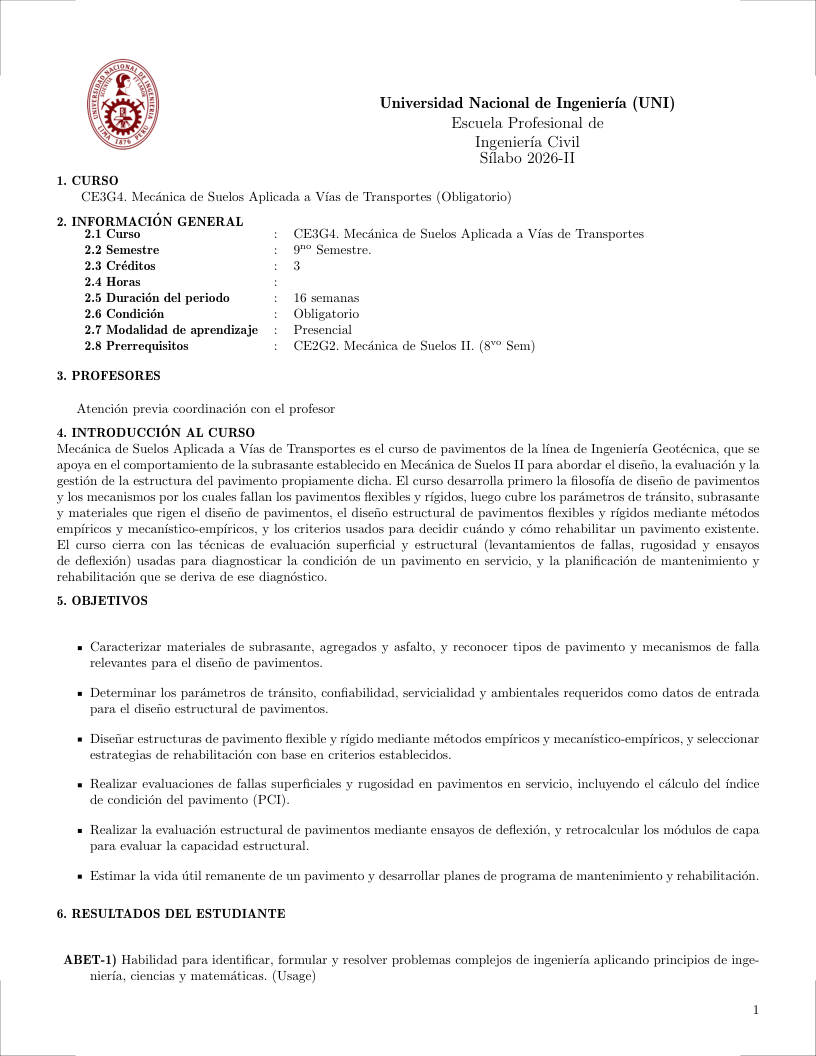
 Español (Latinoamérica)
 English
 - Prerrequisites:
- CE2G2 Soil Mechanics II (8th Sem)
7.56.1. Justification ↑ Back to top
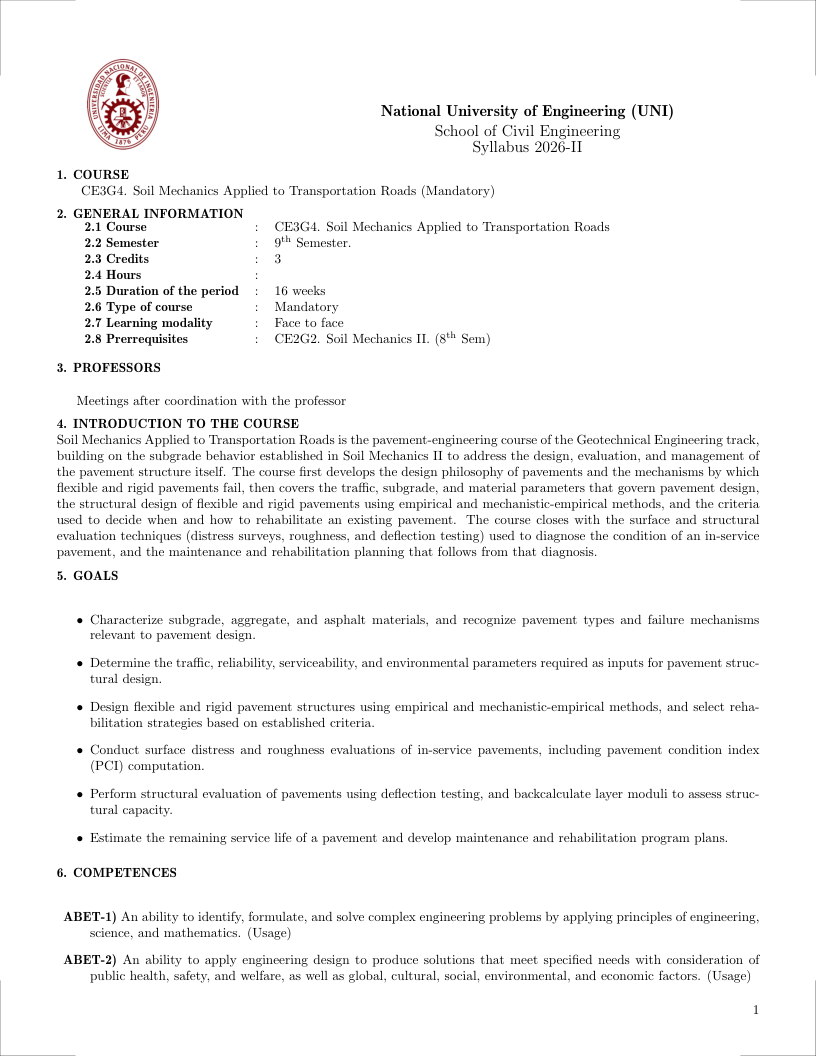
Soil Mechanics Applied to Transportation Roads is the pavement-engineering course of the Geotechnical Engineering track, building on the subgrade behavior established in Soil Mechanics II to address the design, evaluation, and management of the pavement structure itself. The course first develops the design philosophy of pavements and the mechanisms by which flexible and rigid pavements fail, then covers the traffic, subgrade, and material parameters that govern pavement design, the structural design of flexible and rigid pavements using empirical and mechanistic-empirical methods, and the criteria used to decide when and how to rehabilitate an existing pavement. The course closes with the surface and structural evaluation techniques (distress surveys, roughness, and deflection testing) used to diagnose the condition of an in-service pavement, and the maintenance and rehabilitation planning that follows from that diagnosis.
7.56.2. Generales Goals ↑ Back to top
- Characterize subgrade, aggregate, and asphalt materials, and recognize pavement types and failure mechanisms relevant to pavement design.
- Determine the traffic, reliability, serviceability, and environmental parameters required as inputs for pavement structural design.
- Design flexible and rigid pavement structures using empirical and mechanistic-empirical methods, and select rehabilitation strategies based on established criteria.
- Conduct surface distress and roughness evaluations of in-service pavements, including pavement condition index (PCI) computation.
- Perform structural evaluation of pavements using deflection testing, and backcalculate layer moduli to assess structural capacity.
- Estimate the remaining service life of a pavement and develop maintenance and rehabilitation program plans.
7.56.3. Contribution to Outcomes ↑ Back to top
- ABET-1) An ability to identify, formulate, and solve complex engineering problems by applying principles of engineering, science, and mathematics. (Usage)
- ABET-2) An ability to apply engineering design to produce solutions that meet specified needs with consideration of public health, safety, and welfare, as well as global, cultural, social, environmental, and economic factors. (Usage)
- ABET-6) An ability to develop and conduct appropriate experimentation, analyze and interpret data, and use engineering judgment to draw conclusions. (Usage)
7.56.4. Content ↑ Back to top
7.56.4.1. Pavement Materials and Characterization (6 hours) [Skills ABET-1] ↑ Back to top
Bibliography: (Huang, 2004)
Topics
- Pavement types and structural components
- Asphalt binder and mixture properties
- Aggregate properties and gradation requirements
- Subgrade characterization and stabilization
- Sustainable pavement technologies and recycling
Learning Outcomes
- Identify pavement types and describe their structural functions [Familiarity]
- Characterize asphalt binders and design asphalt mixtures [Assessment]
- Evaluate aggregate quality for pavement applications [Usage]
- Assess subgrade strength and specify stabilization treatments [Assessment]
- Incorporate sustainable practices and recycled materials in pavement design [Familiarity]
7.56.4.2. Pavement Design and Management (14 hours) [Skills ABET-1,ABET-2] ↑ Back to top
Bibliography: (Huang, 2004; AASHTO, 1993)
Topics
- Traffic load characterization and equivalent single axle load (ESAL) computation
- Design reliability, serviceability, and drainage/environmental factors in pavement design
- Flexible pavement design using empirical methods
- Rigid pavement design and joint systems
- Mechanistic-empirical pavement design methods
- Pavement performance prediction and distress mechanisms
- Rehabilitation strategies and overlay design
- Pavement management systems and life-cycle cost analysis
Learning Outcomes
- Compute the design equivalent single axle load (ESAL) from traffic composition and growth projections [Usage]
- Determine design reliability, serviceability, and drainage/environmental parameters for flexible and rigid pavement design [Assessment]
- Design flexible pavements using AASHTO or equivalent methods [Assessment]
- Proportion rigid pavement thickness and design joint spacing [Usage]
- Apply mechanistic-empirical methods for pavement design [Usage]
- Predict pavement performance and identify distress mechanisms [Assessment]
- Select appropriate rehabilitation strategies and design overlays [Usage]
- Implement pavement management systems and perform life-cycle analysis [Assessment]
7.56.4.3. Pavement Condition Evaluation and Maintenance Planning (10 hours) [Skills ABET-6] ↑ Back to top
Bibliography: (Huang, 2004; Hudson et al., 1997)
Topics
- Visual distress surveys and pavement condition index (PCI) computation
- Pavement roughness measurement and the international roughness index (IRI)
- Structural evaluation using deflection testing (falling weight deflectometer, Benkelman beam)
- Backcalculation of pavement layer moduli and structural capacity assessment
- Remaining service life estimation and rehabilitation treatment selection
- Maintenance and rehabilitation program planning and scheduling
Learning Outcomes
- Conduct visual distress surveys and compute the pavement condition index (PCI) [Usage]
- Explain pavement roughness measurement methods and interpret the international roughness index [Familiarity]
- Perform structural evaluation of in-service pavements using deflection testing methods [Usage]
- Backcalculate pavement layer moduli from deflection basin data [Assessment]
- Estimate the remaining service life of a pavement and select an appropriate treatment [Assessment]
- Develop maintenance and rehabilitation program plans and schedules [Usage]
7.56.5. Bibliography ↑ Back to top
Huang, Y. H. (2004). Pavement Analysis and Design. Pearson Prentice Hall, 2nd edition.
AASHTO (1993). Aashto guide for design of pavement structures. Technical report, American Association of State Highway and Transportation Officials.
Hudson, W. R., Haas, R., and Uddin, W. (1997). Infrastructure Management: Integrating Design, Construction, Maintenance, Rehabilitation, and Renovation. McGraw-Hill.